
What is an HS Code and Why Does it Matter?
In the intricate world of international trade, where goods cross borders daily, a universal language is essential for efficient and accurate communication. This is precisely the role played by the Harmonized System (HS) Code. Often referred to simply as an HS Code lookup, this standardized classification system is the backbone of global commerce, ensuring that products are identified uniformly regardless of their origin or destination. Understanding what an HS Code is and why its accurate application is paramount is crucial for any business engaged in importing or exporting. From determining duties and taxes to facilitating customs clearance and gathering vital trade statistics, HS Codes streamline complex processes, making global trade more predictable and manageable.
1. Defining the Harmonized System (HS)
The Harmonized System (HS) is an internationally standardized system of names and numbers for classifying traded products. Developed and maintained by the World Customs Organization (WCO), the HS Nomenclature forms the basis for customs tariffs and the collection of international trade statistics in over 200 countries and economies. At its core, the HS provides a logical and systematic structure for categorizing all goods that enter into international commerce.
The standard HS Code is a six-digit number, structured hierarchically:
- The first two digits identify the Chapter (of which there are 99), representing a broad category of goods (e.g., Chapter 01 for Live animals, Chapter 84 for Nuclear reactors, boilers, machinery).
- The next two digits narrow down the category, defining the Heading within that Chapter (e.g., 0101 for Live horses, asses, mules, and hinnies).
- The final two digits further specify the product, forming the Subheading (e.g., 010121 for Pure-bred breeding animals).
While the first six digits are globally harmonized, individual countries often extend these codes to 8, 10, or even 12 digits for greater detail in their national tariffs. For instance, in the United States, this expanded classification is known as the Harmonized Tariff Schedule of the United States (HTSUS). These national extensions allow countries to implement specific import duties, quotas, and regulations tailored to their domestic markets. Therefore, while the core 6-digit HS Code provides a common reference point, traders must often delve deeper to find the full Export commodity codes or import codes specific to their destination country.

2. The Importance of Accurate Customs Tariff Classification
The seemingly straightforward act of assigning an HS Code carries profound implications for international trade. Accurate Customs tariff classification is not merely a bureaucratic formality; it is a critical determinant of costs, compliance, and efficiency throughout the supply chain. Errors in classification can lead to a cascade of negative consequences, making precision absolutely vital.
One of the most significant impacts of an HS Code is its direct correlation with duties and taxes. Every country’s customs authority uses the HS Code to determine the applicable tariff rate for imported goods. An incorrect classification can result in paying too much or too little in duties. Overpaying eroding profit margins, while underpaying can lead to severe penalties, fines, seizure of goods, and significant delays at customs, potentially damaging a company’s reputation and financial health. Businesses often rely on an Import duty calculator which uses the HS Code as its primary input to estimate these crucial costs upfront.
Beyond financial implications, accurate HS Codes are fundamental for regulatory compliance. They help customs officials identify restricted or prohibited goods, enforce quotas, and apply specific trade agreements. For example, certain products might qualify for reduced tariffs under a Free Trade Agreement if classified correctly. Conversely, misclassifying goods could inadvertently lead to non-compliance with import regulations, sanctions, or safety standards. This underscores why every detail matters when performing an HS Code lookup for your products. Furthermore, governments and international bodies rely on HS Codes to collect comprehensive trade statistics, which are vital for economic analysis, policy formulation, and market research. Without accurate classification, these statistics would be skewed, hindering effective global economic planning.
3. Impact on Global Trade & Supply Chains
The global standardization offered by the Harmonized System transforms how international trade operates, injecting predictability and efficiency into complex cross-border transactions. For businesses, the ability to universally identify products through Export commodity codes facilitates smoother operations from procurement to final delivery.
Firstly, HS Codes significantly expedite customs clearance processes. When customs officials can quickly and unambiguously identify a product, inspections are faster, and administrative burdens are reduced. This efficiency translates into shorter lead times, fewer demurrage charges, and a more streamlined flow of goods across borders, which is crucial for just-in-time supply chains.
Secondly, HS Codes provide businesses with greater cost predictability. By accurately classifying goods, companies can use an Import duty calculator to forecast import duties, taxes, and other fees with confidence, enabling more precise pricing strategies and financial planning. This foresight is invaluable in a highly competitive global marketplace.
Finally, the Harmonized System plays a pivotal role in optimizing global supply chains. It allows manufacturers, distributors, and logistics providers to communicate more effectively, track inventory, and manage shipments worldwide. By speaking the same “language” of product classification, all parties involved in the supply chain can reduce misunderstandings and errors, leading to fewer disputes and improved overall operational harmony. In essence, HS Codes are not just numbers; they are the linchpin that connects global markets, fostering transparent, compliant, and efficient international trade for everyone.
Decoding the Harmonized Tariff Schedule (HTS)
Navigating the complexities of international trade demands precision, and at its core lies the Harmonized Tariff Schedule (HTS). This globally recognized system is the bedrock for proper commodity classification, directly impacting import duties, trade statistics, and regulatory compliance. Understanding its structure is not just beneficial; it’s essential for any business involved in cross-border transactions, helping to avoid costly delays and penalties while optimizing supply chain efficiency. A thorough HS Code lookup is the first step towards accurate customs declarations.
1. Understanding the Six-Digit Core
The Harmonized System (HS) forms the fundamental international standard for classifying traded goods. Developed and maintained by the World Customs Organization (WCO), this alphanumeric system begins with a universal six-digit code that every participating country adheres to. This core six-digit code is divided into three pairs:
- The First Two Digits (Chapter): These broadly categorize goods into one of 99 chapters. For instance, Chapter 01 covers live animals, Chapter 02 covers meat, and Chapter 84 covers nuclear reactors, boilers, machinery, and mechanical appliances. These chapters are organized in a logical progression, generally from raw materials to highly processed goods.
- The Next Two Digits (Heading): Within each chapter, these digits provide a more specific classification. For example, within Chapter 01 (Live Animals), Heading 01.01 might be live horses, asses, mules, or hinnies.
- The Final Two Digits (Subheading): These offer the most detailed international breakdown. Continuing the example, within Heading 01.01, Subheading 0101.21 could specify ‘Pure-bred breeding animals’ (of horses). This six-digit structure ensures global consistency, allowing customs authorities worldwide to understand the nature of a product based on its initial six digits, facilitating efficient HS Code lookup and trade data exchange.
2. National Variations and Extended Codes
While the six-digit HS code provides a universal baseline, individual countries often expand upon this core to meet their specific tariff, statistical, and regulatory needs. This is where national variations come into play, extending the six-digit code to eight, ten, or even twelve digits. For example, the United States uses the Harmonized Tariff Schedule of the United States (HTSUS), which typically extends the HS code to ten digits. Similarly, the European Union employs the Combined Nomenclature (CN), also extending to eight digits, and further to ten digits for TARIC (Integrated Tariff of the European Community).
These national extensions allow for finer distinctions within product categories, enabling governments to apply more granular duties and taxes, enforce specific trade policies, and collect more detailed import and export statistics. Understanding these extended codes is critical because the exact tariff rate and any specific import restrictions or requirements (like anti-dumping duties or quotas) are typically tied to these longer, country-specific codes. Therefore, relying solely on the six-digit code for an HS Code lookup can be misleading when calculating actual import duties or ensuring full compliance with national customs regulations. Always ensure you are using the correct national classification for the destination country to determine the accurate Customs tariff classification and use an Import duty calculator with precision.
3. Key Principles of Classification (GRI)
To ensure consistent and accurate Customs tariff classification, the Harmonized System is accompanied by a set of General Rules for the Interpretation (GRI) of the Harmonized System. These six rules provide a legal framework for classifying goods when a product doesn’t neatly fit into a single heading or subheading, or when it comprises multiple components. The GRIs are applied sequentially, with Rule 1 being the most fundamental and subsequent rules addressing increasingly complex classification scenarios.
- GRI 1: States that classification shall be determined according to the terms of the headings and any relative Section or Chapter Notes. This is the primary rule; if a clear classification is possible here, no further rules are needed.
- GRI 2: Addresses incomplete or unfinished articles, mixtures, or combinations of materials. It dictates that an incomplete article should be classified as the complete article if it has the essential character thereof. Mixtures are classified under the heading of the material or component that gives them their essential character.
- GRI 3: Deals with goods classifiable under two or more headings. It provides a hierarchy: specific description over general; essential character; and finally, the heading that occurs last in numerical order.
- GRI 4: Applies when goods cannot be classified by GRIs 1, 2, or 3. It states that goods shall be classified under the heading appropriate to the goods to which they are most akin.
- GRI 5: Covers classification of packing materials and containers, specifying when they are classified with the goods they contain.
- GRI 6: Extends the principles of GRIs 1 to 5 to the classification of goods at the subheading level.
Mastering these GRIs is paramount for customs brokers, importers, and exporters alike, as misclassification can lead to incorrect duty payments, penalties, and customs delays. Proper Customs tariff classification, guided by the GRIs, is the cornerstone of compliant international trade, enabling accurate calculation of import duties and proper reporting of Export commodity codes.
Your Step-by-Step HS Code Lookup Process
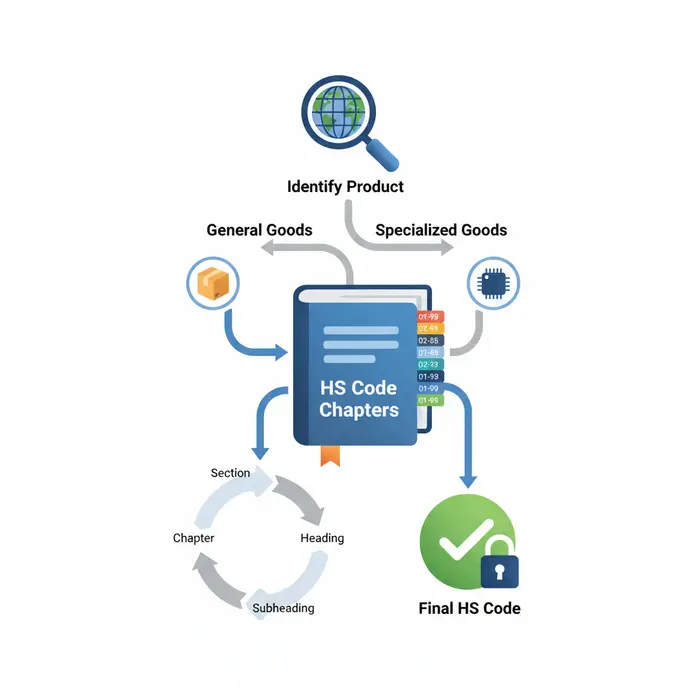
Navigating international trade requires precision, and at its core lies the accurate identification of products through their Harmonized System (HS) Codes. An HS Code lookup is not merely a formality; it’s a critical step that dictates tariffs, regulations, and ultimately, the success of your import or export operations. This guide provides a practical, step-by-step approach to effectively find and verify HS Codes for various products, leveraging official resources to ensure accurate Customs tariff classification and streamline your global supply chain.
1. Utilizing Official Databases and Tools
The foundation of an accurate HS Code lookup lies in consulting official and authoritative sources. Avoid generic search engines for initial classification, as they can lead to outdated or incorrect information. Your primary resources should include:
- National Customs Websites: Every country publishes its own version of the Harmonized Tariff Schedule (HTS), often integrated into its customs authority’s website. These are crucial as they reflect country-specific amendments and duty rates. For example, the U.S. International Trade Commission (USITC) provides the current U.S. HTS.
- World Customs Organization (WCO): As the custodian of the Harmonized System, the WCO offers a comprehensive database and explanatory notes. While direct public access to their full classification tools might be limited, understanding their structure is invaluable.
- International Trade Centre (ITC) Tools: The ITC, a joint agency of the WTO and the UN, offers excellent free tools like its HS Code Finder. This tool allows you to search by product description and provides potential HS Codes along with corresponding duties and requirements for various countries. It’s an excellent starting point for a preliminary HS Code lookup and can help you estimate an Import duty calculator for different markets.
When using these databases, begin by searching for your product using clear, descriptive terms. Refine your search by incorporating material, function, and processing details to narrow down the possible codes.
2. Tips for Specific Product Classification
Classifying products isn’t always straightforward. Many items cross multiple categories, making precise identification challenging. Here are tips to navigate complex classifications:
- Understand the General Interpretative Rules (GIRs): These six rules are the backbone of the Harmonized System. They provide a hierarchical framework for classification when a product could fall under more than one heading. Rule 3, for instance, deals with goods consisting of more than one material or component, guiding you to classify based on the essential character of the item.
- Detailed Product Description is Key: Gather as much information as possible: what is the product made of (materials)? What is its primary function? How is it presented or packaged? Is it a finished good or a component? For example, classifying “garments” is too broad; you need “men’s knitted cotton t-shirt” to get closer to the correct Export commodity codes.
- Consider the Product’s State: Is it raw material, semi-finished, or finished? Is it disassembled or assembled? These factors significantly influence classification. A disassembled bicycle might be classified differently from an assembled one.
- Look for Section and Chapter Notes: The HTS is structured with sections and chapter notes that provide specific inclusions and exclusions, helping to clarify ambiguities. Always read these carefully before settling on a code.
3. Common Pitfalls and How to Avoid Them
Even with official resources, mistakes in Customs tariff classification are common. Being aware of these pitfalls can save you significant time and money:
- Relying on Supplier-Provided Codes: While suppliers often provide HS Codes, always verify them independently. A supplier’s code might be correct for their country but incorrect for your importing country due to different interpretations or national variations in the latter digits of the HS Code.
- Ignoring Updates and Amendments: The Harmonized System is reviewed and updated periodically (e.g., every five years by the WCO), with smaller national amendments occurring more frequently. Using an outdated code can lead to misclassification, fines, or delays. Always ensure you are consulting the most current version of the HTS.
- Misinterpreting Product Use or Composition: A common error is misjudging the primary function or composition of a product. For instance, a multi-function device might be classified based on its most prominent function or the component that gives it its essential character.
- Underestimating Complexity: Some products, especially those in emerging technologies or those with composite materials, are inherently complex to classify. Do not hesitate to seek expert advice. Customs brokers, trade consultants, or even requesting a binding ruling from your customs authority are prudent steps for high-value or ambiguous items.
Mastering your HS Code lookup process is an essential skill for anyone involved in international trade. By diligently using official databases, understanding the nuances of product classification, and proactively avoiding common errors, you can ensure compliance, avoid costly penalties, and optimize your import and export operations. Accurate classification is not just about avoiding penalties; it’s about strategic trade management and ensuring smooth customs clearance for all your Export commodity codes.
Beyond Classification: Import Duties & Export Codes
While the Harmonized System (HS) Code is globally recognized as the bedrock of product classification, its influence extends far beyond mere categorization. For businesses engaged in international trade, understanding how to perform an HS Code lookup is critical, as these six-to-ten digit codes directly dictate the financial implications of imports and the logistical smooth sailing of exports. From determining specific customs tariff classification to serving as indispensable export commodity codes, the HS Code is the linchpin that connects a product to its regulatory and fiscal destiny in the global marketplace.
1. Calculating Import Duties and Taxes (Import Duty Calculator)
One of the most significant functions of the HS Code is its direct correlation with import duties, taxes, and tariffs. Every country maintains its own Import duty calculator, which is fundamentally built upon the Harmonized Tariff Schedule (HTS) — the national implementation of the HS Code. When goods arrive at a customs border, their HS Code is the primary data point used by customs officials to determine the applicable duty rate. These rates can vary dramatically based on the product’s nature, its country of origin, and even its intended use.
For instance, a particular electronic component classified under a specific HS Code might face a 5% import duty in one country, while the same component from a different country of origin, or with a slightly different HS sub-heading, could incur a 15% duty or even be duty-free. This disparity underscores why accurate customs tariff classification is paramount. Incorrect classification can lead to a host of problems, including overpaying duties, which erodes profit margins, or underpaying, which can result in costly penalties, fines, and shipment delays. Businesses often utilize specialized software or consult with customs brokers to ensure precise classification, effectively acting as an advanced import duty calculator to forecast costs and avoid compliance pitfalls.
2. The Role of HS Codes in Export Documentation (Export Commodity Codes)
Beyond imports, HS Codes are equally vital for exports, where they are often referred to as export commodity codes. For every item leaving a country, its corresponding HS Code must be declared on various export documents, including commercial invoices, packing lists, and certificates of origin. This declaration serves multiple critical purposes.
Firstly, the HS Code allows the exporting country’s customs authorities to accurately track and categorize goods leaving their borders for statistical analysis. This data is crucial for trade policy formulation, economic reporting, and understanding global market trends. Secondly, and perhaps more importantly for the exporter, these export commodity codes inform the importing country’s customs officials about the nature of the incoming goods. A mismatch between the declared HS Code on export documents and the classification determined by the importing country’s customs can lead to significant delays, scrutiny, and potential seizure of goods. Ensuring consistent and accurate HS Code declaration from the outset of the export process is a proactive measure against customs complications and ensures a smoother transit of goods across international borders.
3. Special Regimes and Free Trade Agreements
The strategic use of HS Codes extends to navigating the complexities of international trade agreements and special customs regimes. Free Trade Agreements (FTAs) like the Comprehensive and Progressive Agreement for Trans-Pacific Partnership (CPTPP) or the African Continental Free Trade Area (AfCFTA) are designed to reduce or eliminate tariffs on specified goods traded between member countries. However, eligibility for these preferential rates is almost always contingent upon the correct HS Code classification of the product.
Exporters and importers must accurately identify their products’ HS Codes to determine if they qualify for reduced duties under an FTA. A product that might otherwise face a standard 10% tariff could be entirely duty-free if it meets the rules of origin and is correctly classified under the relevant HS Code within an applicable FTA. Similarly, certain goods may qualify for duty exemptions or lower rates under special regimes, such as Generalized System of Preferences (GSP) schemes for developing countries, or specific industry-focused tariff waivers. Misclassification in these scenarios not only means missing out on significant cost savings but could also result in retrospective duty payments and penalties if errors are discovered during a customs audit. Therefore, an in-depth understanding of HS Code nuances is indispensable for leveraging these powerful trade facilitators and optimizing supply chain costs.
In essence, the HS Code is far more than a simple identification tag; it’s a powerful tool that dictates trade costs, facilitates logistical flow, and enables strategic market access. Mastering its application is fundamental for any business aspiring to thrive in the global economy.
Staying Compliant: Updates and Best Practices for 2025
The global trade landscape is in perpetual motion, and at its core lies the intricate system of HS Codes. These Harmonized System (HS) Codes are the universal language of trade, classifying products for customs purposes worldwide. However, their dynamic nature means that staying compliant isn’t a one-time task but an ongoing commitment. As we look towards 2025, businesses must proactively adapt to updates and embrace best practices to avoid costly delays, penalties, and missed opportunities. Accurate HS Code lookup is paramount for seamless international transactions, influencing everything from import duties to trade statistics. Understanding and preparing for future changes in the Harmonized Tariff Schedule is crucial for any business engaged in cross-border trade.

1. Anticipating HS Code Changes for 2025
The Harmonized System is reviewed and updated periodically by the World Customs Organization (WCO) to reflect technological advancements, new products, and environmental concerns. While major revisions typically occur every five years (the last being in 2022), minor amendments and national interpretations can happen annually, especially at the 8-digit or 10-digit level, which varies by country. For businesses, this means that the Export commodity codes you used last year might not be entirely accurate for your shipments in 2025.
To anticipate these changes, monitoring official sources is key. The WCO publishes amendments and explanatory notes, which are then integrated into national customs tariffs. Keeping a close eye on your specific import and export markets’ customs authorities is vital. Subscribing to trade news, industry updates, and government bulletins can provide early warnings. Proactive review of your product portfolio against potential changes, especially for goods in rapidly evolving sectors like technology, chemicals, or sustainable products, can prevent last-minute scrambling. Regularly performing an HS Code lookup for your core products, even when you believe the code is stable, can catch subtle shifts in interpretation or classification guidelines. Checking the official WCO website for general information on the Harmonized System can also provide a foundational understanding of the update cycles and rationale behind changes.
2. Leveraging Technology for Automated Classification
Manual HS Code classification is time-consuming, prone to human error, and increasingly inefficient given the volume and complexity of global trade. Modern businesses are turning to technology to streamline their Customs tariff classification processes. AI-powered classification tools and integrated trade compliance software can significantly enhance accuracy and speed. These platforms often use machine learning algorithms trained on vast datasets of classified products, trade regulations, and customs rulings to suggest the most appropriate HS Codes.
Beyond mere suggestion, advanced software can integrate with Enterprise Resource Planning (ERP) systems, automatically assigning codes at the product master data level. This ensures consistency across all shipments and reduces the risk of discrepancies. Many solutions also offer an Import duty calculator functionality, providing real-time estimates of taxes and duties based on the classified goods and destination country, allowing for better cost forecasting. Furthermore, these technological solutions often come with built-in audit trails, making it easier to demonstrate due diligence to customs authorities. While technology can’t entirely replace human oversight, it can significantly empower your compliance team, allowing them to focus on complex cases and strategic planning rather than repetitive manual lookups. Embracing such tools is becoming a best practice for maintaining competitive advantage and robust compliance in a fast-paced global market.
3. When to Seek Expert Advice (Customs Brokers, Consultants)
Despite the best internal efforts and technological tools, situations will arise where expert advice is indispensable. Harmonized Tariff Schedule classification can be highly nuanced, especially for new or complex products, goods with multiple components, or situations involving specific trade agreements. Customs brokers and trade compliance consultants specialize in navigating these complexities. They possess deep knowledge of international trade regulations, country-specific customs laws, and the latest WCO rulings.
Engaging an expert is particularly advisable in the following scenarios: when classifying new-to-market products that don’t fit neatly into existing categories, when facing repeated customs queries or audits, or when expanding into new, unfamiliar markets with unique tariff structures. They can provide binding rulings requests, conduct thorough classification audits, or offer training to your internal teams. Their expertise can help interpret ambiguous classification notes, identify potential duty-saving opportunities through free trade agreements, and ensure that your classification methodology aligns with regulatory expectations. While there’s a cost associated with their services, the investment often pales in comparison to the potential costs of misclassification – including fines, shipment delays, and reputational damage. Collaborating with trusted professionals ensures that your compliance strategy remains robust and adaptable to the ever-changing demands of global trade.
Partner with Vietnam’s Leading Suppliers
Looking for reliable suppliers in Vietnam? Contact VietnamSuppliers.com today to connect with verified manufacturers and exporters across all industries.
—————————————
References
– World Customs Organization (WCO): https://www.wcoomd.org/en/topics/nomenclature/instrument-and-tools/hs-nomenclature-2022.aspx
– World Customs Organization (WCO) – Harmonized System: https://www.wcoomd.org/en/topics/nomenclature/instrument-and-tools/harmonized_system.aspx
– International Trade Centre HS Code Finder: https://www.intracen.org/itc-tools/hs-code-finder/
– ITC Market Access Map (MAcMap) – Tariff Data: https://www.intracen.org/trade-support/trade-intelligence/tariff-data/
– WCO website: https://www.wcoomd.org/

