The Transformative Power of AI in International Trade
The landscape of global commerce is undergoing a profound transformation, driven by the rapid advancements and integration of Artificial Intelligence (AI). No longer confined to the realm of science fiction, AI is now a tangible force reshaping every facet of international trade, from intricate supply chains to complex regulatory compliance. This revolutionary technology promises unprecedented levels of efficiency, precision, and strategic insight, fundamentally altering how goods and services move across borders. Understanding the AI in International Trade is crucial for businesses aiming to thrive in this evolving global marketplace.

1. Defining AI’s Role in Global Business
At its core, AI in international trade refers to the application of intelligent systems designed to perform tasks that typically require human cognition. This encompasses machine learning algorithms that identify patterns in vast datasets, natural language processing for understanding trade documents, and predictive analytics for forecasting demand and mitigating risks. In global business, AI is not merely about automation; it’s about intelligent automation. It empowers companies to streamline operations, enhance decision-making, and unlock new growth opportunities. From optimizing logistics routes and managing inventory to predicting market trends and identifying potential trade barriers, AI’s multi-faceted capabilities are becoming indispensable. Its role extends to critical areas like AI trade compliance, where complex regulations can be navigated with greater accuracy, reducing errors and penalties.
2. Historical Context: From Automation to Intelligence
The journey towards AI-driven international trade began with earlier forms of automation, which focused primarily on repetitive, rule-based tasks such as data entry, automated warehousing, and basic inventory management systems. While these technologies brought significant efficiencies, they lacked the adaptability and analytical prowess inherent in AI. Traditional automation followed pre-defined scripts; if an unforeseen anomaly occurred, human intervention was required. AI, by contrast, learns and adapts. It can process unstructured data, identify subtle correlations, and make autonomous decisions based on evolving information. This shift from simple automation to cognitive intelligence marks a paradigm change. Early supply chain management systems, for instance, could track goods; modern Supply chain AI solutions can predict disruptions, optimize routing in real-time based on live traffic and weather, and even re-negotiate contracts when conditions change. This evolution signifies a move from mere task execution to intelligent problem-solving and strategic foresight.
3. Economic Implications of AI Adoption
The widespread adoption of AI in international trade carries profound economic implications. Firstly, it drives substantial cost reductions through optimized operations, reduced waste, and enhanced forecasting accuracy. Businesses can minimize inventory holding costs, negotiate better shipping rates, and avoid costly delays. Secondly, AI significantly boosts efficiency and speed, accelerating everything from customs procedures to dispute resolution. AI customs clearance systems, for example, can process documentation exponentially faster than human agents, minimizing port delays and expediting cross-border shipments. Thirdly, AI facilitates greater market access for smaller businesses by leveling the playing field with sophisticated analytical tools previously exclusive to large corporations. Moreover, AI is redefining the very Future of trade definitions by enabling new business models, such as highly personalized cross-border e-commerce and dynamic pricing strategies. While concerns about job displacement exist, AI also fosters job creation in areas requiring AI development, data science, and intelligent system management, ultimately leading to a more dynamic, resilient, and interconnected global economy.
AI Trade Compliance: Navigating Complex Regulations
The landscape of AI in International Trade is rapidly evolving, bringing unprecedented opportunities to streamline operations and enhance decision-making. Among its most critical applications is AI trade compliance, where artificial intelligence acts as a pivotal tool for businesses grappling with an ever-growing web of international regulations. As global trade becomes increasingly interconnected and dynamic, companies face immense pressure to maintain compliance, mitigate risks, and ensure ethical sourcing and distribution. Traditional, manual compliance processes are often slow, prone to human error, and struggle to keep pace with constant changes in tariffs, sanctions, and trade agreements. AI offers sophisticated solutions that automate mundane tasks and provide strategic insights, dramatically improving accuracy and reducing the potential for costly penalties. By leveraging advanced algorithms and machine learning, AI transforms the daunting task of regulatory adherence into a more manageable, proactive, and efficient process, fundamentally reshaping the future of trade definitions.
1. Automating Regulatory Screening and Sanctions Checks
One of the most immediate and impactful applications of AI trade compliance is in the automation of regulatory screening and sanctions checks. Manually sifting through vast databases of denied parties lists, embargoed countries, and specific product restrictions is a time-consuming and error-prone endeavor. AI-powered systems perform these checks with incredible speed and precision, scanning millions of data points across multiple global databases simultaneously. This includes verifying customer and vendor identities against various national and international sanctions lists (OFAC, EU, UN, etc.), ensuring compliance with export control regulations, and identifying high-risk transactions. For instance, AI customs clearance solutions can instantly cross-reference shipment details with tariff codes, origin rules, and product-specific import/export restrictions, flagging potential discrepancies in real-time. This not only significantly reduces the risk of non-compliance and associated fines but also accelerates the customs process, leading to faster transit times and improved supply chain efficiency. Companies can move from reactive problem-solving to proactive risk mitigation, securing their supply chains against illicit activities and ensuring adherence to complex trade laws.
2. Predictive Analytics for Compliance Risk Assessment
Beyond automation, AI brings a powerful dimension to trade compliance through predictive analytics. By analyzing historical trade data, real-time market trends, geopolitical developments, and regulatory changes, AI algorithms can identify patterns and predict potential compliance risks before they escalate. These supply chain AI solutions can forecast the likelihood of a product falling under new export controls, anticipate shifts in tariff rates, or even identify suppliers that might pose a compliance risk based on their past performance or associations. For example, AI can monitor news feeds and regulatory updates globally, alerting businesses to impending policy changes. This proactive approach allows companies to adjust their strategies, diversify their supply chains, or modify product classifications in advance, rather than reacting after a violation has occurred. The ability to foresee potential compliance challenges empowers businesses to build more resilient and compliant supply chains, making informed decisions that safeguard their reputation and financial stability. This capability is vital for navigating the intricate and often opaque nature of global trade regulations, transforming potential vulnerabilities into strategic advantages. The World Trade Organization (WTO) highlights the transformative potential of technology, including AI, in shaping the future of global trade governance and compliance.
3. Real-time Reporting and Documentation Management
The sheer volume and complexity of trade documentation can be a significant bottleneck for businesses. From bills of lading and commercial invoices to certificates of origin and customs declarations, each document must be accurately prepared, submitted, and archived. AI revolutionizes this process by offering real-time reporting and intelligent documentation management systems. AI-powered platforms can automatically generate required documentation, pre-populate forms with accurate data extracted from various sources, and validate information against regulatory requirements, drastically reducing manual effort and errors. Furthermore, these systems provide real-time visibility into the status of shipments and their compliance posture, offering dashboards that track key performance indicators and highlight areas needing attention. This not only ensures that all necessary documentation is completed correctly and on time but also creates an auditable trail, which is crucial during compliance audits. The continuous monitoring capabilities of AI provide an up-to-the-minute overview of an organization’s compliance standing, ensuring businesses remain agile and responsive to regulatory shifts. This enhanced transparency and efficiency are fundamental to the future of trade definitions, establishing a new benchmark for operational excellence in global commerce.
In conclusion, AI trade compliance is no longer a futuristic concept but a present-day imperative for businesses operating in the global arena. By automating regulatory screenings, providing predictive risk assessments, and streamlining documentation, AI solutions empower companies to navigate the complexities of international trade with greater confidence and efficiency. Embracing AI in International Trade not only mitigates compliance risks and avoids penalties but also fosters operational excellence, accelerates supply chain processes, and ultimately drives competitive advantage in an increasingly regulated world.
Supply Chain AI Solutions: Optimizing Global Logistics
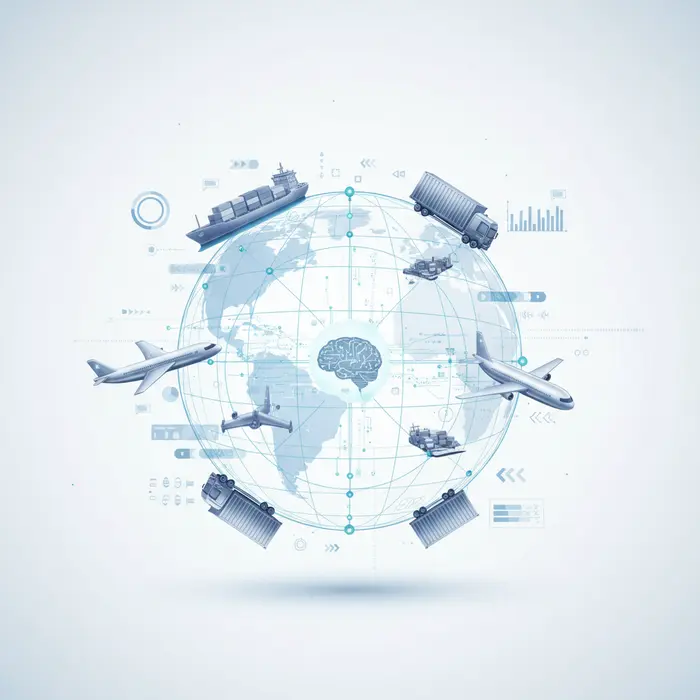
In an increasingly interconnected yet volatile global economy, the efficiency and resilience of supply chains are paramount. Artificial Intelligence (AI) is rapidly emerging as the transformative force, fundamentally reshaping how goods move from source to final delivery. By leveraging advanced algorithms and machine learning, AI in International Trade is not just optimizing processes but also building unprecedented levels of visibility and responsiveness into complex international logistics networks. These Supply chain AI solutions are critical for businesses aiming to navigate the complexities of global commerce, from enhanced freight management to proactive risk mitigation and streamlined customs procedures.
1. Predictive Demand Forecasting and Inventory Management
One of the most significant challenges in global logistics is accurately predicting demand and managing inventory levels across diverse geographic locations. Traditional forecasting methods, often reliant on historical data, struggle to account for sudden market shifts, geopolitical events, or unexpected consumer trends. AI revolutionizes this by analyzing vast datasets – including sales history, seasonal patterns, economic indicators, social media trends, and even weather forecasts – to generate highly accurate demand predictions. Machine learning models can identify subtle correlations and predict future demand with a precision unattainable by human analysis. This capability allows companies to optimize inventory levels, reducing carrying costs, minimizing stockouts, and preventing overstocking. For instance, AI can dynamically adjust safety stock levels for specific SKUs in different regions, ensuring that products are available where and when needed, without tying up excessive capital. This precision in inventory management is a cornerstone of efficient Supply chain AI solutions, directly impacting profitability and customer satisfaction.
2. Route Optimization and Freight Management
The complexities of international shipping, involving multiple modes of transport, varying regulations, and potential disruptions, make route optimization a formidable task. AI-powered systems excel in this area by processing real-time data on traffic, weather conditions, port congestion, fuel prices, and carrier availability. These systems can dynamically calculate the most efficient routes and modes of transport, considering cost, speed, carbon footprint, and reliability. From selecting optimal ocean freight routes to designing multi-modal domestic delivery networks, AI minimizes transit times and operational expenses. Furthermore, AI enhances freight management by consolidating shipments, identifying optimal loading configurations, and automating carrier selection based on performance metrics and contractual agreements. This not only streamlines operations but also contributes to sustainability efforts by reducing fuel consumption and emissions. The “future of trade definitions” will increasingly include agile, AI-driven logistics networks capable of adapting instantly to changing global conditions, making intelligent freight management indispensable.
3. Risk Mitigation and Disruption Prediction
Global supply chains are inherently vulnerable to disruptions, from natural disasters and political instability to cyber-attacks and sudden shifts in trade policies. AI provides a powerful toolkit for proactive risk mitigation and disruption prediction. By continuously monitoring global news feeds, geopolitical indicators, weather patterns, and supplier performance data, AI algorithms can identify potential risks before they escalate. For example, AI can flag an emerging labor dispute in a key manufacturing region or predict the impact of extreme weather on a major shipping lane. This early warning capability allows businesses to activate contingency plans, reroute shipments, or diversify sourcing ahead of time, minimizing impact. Moreover, AI trade compliance plays a crucial role here, as it can analyze regulatory changes, identify potential sanctions risks, and streamline processes like AI customs clearance, ensuring that all shipments adhere to international trade laws, reducing the likelihood of delays or penalties. This foresight is invaluable, transforming reactive problem-solving into proactive resilience, a cornerstone of modern supply chain management. Such capabilities redefine the very “future of trade definitions,” emphasizing agility and preparedness in the face of global uncertainties.
AI Customs Clearance: Accelerating Border Processes
In an increasingly interconnected global economy, the efficiency of international trade hinges significantly on streamlined customs procedures. Traditionally, customs clearance has been a labor-intensive, documentation-heavy process prone to delays and human error. However, the advent of Artificial intelligence (AI) is rapidly transforming this landscape, ushering in an era of unprecedented speed, accuracy, and security at borders. AI in International Trade is not just a buzzword; it’s a transformative force redefining how goods move across continents, promising faster clearance times and dramatically improving data integrity for international shipments. By leveraging sophisticated algorithms and machine learning, AI customs clearance solutions are addressing longstanding bottlenecks, offering robust supply chain AI solutions that benefit importers, exporters, and customs authorities alike, fundamentally reshaping the future of trade definitions.
1. Automated Documentation and Classification
One of the most significant contributions of AI to customs processes is its ability to automate the daunting task of documentation and commodity classification. Manual review of thousands of pages of invoices, packing lists, certificates of origin, and other trade documents is incredibly time-consuming and susceptible to errors that can lead to significant delays and penalties. AI-powered systems can swiftly scan, extract, and verify data from these diverse documents, cross-referencing information to ensure consistency and compliance. Furthermore, AI excels at commodity classification, a complex process that requires deep knowledge of the Harmonized System (HS) codes. Machine learning algorithms, trained on vast datasets of historical trade data and regulations, can accurately classify goods, even those with intricate descriptions or mixed compositions. This not only dramatically reduces processing times but also minimizes classification errors, a common source of customs disputes and fines. The precision offered by automated classification ensures greater predictability in duty and tax calculations, enhancing AI trade compliance and fostering smoother supply chain operations.
2. Fraud Detection and Security Enhancements
Beyond efficiency, AI plays a crucial role in bolstering the security and integrity of global trade. Traditional methods of fraud detection often rely on random checks, tips, or rule-based systems that can be easily circumvented by sophisticated criminals. AI, however, brings a new level of intelligence to this challenge. Machine learning models can analyze vast quantities of real-time and historical trade data, including shipper and consignee details, shipment routes, commodity types, and declared values, to identify suspicious patterns and anomalies that human analysts might miss. For instance, an AI system might flag an unusually low declared value for a high-value commodity, a frequent change in shipping routes, or connections between previously unrelated entities as potential indicators of smuggling, intellectual property infringement, or other illicit activities. This predictive analytics capability allows customs authorities to focus their resources on high-risk shipments, significantly improving their ability to intercept contraband, counterfeit goods, and dangerous materials. By proactively identifying potential threats, AI-driven solutions enhance border security without impeding legitimate trade, showcasing the power of supply chain AI solutions in safeguarding global commerce.
3. Seamless Integration with Customs Authorities
The true potential of AI in customs clearance is realized through its seamless integration with existing customs IT systems and regulatory frameworks worldwide. For AI-powered solutions to be effective, they must be able to communicate and exchange data efficiently with national customs databases, global trade platforms, and other stakeholders. Modern AI systems are designed with API-driven architectures, enabling them to connect directly with customs declaration platforms, port systems, and logistics providers. This interoperability facilitates the automated submission of declarations, the instant retrieval of regulatory updates, and real-time status tracking of shipments. Such integration reduces manual data entry, eliminates redundant processes, and provides a single, unified view of the trade flow for all parties involved. This level of digital interconnectedness supports collaborative decision-making and ensures that all parties operate from the most current and accurate information. As more countries adopt advanced digital customs platforms, the capacity for AI tools to create a truly global, efficient, and secure trade ecosystem will only grow. This evolution is central to defining the future of trade definitions, where AI in International Trade is not just an auxiliary tool but an integral part of the global trading infrastructure.
The Future of Trade Definitions: AI’s Evolving Role 2025 and Beyond
Artificial Intelligence (AI) is rapidly transforming the landscape of global commerce, moving beyond mere process optimization to fundamentally redefine the very essence of international trade. As we look towards 2025 and beyond, AI’s evolving role will influence new definitions, standards, and global economic structures, promising an era of unprecedented efficiency, transparency, and complexity. This technological revolution necessitates a proactive re-evaluation of how goods, services, and data traverse borders, driven by intelligent algorithms and predictive analytics.

AI’s capabilities in advanced data analysis, predictive modeling, and automation are set to usher in an era where trade definitions are more dynamic, data-driven, and globally harmonized. We’ll see AI redefining what constitutes a “fair price,” “country of origin,” or “compliant shipment” through real-time data analysis and machine learning. This shift will require businesses and policymakers alike to adapt rapidly to evolving standards and metrics influenced by algorithms. AI’s role in streamlining AI trade compliance and enhancing AI customs clearance is already evident, but its future impact will be even more profound, leading to proactive, intelligent trade systems that anticipate challenges rather than merely reacting to them.
1. Emerging Technologies: Blockchain and IoT Integration
AI will not operate in a vacuum. Its true power in defining future trade will be realized through synergistic integration with other frontier technologies like Blockchain and the Internet of Things (IoT). Blockchain provides immutable, transparent ledgers, enabling unprecedented traceability and trust across supply chains. When combined with AI, this means supply chain AI solutions can verify the authenticity of goods, track their provenance from raw material to consumer, and automatically trigger payments or release goods upon predefined conditions being met. IoT devices, embedded in products, containers, and infrastructure, will feed vast amounts of real-time data—location, temperature, humidity, security status—directly into AI systems. These systems will then analyze this data to enforce new standards for product quality, ethical sourcing, and environmental compliance, effectively creating new, data-driven definitions for trade terms that were once subjective or difficult to verify. For instance, AI could automatically flag goods that deviate from “sustainable origin” criteria based on real-time sensor data and blockchain-verified supply chain movements.
2. Ethical AI and Data Governance in Trade
As AI becomes more ingrained in defining trade parameters, the need for robust ethical frameworks and comprehensive data governance becomes paramount. The decisions made by AI algorithms, from assessing risk to optimizing trade routes, will have significant economic and societal consequences. Ensuring these algorithms are transparent, fair, and unbiased is crucial. This involves developing international standards for algorithmic accountability and auditing, preventing discriminatory practices, and safeguarding data privacy. Global trade bodies and national governments will need to collaborate to establish guidelines for the collection, sharing, and use of trade-related data by AI systems, balancing innovation with protection. The challenge lies in creating regulatory sandboxes and legal frameworks that allow for the rapid evolution of AI in trade while mitigating risks like data breaches, algorithmic bias, and market manipulation. Trust in these AI-driven systems will depend heavily on their perceived fairness and the robust governance structures supporting them.
3. Policy Adaptations and International Collaboration
The radical shifts brought about by AI in defining trade necessitate equally radical adaptations in international trade policy and unparalleled global collaboration. Existing trade agreements, customs regulations, and international standards were largely designed for an era predating sophisticated AI. Future policy must accommodate AI’s ability to create dynamic, real-time trade definitions, potentially even learning and adapting rules on the fly. This requires a proactive approach to rulemaking, moving beyond reactive adjustments. International organizations, such as the World Trade Organization (WTO), will play a critical role in facilitating discussions and forging consensus on AI-driven trade norms. Harmonizing data standards, promoting interoperability between national AI systems, and addressing digital trade barriers will be key to unlocking the full potential of AI in International Trade without fragmenting the global economy. This collaborative effort will shape the future of trade definitions, ensuring they remain relevant and effective in a rapidly evolving, AI-powered global marketplace that fosters inclusive growth and sustainable development.
Partner with Vietnam’s Leading Suppliers
Looking for reliable suppliers in Vietnam? Contact VietnamSuppliers.com today to connect with verified manufacturers and exporters across all industries.
—————————————
References
– AI trade compliance: https://www.wto.org/english/news_e/news23_e/dg_11may23_e.htm
– WTO on AI and Global Trade Governance: https://www.wto.org/english/news_e/news23_e/dg_wto_en_tech_summit_2023_e.htm
– AI and the future of supply chain risk: https://www.mckinsey.com/industries/americas/our-insights/ai-and-the-future-of-supply-chain-risk
– WCO Technology Conference and Exhibition Day 3: https://www.wcoomd.org/en/media/newsroom/2021/october/wco-technology-conference-and-exhibition-day-3.aspx
– International Trade Policy: https://www.wto.org/english/tratop_e/tradfa_e/ai_e.htm