What is an HS Code and Why Does it Matter?
Navigating the complexities of international trade requires a universally understood system for classifying goods. At the heart of this system lies the Harmonized System (HS) Code, a fundamental tool that impacts virtually every aspect of global commerce. Understanding the fundamentals of the Harmonized System Code and its critical role in international trade is not merely an administrative task; it’s a strategic imperative for businesses aiming for efficiency, compliance, and profitability on a global scale. From determining duties to ensuring regulatory adherence, the HS Code is the silent backbone of cross-border transactions.
Decoding the Harmonized System (HS) Code
At its core, the Harmonized System (HS) Code is a standardized numerical classification system for traded products. Developed and maintained by the World Customs Organization (WCO), it provides a logical and structured method for *Product Classification for Global Trade*. Every product that crosses international borders is assigned a unique HS Code, which typically consists of six digits globally, though individual countries often extend this to eight or ten digits for more granular classification (known as tariff codes or national codes).
The structure of an HS Code is hierarchical and logical:
- The first two digits identify the Chapter (e.g., 01 for Live Animals, 85 for Electrical Machinery). There are 97 chapters covering all possible goods.
- The next two digits identify the Heading within that chapter (e.g., 0101 for Live horses, asses, mules, or hinnies).
- The subsequent two digits identify the Subheading within that heading (e.g., 0101.21 for Purebred breeding animals).
This systematic breakdown ensures that a product, whether it’s a live animal or a complex piece of machinery, can be identified with precision, making the *Harmonized System Code Explained* a process of understanding this layered classification.
The Global Language of Trade Classification
The beauty of the HS Code lies in its universality. It serves as a common language for customs authorities, statistical agencies, and traders worldwide. Imagine trying to trade goods internationally if every country used its own unique descriptions and classification systems; chaos would ensue. The HS Code streamlines this by providing a consistent framework, significantly reducing ambiguity and facilitating smooth customs clearance processes across different nations. This standardization is critical for efficient *Trade Compliance Solutions*, allowing for seamless data exchange and minimizing delays at borders.
By offering a unified method for identifying goods, the HS Code plays a pivotal role in:
- Customs Procedures: Expediting inspections and processing.
- Trade Statistics: Enabling countries to collect comparable data on imports and exports, crucial for economic analysis and policy-making.
- Negotiating Trade Agreements: Providing a common ground for defining product scope and tariff concessions.
In essence, it’s the Rosetta Stone of international commerce, ensuring that a “widget” imported into one country is understood as the same “widget” exported from another.

Impact on Duties, Taxes, and Regulations
Perhaps the most immediate and tangible impact of the HS Code on businesses is its direct correlation with *Customs Duty Calculation*, taxes, and various trade regulations. The correct HS Code for a product dictates the tariff rate applied to it upon import. Different codes can result in vastly different duty rates, directly affecting the landed cost of goods and, consequently, a company’s profitability and competitiveness. Incorrect classification can lead to overpayment of duties or, worse, underpayment, resulting in fines, penalties, and severe delays.
Beyond duties, the HS Code is also instrumental in:
- Taxes: Determining the application of Value Added Tax (VAT), Goods and Services Tax (GST), or excise duties.
- Trade Agreements: Identifying if goods qualify for preferential tariff treatment under Free Trade Agreements (FTAs).
- Regulatory Compliance: Linking products to specific import/export restrictions, prohibitions, safety standards, quota limits, or licensing requirements. For example, certain chemicals or agricultural products might require specific permits based on their HS Code.
Therefore, precise and accurate product classification is not just a recommendation; it’s a critical component of effective *Trade Compliance Solutions*. Companies must invest time and resources into proper HS Code Lookup and verification to ensure adherence to international trade laws and avoid costly disruptions. Leveraging expert knowledge or specialized software can significantly mitigate risks and optimize supply chain operations, solidifying the HS Code’s position as a cornerstone of successful global trade.

Mastering HS Code Lookup: Tools and Best Practices
Guiding users through effective methods and resources for accurate HS Code identification and validation.
Accurate HS Code Lookup is not merely a bureaucratic step; it’s a critical foundation for successful global trade. The Harmonized System (HS) Code, a globally standardized numerical classification for traded products, dictates everything from customs duties and taxes to import/export restrictions and trade agreements. Misclassification can lead to costly delays, hefty fines, and even legal complications, underscoring the necessity of mastering its identification. This section will guide you through effective methods and resources for precise HS Code identification and validation, ensuring smoother, compliant international transactions.
1. Official Databases and Online Resources
When embarking on an HS Code lookup, always prioritize official, government-sanctioned databases. These are the most authoritative sources for classification rules and rates applicable to specific countries or trade blocs. Key resources include:
- National Customs Websites: Most countries provide their own searchable tariff databases. For example, the U.S. International Trade Commission (USITC) offers its Harmonized Tariff Schedule (HTS) search tool, while the European Union has its TARIC database. These platforms often include detailed explanatory notes, rulings, and duty rates.
- World Customs Organization (WCO): As the custodian of the World Customs Organization (WCO) Harmonized System, the WCO provides a global framework and publications that are indispensable for understanding the system’s structure and interpretative rules. While not a direct tariff lookup tool for specific countries, its resources are vital for grasping the underlying principles.
- Commercial HS Code Search Tools: Numerous third-party platforms offer sophisticated search functionalities, often integrating data from multiple countries and providing advanced analytics. While convenient, always cross-reference their findings with official government sources, especially for complex classifications or high-value goods. Reputable tools can significantly streamline the process, but they should complement, not replace, official checks.
Leveraging these resources systematically helps build a robust foundation for accurate HS Code Lookup and reduces reliance on potentially outdated or incorrect information.
2. Tips for Accurate Product Classification
Accurate product classification for global trade extends beyond simply typing a product name into a search bar. It requires a systematic approach and a deep understanding of the product itself:
- Know Your Product Inside Out: Understand its primary function, the materials it’s made from, its composition, and how it’s packaged or presented for sale. For example, is it a finished product, a component, or raw material? Is it made of plastic, metal, or textiles? This detailed knowledge is crucial for navigating the various sections and chapters of the Harmonized System.
- Utilize the General Interpretative Rules (GIRs): The Harmonized System includes six General Interpretative Rules (GIRs) that provide the fundamental principles for classifying goods. Mastering these rules is paramount, as they guide the classification process when a product could potentially fall into more than one heading. Rule 1 (legal text), Rule 3 (mixed goods), and Rule 6 (subheadings) are particularly vital.
- Read Chapter, Section, and Subheading Notes: These notes provide specific legal clarifications, inclusions, and exclusions that override general rules. Often, the key to accurate classification lies within these detailed notes, which can dramatically alter a product’s HS Code.
- Consider the “Whole” Product: Sometimes a product is comprised of multiple components. The classification often depends on what gives the product its “essential character.” This concept is vital for items shipped in sets or unassembled.
By applying these tips, you’ll gain a clearer understanding of the Harmonized System Code Explained and significantly improve your classification accuracy.
3. Avoiding Common Classification Errors
Even with access to the right tools, errors can occur. Proactive measures are essential for robust trade compliance solutions and to prevent costly mistakes:
- Don’t Rely Solely on Vendor-Provided Codes: While a supplier might provide an HS Code, it’s crucial to verify it yourself. Their classification might be based on their country’s specific interpretation or tariff schedule, which could differ from your importing country’s rules, leading to incorrect Customs Duty Calculation.
- Beware of Generic Descriptions: Vague product descriptions can lead to broad, often incorrect, classifications. Ensure your product description is highly detailed, leaving no room for ambiguity. Specificity helps pinpoint the correct subheading.
- Understand Country-Specific Variations: While the first six digits of an HS Code are globally harmonized, the subsequent digits (usually 2-4) are country-specific. An 8-digit code valid in one country might not be valid or might have a different meaning in another. Always use the full tariff code relevant to your destination country.
- Stay Updated with Changes: The Harmonized System undergoes revisions every five years, and national tariff schedules are updated more frequently. Regularly check for updates to ensure your classifications remain current. Failing to update can lead to non-compliance.
- Seek Expert Advice When in Doubt: For complex or high-value classifications, consult with a customs broker, trade consultant, or seek an advance ruling from customs authorities. This can save significant time and money in the long run and provides legal certainty.
By diligently following these practices, businesses can minimize risks associated with HS Code lookup errors and ensure seamless international trade operations.
HS Codes and Customs Duty Calculation Simplified
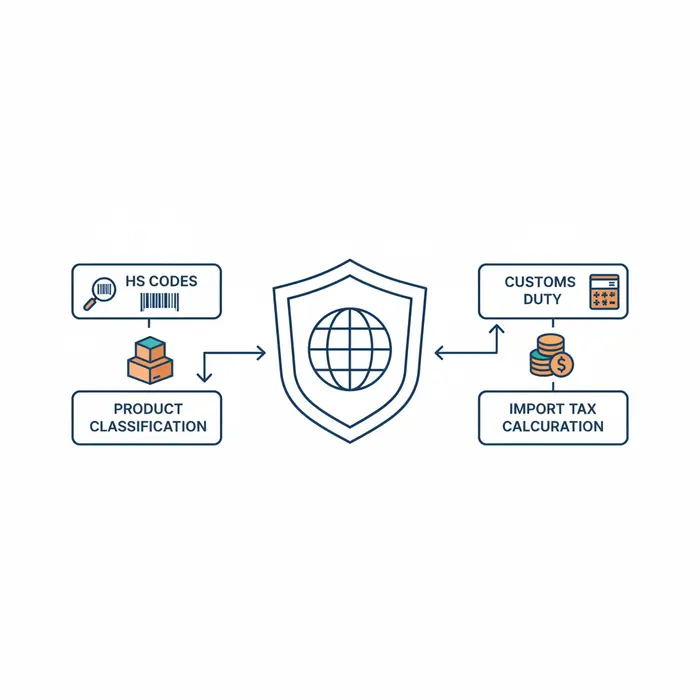
Navigating the complexities of international trade requires a deep understanding of various regulations, with Harmonized System (HS) Codes standing at the forefront. These internationally standardized numbers are the bedrock upon which global trade classifications are built, directly influencing everything from import duties to trade statistics. For businesses engaged in cross-border commerce, mastering the HS Code Lookup process is not merely a formality but a critical component of strategic planning and achieving seamless trade compliance solutions. This section will demystify how these crucial codes determine the financial obligations for importing and exporting goods, providing clarity on the intricate customs duty calculation processes and ensuring your shipments move efficiently and cost-effectively.
1. Connecting HS Codes to Duty Rates
At its core, the Harmonized System (HS) is a standardized numerical method of classifying traded products. Developed and maintained by the World Customs Organization (WCO), an Harmonized System Code Explained is a six-digit code used by over 200 countries and economies as the basis for their customs tariffs and for the collection of international trade statistics. Beyond the initial six digits, countries can add further digits for more specific classification, resulting in codes of 8, 10, or even 12 digits, which vary by nation.
The direct link between an HS Code and customs duty rates is fundamental. Each specific HS Code is assigned a corresponding tariff rate by the importing country. This rate dictates the percentage of the product’s value (or sometimes a fixed amount per unit) that must be paid as customs duty. For instance, a particular type of machinery might have one HS Code with a 5% duty rate, while a different type of textile might have another with a 12% rate. Accurate product classification for global trade using the correct HS Code is paramount. Misclassifying goods, even unintentionally, can lead to incorrect duty payments, fines, delays, and even seizure of goods. Utilizing a reliable HS Code Lookup tool or consulting with customs brokers is essential to ensure precision.
2. Factors Influencing Customs Duty
While the HS Code forms the foundation, several other critical factors play a significant role in the final customs duty calculation:
- Country of Origin: Goods imported from countries with which the destination country has Free Trade Agreements (FTAs) or other preferential trade agreements may qualify for reduced or zero duty rates. Proving origin often requires specific documentation, such as a Certificate of Origin.
- Value of Goods: Customs duties are typically calculated based on the dutiable value of the goods, which often includes the cost of the goods, insurance, and freight (CIF value). The method of valuation can vary by country, but understanding the declared value is crucial.
- Quantity and Weight: For some products, duty may be assessed based on quantity (e.g., per piece, per liter) or weight, rather than solely on value.
- Specific Tariffs and Taxes: Beyond standard duties, imports might be subject to additional levies such as Value Added Tax (VAT), Goods and Services Tax (GST), excise taxes, anti-dumping duties, or countervailing duties. These are often applied to protect domestic industries or to regulate consumption of certain goods.
- Incoterms: The chosen Incoterm (International Commercial Term) defines the responsibilities of buyers and sellers for the delivery of goods, including who pays for and manages the shipment, insurance, and customs duties. This indirectly impacts the financial burden and duty calculation process.
Understanding these variables is key to an accurate estimate. For detailed information on specific tariffs and trade regulations, consulting authoritative sources like the World Customs Organization or national customs authorities is highly recommended.
3. Estimating Costs for International Shipments
Accurately estimating the total costs for international shipments involves a systematic approach, integrating the insights from HS Codes and other duty-influencing factors. This proactive estimation is vital for pricing strategies, budget allocation, and ensuring profitability in global trade.
- Precise HS Code Determination: Begin by correctly identifying the HS Code for each product. This is the most crucial first step. Utilize a thorough HS Code Lookup, consult official government databases, or seek expert assistance if your product is complex.
- Identify Origin and Destination: Clearly define the country where the goods were manufactured and the country where they will be imported. This informs potential preferential duty rates.
- Research Duty Rates and Taxes: Once the HS Code, origin, and destination are confirmed, research the specific customs duty rates, VAT/GST, and any other applicable taxes or fees for that code in the destination country. National customs websites or specialized trade compliance platforms are invaluable resources.
- Calculate Dutiable Value: Determine the value of the goods according to the importing country’s valuation rules. This often involves adding shipping and insurance costs to the product’s price.
- Factor in Additional Costs: Don’t forget other potential expenses such as customs brokerage fees, port charges, inspection fees, and domestic transportation within the destination country.
By following these steps, businesses can develop a comprehensive cost estimate, mitigating unexpected expenses and avoiding delays. Accurate product classification for global trade and diligent customs duty calculation are indispensable for successful and compliant international shipping. Investing time in these processes upfront ensures smoother operations and stronger financial outcomes, reinforcing robust trade compliance solutions.
Ensuring Product Classification for Global Trade Compliance
In the complex landscape of international trade, accurate product classification stands as a cornerstone for regulatory adherence and avoiding severe penalties. The global movement of goods is governed by a myriad of rules, tariffs, and agreements, all hinged upon how a product is identified. Misclassifying an item, whether intentionally or inadvertently, can lead to significant financial repercussions, delays, and even legal action. Therefore, understanding and correctly applying the Harmonized System (HS) code is not merely a bureaucratic step but a critical element of effective trade compliance solutions.
The Harmonized System, managed by the World Customs Organization, provides a standardized numerical method of classifying traded products. This system is universally recognized, though individual countries may have additional sub-classifications. For businesses engaged in cross-border trade, mastering the HS Code Lookup process is paramount for smooth operations, accurate customs duty calculation, and maintaining a strong reputation in the global marketplace. It’s about more than just identifying a product; it’s about navigating the intricate web of international commerce with precision and foresight.
1. Legal Implications of Misclassification
The stakes involved in product classification are incredibly high, particularly concerning its legal ramifications. Incorrectly assigning an HS code to a product can trigger a cascade of adverse consequences for importers and exporters alike. These can range from significant monetary penalties and fines imposed by customs authorities to the seizure of goods, leading to substantial financial losses and supply chain disruptions. In some cases, repeated or deliberate misclassification can even result in criminal charges, especially when it involves attempts to evade duties or circumvent import/export restrictions.
Beyond immediate financial penalties, misclassification can lead to increased scrutiny from customs agencies, resulting in longer processing times for future shipments and a tarnished compliance record. Businesses might also face retroactive duty assessments, meaning they could be required to pay the difference in duties for past shipments, plus interest and penalties. This burden can be substantial, underscoring why an accurate understanding of Product Classification for Global Trade is not just good practice, but a legal imperative. Companies must invest in robust internal processes and expertise to ensure that their classifications withstand regulatory scrutiny.
2. Role of HS Codes in Trade Agreements
The Harmonized System (HS) code is far more than just a classification number; it serves as the universal language of international trade, playing a pivotal role in the execution and benefits of various trade agreements. When an Harmonized System Code Explained is accurately applied, it directly impacts the tariffs, duties, and taxes that a product incurs upon import or export. This is particularly crucial in the context of free trade agreements (FTAs) and preferential trade agreements (PTAs), which offer reduced or zero tariffs for goods originating from signatory countries.
For businesses to leverage these agreements and benefit from lower Customs Duty Calculation, their products must be correctly classified under the respective HS chapters and headings. A misclassified product might erroneously be deemed ineligible for preferential treatment, leading to higher duties than anticipated, eroding profit margins, and making products less competitive. Conversely, correct classification ensures that businesses can fully capitalize on trade agreements, enhancing their competitiveness and market access. This makes understanding the nuances of HS codes indispensable for strategic international trade planning.
3. Streamlining Import/Export Operations
Accurate product classification is a linchpin for efficient and streamlined import/export operations. Beyond legal and financial compliance, precise HS codes significantly reduce the likelihood of customs delays, which can be costly in terms of demurrage charges, storage fees, and lost sales opportunities. When customs officials can quickly verify a product’s classification, clearance processes become smoother and faster, ensuring goods reach their destination on time.
Implementing an effective HS Code Lookup strategy and utilizing robust Trade Compliance Solutions can automate much of the classification process, minimizing human error and increasing efficiency. This not only speeds up customs clearance but also provides a solid foundation for accurate record-keeping, audit trails, and consistent reporting. Streamlined operations, fueled by accurate product classification, lead to predictable supply chains, reduced operational costs, and enhanced customer satisfaction. In essence, getting the classification right from the outset is an investment in operational excellence and sustainable global trade success.
Advanced Strategies for Trade Compliance Solutions
Exploring sophisticated approaches and technologies to optimize trade compliance and classification management.

1. Leveraging AI and Automation in Classification
The complexity of global trade, with its myriad products and ever-evolving regulations, makes accurate HS Code Lookup a formidable challenge. Manual classification is prone to errors, time-consuming, and scales poorly with increasing product catalogs. Advanced strategies increasingly rely on Artificial intelligence (AI) and automation to revolutionize product classification. Machine learning algorithms, trained on vast datasets of historical classification decisions, product descriptions, and technical specifications, can now suggest or even autonomously assign HS codes with high accuracy. These systems can process thousands of product SKUs rapidly, identifying patterns and nuances that might elude human classifiers. Furthermore, Robotic Process Automation (RPA) can automate the data extraction from product manifests, invoices, and technical documents, feeding this information directly into AI classification engines. This not only significantly reduces the time and effort involved in product classification for global trade but also enhances consistency and reduces the risk of non-compliance fines. Implementing such intelligent systems is a critical step towards achieving optimal trade compliance solutions, freeing up human experts to focus on complex cases and strategic oversight rather than repetitive tasks.
2. Working with Customs Brokers and Experts
While technology offers powerful tools, the human element remains indispensable in advanced trade compliance strategies. Partnering with experienced customs brokers, trade consultants, and legal experts provides an invaluable layer of insight and security. These professionals possess an in-depth understanding of the intricate regulatory landscape, including country-specific customs requirements, free trade agreements, and anti-dumping duties. They can offer guidance on complex classification scenarios, interpret ambiguous regulations, and provide strategic advice to minimize customs duty calculation and mitigate risks. For businesses engaging in international trade, their expertise is crucial for navigating specific import/export declarations, licensing requirements, and audits. Customs brokers, for instance, act as intermediaries, ensuring that all documentation is accurate and submitted correctly, thereby preventing delays and penalties. Their proactive approach to staying updated on changes in global trade policies and tariff schedules ensures that a company’s trade compliance framework remains robust and adaptable, complementing automated systems by providing the nuanced judgment and experience that only human experts can offer.
3. Future Trends in HS Code Management
The future of Harmonized System Code explained and management is set to evolve further with emerging technologies and global initiatives. One significant trend is the increasing integration of blockchain technology to create transparent and immutable records of product origin, classification, and trade transactions. This could drastically improve traceability and trust across the supply chain, making it easier to verify compliance data. Predictive analytics will also play a larger role, enabling businesses to anticipate potential classification challenges or regulatory changes before they impact operations. Furthermore, the development of a more standardized, global digital trade infrastructure promises to streamline information exchange between businesses and customs authorities worldwide. The World Customs Organization (WCO) continues to refine the Harmonized System, with periodic updates that necessitate continuous adaptation of classification processes. The next major update is expected in 2027, highlighting the need for systems that can quickly incorporate these changes. As global trade becomes even more interconnected, real-time data exchange and collaborative platforms will be essential for efficient HS code management, moving towards a proactive, rather than reactive, approach to trade compliance.
Partner with Vietnam’s Leading Suppliers
Looking for reliable suppliers in Vietnam? Contact VietnamSuppliers.com today to connect with verified manufacturers and exporters across all industries.
—————————————
References
– World Customs Organization – Harmonized System: https://www.wcoomd.org/en/topics/nomenclature/instrument-and-tools/harmonized_system.aspx
– World Customs Organization Harmonized System: https://www.wcoomd.org/en/topics/nomenclature/instrument-and-tools/harmonized-system.aspx
– World Customs Organization: https://www.wcoomd.org/
– Harmonized System Code Explained: https://www.wcoomd.org/en/topics/nomenclature/overview.aspx
– World Customs Organization Harmonized System: https://www.wcoomd.org/en/topics/nomenclature/instrument-and-tools/harmonized_system.aspx