The Evolving Landscape of Global Shipping Regulations
The global shipping industry stands at a pivotal juncture, navigating an increasingly intricate web of international and regional maritime regulations. As we move through 2024 and beyond, these global shipping regulatory changes 2024 are not merely administrative hurdles but transformative forces reshaping operational practices, financial models, and strategic planning across the maritime supply chain. The sheer volume and ambition of new legislation, particularly in areas of environmental sustainability and operational transparency, demand a proactive and informed approach from all stakeholders, from vessel owners to cargo owners, impacting everything from freight rates to port calls.

1. Key Drivers Behind New Legislation (Climate, Geopolitics, Technology)
The impetus for the current surge in maritime regulation stems from a confluence of powerful global trends. Foremost among these is the escalating urgency of climate change. International bodies and national governments are responding to public and scientific pressure to decarbonize an industry responsible for a significant portion of global greenhouse gas emissions. This has led to ambitious IMO decarbonization targets, pushing for radical shifts towards cleaner fuels and more efficient operations.
Geopolitical shifts also play a crucial role. Trade disputes, sanctions, and conflicts in key maritime corridors necessitate regulations that address security, traceability, and compliance with international law, adding layers of complexity to global routes. Finally, rapid advancements in technology are both a solution and a driver of new regulations. Digitalization, automation, and advanced data analytics offer pathways to greater efficiency and transparency but also introduce new regulatory needs related to cyber security, data privacy, and the safe integration of autonomous systems. The development of green shipping corridors development, for instance, relies heavily on both technological innovation and robust regulatory frameworks to certify and monitor their environmental performance.
2. Overview of International & Regional Regulatory Frameworks
The regulatory landscape is characterized by a two-pronged approach: overarching international frameworks set by bodies like the IMO, and more specific regional mandates, most notably from the European Union. At the international level, the IMO continues to roll out comprehensive measures aimed at reducing the carbon footprint of shipping. Key among these are the Carbon Intensity Indicator (CII) and the Energy Efficiency Existing Ship Index (EEXI), both of which came into force in 2023, requiring ships to measure and report their carbon intensity and meet specific energy efficiency standards. The IMO’s strategy for achieving net-zero emissions by or around 2050 further underscores the long-term commitment to environmental sustainability, impacting future vessel design and fuel choices.
Regionally, the European Union is pioneering some of the most stringent and impactful regulations. The EU ETS maritime impact is perhaps the most significant, extending the EU’s Emissions Trading System to cover shipping emissions from voyages to, from, and between EU ports starting January 1, 2024. This scheme requires shipowners to surrender allowances for their greenhouse gas emissions, introducing a direct financial cost for carbon and incentivizing cleaner operations. Other regional initiatives, such as FuelEU Maritime, aim to accelerate the uptake of renewable and low-carbon fuels in the maritime sector, setting progressively stricter limits on the greenhouse gas intensity of energy used on board ships. These frameworks, whether global or regional, collectively contribute to the monumental task of de-risking and decarbonizing maritime transport.
3. Navigating Compliance and Future Strategies
For businesses engaged in international trade, adapting to these evolving regulations is paramount for maintaining competitive advantage and ensuring operational continuity. The cumulative effect of global shipping regulatory changes 2024 is a significant increase in operational complexity and potential costs. Companies are compelled to reassess their fleets, invest in advanced data monitoring and reporting systems, and explore alternative fuel technologies. This often translates into higher capital expenditures and potentially increased freight charges, which will ultimately trickle down the supply chain.
To mitigate risks and leverage opportunities, businesses must develop robust supply chain resilience strategies B2B. This includes diversifying shipping routes and carrier partnerships, exploring contractual clauses that account for new compliance costs, and investing in transparent data sharing capabilities. Proactive engagement with regulatory bodies and industry associations is also vital to stay ahead of upcoming changes. Furthermore, the development of green shipping corridors and the increasing availability of sustainable marine fuels present opportunities for first movers to enhance their environmental credentials and appeal to eco-conscious consumers and partners. Ultimately, successful navigation of this dynamic regulatory landscape will require agility, foresight, and a commitment to integrating sustainability into the core of maritime business operations.
EU ETS Maritime: Understanding Financial & Operational Impact
The maritime sector stands at the precipice of significant transformation driven by stringent environmental regulations. Among the most impactful are the EU Emissions Trading System (EU ETS) and the ongoing efforts to meet IMO decarbonization targets 2024. Effective January 1, 2024, the EU ETS expanded its scope to include emissions from large ships (5,000 gross tonnage and above), marking a pivotal shift towards decarbonizing global shipping. This move underscores Europe’s commitment to the ‘polluter pays’ principle, compelling shipping companies to account for their carbon footprint.
1. Carbon Pricing Mechanisms and Reporting Requirements
Under this new regime, shipowners and operators are required to surrender EU Allowances (EUAs) for verified greenhouse gas emissions from voyages between EU ports, voyages within EU ports, and 50% of emissions from voyages between an EU port and a non-EU port. The implementation is phased: 40% of emissions must be covered in 2024, rising to 70% in 2025, and a full 100% by 2026. This incremental approach allows the industry a brief adjustment period, though the financial and operational implications are immediate.
A cornerstone of EU ETS compliance is robust Monitoring, Reporting, and Verification (MRV) of emissions. Operators must meticulously track fuel consumption and associated CO2 emissions for all relevant voyages. This data is then compiled into an annual emissions report, which must be independently verified by an accredited body. The verified report forms the basis for the subsequent surrender of EUAs. Non-compliance can result in substantial penalties, including fines and potential operational restrictions, emphasizing the critical need for accurate data management and timely reporting. The stringent requirements necessitate significant upgrades in data collection systems, personnel training, and a deep understanding of the regulatory nuances for any entity involved in the maritime value chain, highlighting the substantial EU ETS maritime impact.
2. Strategic Vessel Optimization for EU ETS Compliance
Beyond mere compliance with reporting protocols, shipping companies must embark on strategic vessel optimization to mitigate the financial burden imposed by the EU ETS. Operational efficiency directly translates into reduced emissions, thereby lowering the requirement for costly EUAs. One of the most immediate and effective strategies is speed optimization, commonly known as slow steaming. By reducing vessel speed, fuel consumption—and consequently, CO2 emissions—can be significantly curtailed. While this may extend voyage times, careful planning can minimize disruption and even improve schedule reliability in some cases.
Route optimization is another critical avenue. Leveraging advanced weather routing software allows vessels to navigate the most fuel-efficient paths, avoiding adverse weather conditions that increase resistance and fuel burn. Just-in-time (JIT) arrivals also play a crucial role, preventing vessels from idling inefficiently outside ports, a practice that contributes to unnecessary emissions. Furthermore, investing in hull and propeller cleaning and maintenance is a low-hanging fruit for efficiency gains. Biofouling on hulls can dramatically increase drag, leading to higher fuel consumption. Regular cleaning and application of advanced antifouling coatings can restore hydrodynamic efficiency.
Engine tuning and optimization, along with the adoption of shore power where available, further contribute to reducing emissions, particularly during port stays. For a sector facing increasing Global shipping regulatory changes 2024, these operational adjustments are not merely cost-saving measures but fundamental shifts towards sustainable practices. While these strategies primarily address existing fleet efficiency, they lay the groundwork for future investments in alternative fuels and advanced propulsion systems, aligning with broader IMO decarbonization targets 2024 and pushing the industry towards a greener future.
3. Financial Implications and Supply Chain Adaptation
The EU ETS introduces a dynamic and potentially volatile financial element to maritime operations. The price of EUAs fluctuates based on market demand and supply, making emissions a variable cost that requires careful financial planning and risk management. Shipowners will face direct costs for purchasing and surrendering EUAs, which are expected to be passed through to charterers and cargo owners via surcharges. This directly impacts freight rates and the overall cost of goods transported, prompting a re-evaluation of current contractual agreements and pricing models. The need for transparency in passing on these costs will be paramount to maintain healthy B2B relationships.
Beyond direct costs, the EU ETS incentivizes significant long-term investment in decarbonization technologies. This includes adopting alternative fuels such as ammonia, methanol, and hydrogen, or exploring carbon capture and storage (CCS) solutions. These investments are substantial but crucial for long-term competitiveness and compliance with increasingly stringent environmental targets. Managing the financial risk associated with EUA price volatility, potentially through hedging strategies, will become an integral part of treasury operations for shipping companies.
For the wider supply chain, the EU ETS necessitates substantial adaptation. Businesses engaged in global trade, particularly those reliant on maritime transport to and from Europe, must integrate these new costs and operational considerations into their strategic planning. This includes evaluating the potential for port shifting (though the EU has measures to prevent evasion) and exploring collaborative models with shipping partners. Supply chain resilience strategies B2B will increasingly incorporate carbon efficiency as a key performance indicator. Furthermore, the development of green shipping corridors development, which aim to establish zero-emission maritime routes, offers a long-term strategic pathway for decarbonizing specific trade lanes and could become a competitive advantage for early adopters. The overarching impact is a fundamental recalibration of economic relationships across the maritime value chain, driving innovation and requiring proactive engagement from all stakeholders.
The global maritime industry, responsible for transporting over 80% of world trade, faces increasing pressure to reduce its environmental footprint. At the forefront of this transformation are the Global shipping regulatory changes 2024, spearheaded by the International Maritime Organization (IMO). The IMO’s Decarbonization Roadmap is not just a set of environmental aspirations; it’s a comprehensive strategy aiming to steer the industry towards a sustainable, low-carbon future through ambitious targets and the rapid adoption of innovative technologies. This roadmap fundamentally reshapes operational practices, investment decisions, and ultimately, the resilience of global supply chains.
1. Revised GHG Strategy and Short-Term Measures (EEXI, CII)
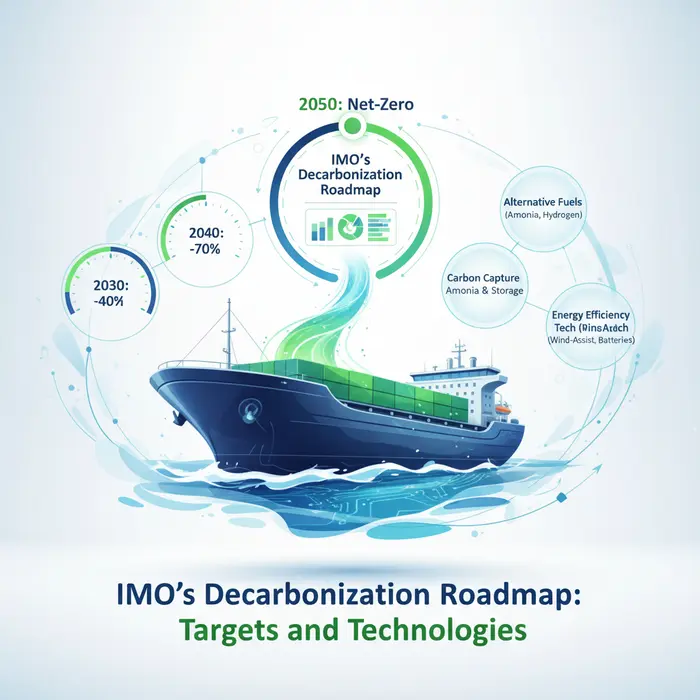
In July 2023, the IMO significantly raised its climate ambition by adopting a revised Greenhouse Gas (GHG) Strategy. This landmark agreement sets a target of net-zero GHG emissions from international shipping by or around 2050, with indicative checkpoints of at least a 20% reduction by 2030, and at least a 70% reduction by 2040 (compared to 2008 levels). This revised strategy provides a clear, long-term direction, underscoring the urgency for immediate action. To facilitate this, the IMO has already implemented crucial short-term measures: the Energy Efficiency Existing Ship Index (EEXI) and the Carbon Intensity Indicator (CII).
The EEXI regulates the technical efficiency of existing ships, mandating that vessels meet a specific energy efficiency standard based on their design parameters. Ships failing to meet this standard must implement technical modifications to comply. Complementing EEXI, the CII is an operational measure that rates ships annually based on their carbon intensity – the actual CO2 emissions per transport work. Vessels receive an A to E rating, with those rated D or E for three consecutive years potentially facing mandatory corrective action plans. These measures, in conjunction with regional initiatives like the EU ETS maritime impact, which started phasing in for shipping emissions in 2024, are compelling operators to optimize vessel performance and consider early adoption of cleaner technologies to meet the evolving IMO decarbonization targets 2024 and beyond.
2. Future Fuels and Propulsion Technologies Development
Achieving the IMO’s ambitious net-zero goal by 2050 necessitates a radical shift from conventional heavy fuel oil to a diverse portfolio of low- and zero-carbon fuels. The industry is actively exploring various alternative fuels, including green ammonia, methanol, hydrogen, and sustainable biofuels. Each presents unique opportunities and challenges concerning production scalability, bunkering infrastructure development, safety protocols, and cost-effectiveness. Ammonia and methanol, for instance, are gaining traction due to their potential for easier handling compared to hydrogen, while advanced biofuels offer a ‘drop-in’ solution with immediate carbon reduction benefits if sustainably sourced.
Beyond fuel switching, the development and deployment of innovative propulsion technologies are equally vital. This includes the re-emergence of wind-assisted propulsion (e.g., rotor sails, rigid sails), the integration of battery-electric systems for hybrid vessels or short-sea shipping, and the advancement of fuel cell technology, particularly for hydrogen applications. Significant investment in research and development, alongside pilot projects, is crucial to de-risk these technologies and scale their adoption. The transition demands a collaborative effort across the entire maritime value chain – from fuel producers and engine manufacturers to shipyards and port operators – to ensure the necessary ecosystem for these future technologies is robust and ready.
3. Green Shipping Corridors and Supply Chain Resilience
A key enabler for accelerating decarbonization and fostering Supply chain resilience strategies B2B in the maritime sector is the development of Green Shipping Corridors. These are specific maritime routes where ships operate with zero or near-zero greenhouse gas emissions, supported by dedicated infrastructure, regulatory frameworks, and collaborative partnerships. These corridors serve as vital demonstration projects, proving the viability of new fuels and technologies on a commercial scale, while simultaneously building confidence among stakeholders and policymakers. They act as incubators for innovation, allowing for the practical application of alternative fuels and advanced propulsion systems in a controlled environment.
The establishment of such corridors requires profound collaboration among governments, ports, carriers, fuel suppliers, and cargo owners. For businesses, embracing these initiatives is becoming a critical component of their environmental, social, and governance (ESG) strategies, directly impacting their B2B relationships and overall market competitiveness. As Green shipping corridors development progresses, they will not only facilitate faster decarbonization but also enhance the predictability and stability of logistics networks by creating dedicated, environmentally optimized trade lanes. This strategic approach minimizes regulatory uncertainty and offers a clear pathway for businesses to adapt to the evolving landscape of global maritime commerce, ensuring long-term operational resilience and sustainability.
Building Supply Chain Resilience in a Regulated Environment
The global shipping landscape is undergoing a profound transformation, driven by an escalating focus on sustainability and regulatory compliance. For B2B businesses, this means navigating a complex web of Global shipping regulatory changes 2024, which demand proactive adaptation to maintain competitiveness and ensure business continuity. From the significant EU ETS maritime impact extending carbon pricing to shipping, to ambitious IMO decarbonization targets 2024 and beyond, businesses must build robust supply chain resilience strategies to mitigate risks and capitalize on emerging opportunities in a dynamic global environment.
1. Diversification and Risk Mitigation Strategies for Logistics
Diversification and risk mitigation are foundational supply chain resilience strategies B2B can employ to counteract the volatility inherent in modern logistics. This strategy extends beyond simply having multiple suppliers; it encompasses geographical, modal, and inventory diversification. Geographically, businesses should avoid over-reliance on single regions prone to political instability, natural disasters, or concentrated regulatory bottlenecks. By establishing logistics hubs in diverse locations, companies can reroute shipments more effectively when disruptions occur. Modal diversification involves utilizing a mix of sea, air, rail, and road transport, rather than depending solely on ocean freight, which is particularly susceptible to the impact of new environmental regulations and capacity constraints. For instance, while ocean shipping faces the brunt of the EU ETS maritime impact, a multi-modal approach can offer alternatives for time-sensitive or high-value goods. Furthermore, strategic inventory management, including maintaining safety stock or utilizing regional distribution centers, can buffer against unexpected delays and price surges. Implementing flexible contracting with logistics providers, allowing for adaptable routing and pricing models, further enhances a company’s ability to respond to unforeseen circumstances and navigate the evolving regulatory landscape effectively.
2. Leveraging Digitalization for Supply Chain Visibility and Compliance
In an environment shaped by stringent Global shipping regulatory changes 2024, digitalization is no longer a luxury but a necessity for B2B supply chains. Enhancing end-to-end visibility is paramount, allowing businesses to track goods in real-time, predict potential disruptions, and swiftly adapt. Technologies such as Artificial Intelligence (AI) and Machine Learning (ML) can analyze vast datasets to forecast demand, optimize routes, and identify compliance risks before they materialize. Internet of Things (IoT) sensors provide granular data on cargo location, condition, and environmental parameters, crucial for meeting increasingly strict reporting requirements. Blockchain technology offers immutable records of transactions and movements, fostering transparency and trust across complex supply networks—an essential tool for verifying compliance with new emissions standards and tracking progress towards IMO decarbonization targets 2024. Beyond visibility, digitalization automates compliance processes, reducing human error and ensuring accurate reporting for schemes like the EU ETS. Integrated digital platforms allow for seamless data exchange between partners, streamlining customs procedures and regulatory submissions, ultimately transforming regulatory hurdles into manageable, transparent operations.
3. Fostering Collaboration and Sustainable Practices for Future-Proofing
Achieving true supply chain resilience and navigating the future of global shipping requires a concerted effort towards collaboration and sustainable practices. B2B businesses must forge stronger partnerships with logistics providers, technology vendors, and even competitors to share insights, resources, and best practices. This collaborative spirit is vital for the development and adoption of innovative solutions, such as Green shipping corridors development, which aim to accelerate the decarbonization of maritime routes through shared infrastructure and zero-emission fuels. These corridors, often supported by government initiatives and international bodies, offer a clear pathway for businesses committed to reducing their carbon footprint and aligning with stringent IMO decarbonization targets 2024. Investing in sustainable practices extends to exploring alternative fuels (e.g., green methanol, ammonia, hydrogen), optimizing vessel designs for energy efficiency, and engaging in circular economy initiatives within the supply chain. Companies that actively participate in these forward-thinking endeavors not only future-proof their operations against tightening regulations but also enhance their brand reputation and appeal to environmentally conscious stakeholders. Ultimately, a collaborative and sustainability-driven approach ensures that businesses are not merely reacting to regulatory changes but are actively shaping a more resilient and responsible global shipping ecosystem.
Green Shipping Corridors: Paving the Way for Sustainable Trade
As the global economy increasingly relies on maritime transport, the imperative to decarbonize the shipping industry has become paramount. Green Shipping Corridors represent a pivotal strategy in this transformation, offering practical pathways towards achieving zero-emission maritime routes. These corridors are specific shipping lanes where zero-emission solutions are supported and deployed, encompassing everything from alternative fuel availability and charging infrastructure at ports to incentivizing zero-emission vessels. They are not merely hypothetical concepts but tangible commitments by ports, shipping lines, and governments to accelerate the transition to sustainable trade. The establishment of these corridors is a direct response to escalating environmental concerns and the ambitious international maritime regulations aimed at drastically reducing shipping’s carbon footprint, including significant Global shipping regulatory changes 2024.

1. Pilot Projects and Collaborative Initiatives
The development of Green Shipping Corridors is currently driven by a surge of pilot projects and collaborative initiatives across various regions. These pioneering efforts bring together a diverse array of stakeholders, including port authorities, shipowners, cargo owners, fuel producers, and technology providers. For instance, projects linking major international ports are exploring the viability of routes powered by green hydrogen, ammonia, or sustainable biofuels. These initiatives are crucial for demonstrating the technical and operational feasibility of zero-emission vessels and their associated infrastructure. Collaborative frameworks, often supported by government funding and international bodies, are facilitating knowledge sharing, risk reduction, and the establishment of common standards. The insights gained from these early Green shipping corridors development projects are invaluable for refining strategies, identifying scalable solutions, and informing future expansion plans, laying the groundwork for widespread adoption.
2. Infrastructure Development and Future Expansion Plans
A cornerstone of successful Green Shipping Corridors lies in robust infrastructure development. This includes substantial investments in port-side facilities capable of providing alternative fuels like green hydrogen, ammonia, methanol, and shore power connections. The transition requires a complete overhaul of existing bunkering and energy supply chains, ensuring that ports become hubs for renewable energy generation and distribution. Furthermore, the expansion plans envision a network of interconnected corridors, ultimately forming a global web of sustainable trade routes. This holistic approach demands meticulous planning for energy storage, charging stations, and efficient logistical operations. Such strategic infrastructure upgrades are also pivotal for enhancing Supply chain resilience strategies B2B, as they reduce reliance on volatile fossil fuel markets and integrate more sustainable practices into the core of maritime logistics. The vision extends beyond individual corridors, aiming for a scalable model that can be replicated and integrated worldwide.
3. Regulatory Frameworks and Economic Incentives
The widespread adoption of Green Shipping Corridors will be significantly influenced by supportive regulatory frameworks and compelling economic incentives. International bodies like the IMO are at the forefront of setting ambitious IMO decarbonization targets 2024, pushing for global consistency in emissions reduction. These efforts are part of broader Global shipping regulatory changes 2024 that aim to transform the industry. Regionally, initiatives such as the EU ETS maritime impact are already imposing carbon pricing on shipping emissions, providing a strong financial incentive for carriers to embrace greener alternatives. Governments worldwide are exploring various mechanisms, including subsidies for zero-emission vessel construction, tax breaks for green fuel production, and preferential port access for vessels operating on clean energy. These policies, coupled with impending Global shipping regulatory changes 2024, are critical for bridging the cost gap between conventional and sustainable shipping, making green corridors economically viable and attractive. A harmonized regulatory environment, complemented by innovative financial instruments, will be essential to accelerate the transition and unlock the full global potential of these sustainable trade pathways. The continued evolution of Global shipping regulatory changes 2024 will further shape the landscape for green shipping, making these corridors an indispensable part of future maritime commerce.
Partner with Vietnam’s Leading Suppliers
Looking for reliable suppliers in Vietnam? Contact VietnamSuppliers.com today to connect with verified manufacturers and exporters across all industries.
—————————————
References
– IMO decarbonization targets: https://www.imo.org/en/OurWork/Environment/Pages/Decarbonization-of-international-shipping.aspx
– EU Allowances (EUAs): https://climate.ec.europa.eu/eu-action/eu-emissions-trading-system-eu-ets/eu-ets-maritime_en
– IMO’s GHG Emissions Work: https://www.imo.org/en/OurWork/Environment/Pages/GHG-Emissions.aspx
– EU Emissions Trading System (ETS) for Shipping: https://ec.europa.eu/commission/presscorner/detail/en/QANDA_22_3874
– international maritime regulations: https://www.imo.org/en/OurWork/Environment/Pages/GHG-emissions.aspx