What is an Import Quota? A Core Definition
In the intricate world of international commerce, governments often employ various tools to manage the flow of goods across their borders. Among these, the import quota definition stands out as a critical non-tariff barrier. Understanding what an import quota is, its underlying purpose, and the rationale behind its implementation is fundamental for businesses, policymakers, and consumers alike navigating the complexities of global trade.
1. Basic Definition & Core Purpose
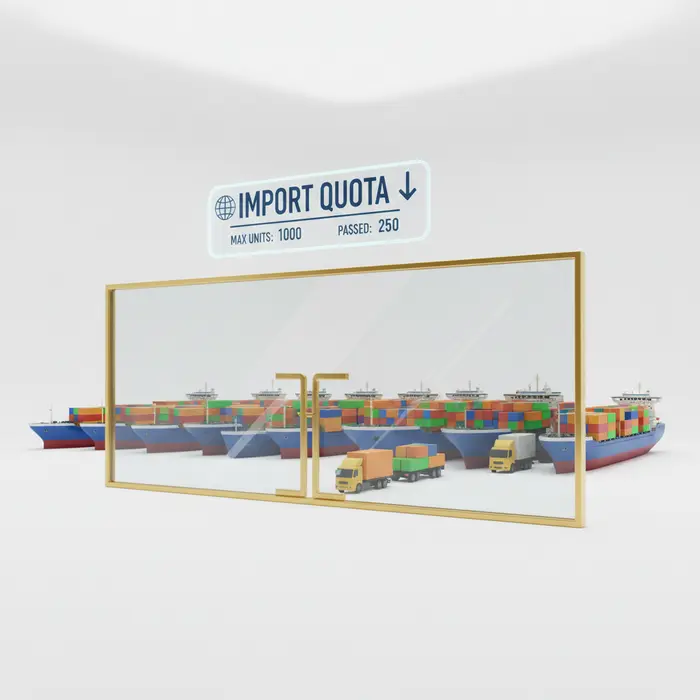
An import quota is a quantitative restriction on the amount of a specific good or service that can be imported into a country during a given period, typically a year. Unlike tariffs, which levy a tax on imported goods, an import quota directly limits the volume of goods, acting as a physical cap. For instance, a country might impose a quota allowing only 100,000 units of foreign-made cars to enter its market each year. Once this limit is reached, no further imports of that product are permitted until the next quota period begins.
The core purpose of an import quota is straightforward: to reduce the supply of foreign goods in the domestic market. By restricting the availability of imports, governments aim to protect domestic industries from intense foreign competition. This protection can manifest in various ways, such as fostering local production, preserving jobs within specific sectors, or allowing emerging industries to grow without being overwhelmed by established international players. This direct quota restriction in international trade directly impacts market dynamics by artificially limiting supply.
2. Historical Context of Trade Quotas
The concept of trade quotas is not new; it has been a feature of international trade policy for centuries, evolving in response to changing economic and political landscapes. Historically, nations have resorted to such measures during times of economic distress, war, or strategic shifts. Following major global conflicts, for example, many countries imposed strict import quotas to conserve foreign exchange reserves, rebuild war-torn domestic industries, and prioritize self-sufficiency. This period saw various types of trade quotas explained and implemented, ranging from global quotas (limiting total imports regardless of origin) to country-specific quotas (allocating specific amounts to particular trading partners).
In the post-World War II era, as global trade liberalization gained momentum through organizations like the General Agreement on Tariffs and Trade (GATT) and later the World Trade Organization (WTO), there was a concerted effort to reduce and eventually eliminate quantitative restrictions like import quotas, favoring tariffs instead due to their greater transparency and predictability. However, quotas still persist, often in sectors deemed sensitive (like agriculture or textiles) or in specific bilateral agreements, serving as a reminder of their enduring utility as a policy instrument.
3. Primary Goals of Implementing Import Quotas
Governments employ import quotas for a multitude of strategic economic and political reasons. One primary goal is to protect nascent or struggling domestic industries. By limiting the inflow of cheaper or higher-quality foreign goods, local producers gain a competitive advantage, allowing them to capture a larger share of the domestic market, increase production, and invest in growth without immediate overwhelming pressure. This can directly impact employment levels, securing jobs in targeted sectors.
Another significant objective is to improve the balance of payments. By reducing imports, a country can decrease the outflow of its currency, thereby strengthening its trade balance. This can be particularly crucial for nations facing persistent trade deficits or foreign exchange shortages. Additionally, quotas can be used for national security reasons, ensuring that critical industries (e.g., defense, essential food supplies) maintain a baseline production capacity domestically, rather than relying entirely on potentially unstable foreign sources.
Furthermore, import quotas can serve as a tool for retaliation in trade disputes, pressuring another country to change its trade policies. They can also be implemented to manage supply and demand for specific products, or to enforce international agreements on resource conservation or health and safety standards. The impact of import quotas on businesses varies significantly: domestic producers within protected sectors often benefit from increased sales and market share, while importers face restricted access to goods, potentially leading to higher domestic prices for consumers due to reduced competition and limited supply. Understanding the difference between trade quotas vs. tariffs is key here; while both restrict trade, quotas directly limit quantity, potentially leading to greater price inelasticity and higher profit margins for licensed importers, whereas tariffs primarily raise prices for consumers and generate government revenue.
Types of Import Quotas Explained in Detail
Import quotas are a fundamental tool in international trade policy, representing a non-tariff barrier used by governments to restrict the quantity of specific goods entering a country. Unlike tariffs, which impose a tax on imports, quotas directly limit the volume. Understanding the various types of trade quotas explained is crucial for businesses engaged in global commerce, as these restrictions can significantly alter market dynamics, supply chains, and pricing strategies. Governments employ import quotas for several reasons, including protecting domestic industries from foreign competition, managing balance of payments, or addressing national security concerns. The Import Quota Definition broadly refers to these quantitative limits, but their implementation can take different forms, each with distinct implications for international trade.
1. Absolute Quotas: Setting Hard Limits
An absolute quota, also known as a global quota, is the most straightforward and restrictive type of import quota. It sets a strict, fixed maximum quantity of a particular good that can be imported into a country during a specified period, typically a year. Once this predetermined limit is reached, no further imports of that good are permitted, regardless of demand or origin, until the next quota period begins. This mechanism provides unambiguous quota restrictions international trade, offering a high degree of protection to domestic industries.
The implementation of absolute quotas involves customs authorities closely monitoring import volumes. As shipments arrive, the quantities are deducted from the remaining quota. When the quota is exhausted, import licenses for that product cease to be issued, or incoming shipments are simply denied entry. The impact of import quotas on businesses under an absolute system is profound: it creates artificial scarcity, often leading to higher domestic prices for the restricted goods, benefiting local producers while potentially disadvantaging consumers and businesses reliant on imported components. For example, historically, the United States has used absolute quotas on certain agricultural products like sugar to support domestic sugar cane and beet farmers, ensuring a stable, higher price for locally produced sugar by limiting foreign competition.
2. Tariff-Rate Quotas (TRQs): Dual-Tiered Systems
Tariff-Rate Quotas (TRQs) represent a more nuanced approach compared to absolute quotas, blending elements of both tariffs and quotas. A TRQ establishes a two-tiered system for imports: a specific quantity of a product is allowed to enter at a lower, preferential tariff rate. However, any imports exceeding this initial quota volume are subject to a significantly higher, often prohibitive, tariff rate. This system provides a certain level of market access while still offering protection to domestic industries.
The mechanism of TRQs works by encouraging imports up to the quota limit with a lower duty, thereby satisfying a portion of domestic demand or providing raw materials at a competitive price. Once the ‘in-quota’ volume is filled, the ‘over-quota’ tariff kicks in, making further imports much more expensive and thus less attractive. This acts as a disincentive for excessive imports, effectively limiting the overall supply. TRQs are commonly found in agricultural trade, frequently negotiated under the World Trade Organization (WTO) agreements. For instance, many countries employ TRQs for products like dairy, beef, or cereals. The European Union, for example, utilizes TRQs for a variety of agricultural products, allowing a specific volume of goods from certain countries to enter at a reduced tariff, while imports beyond that volume face the full, higher tariff. This system aims to balance domestic supply and demand, protect local farmers, and maintain some level of international trade.
3. Voluntary Export Restraints (VERs): Self-Imposed Limits
Voluntary Export Restraints (VERs) are a unique category of trade quotas because, despite their name, they are rarely truly voluntary. A VER is an agreement between an importing country and an exporting country, where the exporting country “voluntarily” agrees to limit the quantity of its exports to the importing country. While seemingly self-imposed, these restraints are typically adopted under the implicit or explicit threat of more severe trade restrictions (like tariffs or absolute quotas) being imposed by the importing nation if the exporting country does not comply. This illustrates a key trade quotas vs tariffs difference in how pressure is exerted.
The mechanism of VERs allows the importing country to achieve its protectionist goals without formally violating international trade agreements that prohibit unilateral import quotas. For the exporting country, agreeing to a VER might be seen as the lesser of two evils, avoiding potentially harsher penalties and maintaining some market access, albeit restricted. The impact of import quotas on businesses and industries involved in VERs can be complex. In the exporting country, it can lead to domestic industries consolidating, upgrading product quality, or shifting production to higher-value goods to maximize revenue within the limited quota. A classic real-world example is the VERs imposed on Japanese automobile exports to the United States in the 1980s. Faced with calls for protectionism from American auto manufacturers, Japan agreed to limit its car exports. This led Japanese companies to focus on producing more luxurious and expensive models, improving quality, and eventually establishing manufacturing plants within the U.S. to circumvent the export limits, fundamentally reshaping the global automotive industry.
In conclusion, whether through absolute limits, dual-tiered tariff systems, or seemingly voluntary agreements, import quotas remain a powerful instrument in a nation’s trade policy toolkit. Each type offers distinct advantages and disadvantages, profoundly influencing global supply chains, international relations, and the competitive landscape for businesses worldwide.
Import Quotas vs. Tariffs: Understanding the Difference
In the intricate world of international trade, governments frequently employ various tools to manage the flow of goods across borders. Among the most common are import quotas and tariffs, both designed to restrict imports and protect domestic industries. While they share the overarching goal of limiting foreign competition, their mechanisms, economic effects, and implications for trade policy differ significantly. Clearly differentiating between these two forms of trade barriers is crucial for businesses, policymakers, and anyone seeking to understand the dynamics of global commerce.
A tariff, at its core, is a tax imposed by a government on imported goods or services. It functions as a surcharge, increasing the price of foreign products and making them less competitive compared to domestically produced alternatives. Tariffs can be specific (a fixed charge per unit, e.g., $2 per shirt) or ad valorem (a percentage of the value of the imported good, e.g., 10% of the car’s value). Their primary effect is to raise the cost for consumers and businesses importing goods, thereby reducing demand for those imports and encouraging the consumption of local products.
Conversely, an Import Quota Definition refers to a non-tariff barrier that places a direct quantitative limit on the amount of a specific good that can be imported into a country during a given period. Unlike tariffs, which operate through price, quotas impose a hard ceiling on volume. Once this pre-set limit is reached, no further imports of that particular product are permitted, regardless of demand or price. This direct control over quantity has distinct implications for markets and trade relations.
1. Mechanism of Restriction: Quantity vs. Price
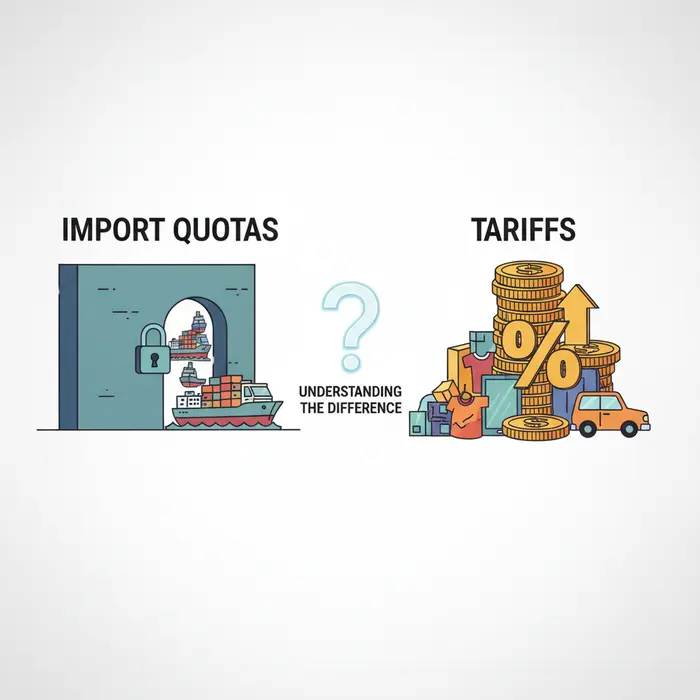
The fundamental distinction between import quotas and tariffs lies in how they restrict trade. Tariffs operate on a price mechanism: by making imports more expensive, they disincentivize purchases, thereby reducing the quantity demanded. The market still has the flexibility to import more if consumers or businesses are willing to pay the higher, tariff-inclusive price. This means that while tariffs increase costs, they do not necessarily impose a hard limit on the volume of trade.
An import quota, however, imposes a direct quantity restriction. It doesn’t primarily aim to raise the price of imports (though prices will inevitably rise due to scarcity); rather, it physically caps the number of units or the total value of goods allowed into the country. This makes it a more rigid form of protectionism. There are typically two main Types of trade quotas explained: absolute quotas, which are a strict limit, and tariff-rate quotas (TRQs), which allow a certain quantity to be imported at a lower tariff rate, with any imports beyond that quantity subject to a much higher (often prohibitive) tariff. This direct control over volume profoundly impacts market supply.
2. Revenue Generation for Governments
Another significant difference emerges in terms of government revenue. Tariffs are a direct source of income for the importing country’s government. The revenue collected from customs duties can be substantial, contributing to the national budget. This fiscal benefit often makes tariffs an attractive policy tool, especially for countries seeking to bolster their public funds.
Import quotas, on the other hand, do not directly generate revenue for the government. When a quota limits supply, the domestic price of the imported good typically rises above the world price. This difference in price, often referred to as “quota rent,” represents an additional profit. This rent usually accrues to the holders of the import licenses (who can purchase goods at the lower world price and sell them at the higher domestic price) or, in some cases, to the foreign exporters if they control the supply to the restricted market. This lack of direct government revenue can make quotas less appealing from a fiscal perspective and can foster rent-seeking behavior, lobbying, and even corruption as businesses compete for valuable import licenses.
3. Impact on Domestic Prices and Supply
Both tariffs and quotas aim to support domestic industries by reducing import competition, which typically leads to higher domestic prices and increased domestic production. However, their specific impacts differ. With a tariff, the price increase is usually limited to the amount of the tariff itself. While consumers face higher prices, the market mechanism still functions, allowing for a degree of price discovery and adjustment. The price increase is generally more predictable.
For import quotas, the impact on domestic prices can be more pronounced and less predictable. By artificially restricting supply, quotas can lead to significantly higher domestic prices, potentially creating a monopolistic or oligopolistic environment for domestic producers. The Impact of import quotas on businesses can be multifaceted: domestic producers benefit from reduced competition and higher prices, while downstream industries that rely on the imported good as an input may face increased costs, making them less competitive internationally. Furthermore, quotas remove the incentive for foreign producers to compete on price, as they are guaranteed a share of the limited market.
Understanding these Trade quotas vs tariffs difference extends beyond immediate market effects to broader implications for international trade policy. Tariffs, being more transparent, are often easier to negotiate within multilateral trade agreements and typically fall under the purview of organizations like the World Trade Organization (WTO). Quotas, due to their less transparent nature and potential for rent-seeking, are generally viewed as more distorting to trade and are often discouraged or subject to strict conditions under international trade rules. The choice between a quota and a tariff often depends on specific policy objectives, the desired degree of market intervention, and the willingness to accept the associated economic consequences and political complexities of quota restrictions international trade.
In conclusion, while both import quotas and tariffs serve as protective trade barriers, they employ distinct mechanisms to achieve their goals. Tariffs work through price, generating government revenue and offering some market flexibility. Quotas, conversely, impose direct quantity limits, do not generate direct government revenue, and can lead to more significant price volatility and less transparent market distortions. Grasping these fundamental differences is essential for comprehending the dynamics of global commerce and for formulating effective trade strategies.
Impact of Import Quotas on Businesses and Economy
An Import Quota Definition refers to a government-imposed limit on the quantity of a specific good that can be imported into a country during a given period. Unlike tariffs, which are taxes on imports, quotas directly restrict volume. These restrictions are often implemented to protect domestic industries, manage balance of payments, or for national security reasons. However, their wide-ranging effects reverberate across various stakeholders, significantly impacting domestic producers, importers, exporters, and consumers, while also shaping broader economic landscapes. Understanding these dynamics is crucial for businesses navigating global trade and policymakers crafting economic strategies.
1. For Domestic Producers: Benefits and Drawbacks
Import quotas are primarily designed to shield domestic industries from foreign competition. By limiting the influx of cheaper or more abundant foreign goods, domestic producers often experience several benefits. They gain an increased share of the domestic market, which can lead to higher sales volumes, greater production capacity utilization, and potentially higher profits. This protection can foster job creation within the protected sector and allow infant industries to develop without being overwhelmed by established international competitors. Furthermore, reduced competition can enable domestic firms to charge higher prices, as the supply of competing imported goods is artificially constrained.
However, these benefits come with significant drawbacks. The lack of foreign competition can lead to complacency among domestic producers, reducing their incentive to innovate, improve efficiency, or enhance product quality. Over time, this can result in less competitive domestic industries that struggle to thrive without protection, making them vulnerable if quotas are eventually removed. Consumers might also face limited choices and higher prices, further reducing the overall market’s dynamism.
2. For Importers and Exporters: Supply Chain and Costs
For importers, import quotas present substantial challenges. The direct limitation on quantity means they can only source a restricted amount of goods, leading to potential supply shortages. This scarcity often drives up the cost of available import licenses or the price of the goods themselves in the global market, known as “quota rents,” which importers must bear. These increased costs can erode profit margins, force importers to seek alternative, potentially less efficient, suppliers, or even exit the market. Managing complex administrative procedures and securing quota allocations adds another layer of operational burden and uncertainty to their supply chains.
Exporters in the quota-imposing country also face indirect consequences. Other nations, facing their exports being restricted, may retaliate by imposing their own quota restrictions on international trade against the first country’s exports. This can significantly reduce market access for domestic exporters, dampening their sales, profitability, and growth potential in international markets. The overall global supply chain becomes more fragmented and less efficient, increasing logistical complexities and costs for all involved parties.
3. For Consumers: Prices and Product Availability
Consumers are often the ultimate bearers of the costs associated with import quotas. By restricting the supply of imported goods, quotas directly reduce competition in the domestic market. This typically leads to higher prices for both the imported goods that are available and the domestically produced alternatives, as local producers face less pressure to keep their prices low. Consumers are left with fewer choices, less variety, and potentially lower-quality products, especially if domestic industries become less innovative due to protection.
The impact extends beyond just price; product availability is also curtailed. Specific brands or types of goods may become scarce or entirely unavailable, forcing consumers to settle for substitutes that may not fully meet their preferences or needs. Over time, this reduction in consumer welfare can lead to a lower standard of living, as households pay more for essential goods and have access to a narrower range of options. In essence, while quotas aim to protect specific industries, they often do so at the expense of the broader consumer base and overall economic efficiency.
Navigating Quota Restrictions in International Trade
In an increasingly interconnected global economy, businesses frequently encounter various barriers to international trade. Among the most challenging are import quota restrictions, which impose quantitative limits on the volume or value of specific goods that can be imported into a country. Understanding the Import Quota Definition is crucial. Unlike tariffs, which tax imports, quotas directly control quantity, serving as a powerful tool for governments to protect domestic industries or manage balance of payments. The Impact of import quotas on businesses can range from increased sourcing costs and reduced market access to the need for complete strategic re-evaluation. This section offers practical insights into how businesses can adapt to, comply with, and strategically manage these complex challenges.

1. Compliance and Documentation Requirements
Successfully navigating import quotas begins with a meticulous understanding of the regulatory landscape of each target market. Governments implement quotas through various mechanisms, requiring specific compliance and extensive documentation. Businesses must first identify the Types of trade quotas explained by the importing country, typically absolute quotas or tariff-rate quotas (TRQs). Absolute quotas set a strict ceiling on the quantity of goods allowed to enter, often ceasing imports once the limit is reached. TRQs permit a certain quantity of goods at a lower tariff, with any imports exceeding that quantity subject to a higher rate. Compliance often necessitates obtaining specific import licenses, permits, or certificates of origin well in advance of shipments. These documents prove that goods meet national standards and qualify for quota allocations. Failure to adhere to these stringent requirements can result in significant penalties, including fines, confiscation of goods, and legal action. This underscores the importance of accurate documentation, timely submissions, and staying abreast of dynamic regulatory changes. Leveraging local customs brokers and trade consultants can be invaluable in ensuring seamless compliance and avoiding costly errors.
2. Strategic Responses for Businesses (Diversification, Local Sourcing)
When faced with import quota restrictions, businesses must adopt proactive and flexible strategies to maintain competitiveness and market presence. One primary strategy is **diversification**. This involves expanding supply chains to multiple countries, reducing reliance on single sources heavily affected by quotas. By sourcing components or finished goods from various origins, businesses can mitigate disruption risks from quota limitations. Similarly, diversifying sales markets to regions with fewer or no quota restrictions can open new avenues for growth. Another powerful response is **local sourcing** or establishing in-country production facilities. By manufacturing goods within the target market, businesses can bypass import quotas, benefiting from local labor and resources, and often gaining preferential market access. This strategy not only ensures supply continuity but can also strengthen local relationships and offer a competitive edge. Businesses might also explore forming strategic alliances or joint ventures with local partners, leveraging their quota allocations or domestic production capabilities. Understanding the Trade quotas vs tariffs difference is key; while tariffs allow imports at a higher cost, quotas impose an absolute limit, necessitating more fundamental changes in sourcing or production.
3. Role of International Trade Agreements (e.g., WTO)
International trade agreements play a pivotal role in shaping the global landscape of import quotas. Organizations like the World Trade Organization (WTO) strive to reduce non-tariff barriers, including quantitative restrictions, through multilateral negotiations and dispute settlement mechanisms. The WTO’s agreements, such as the General Agreement on Tariffs and Trade (GATT), generally prohibit quantitative restrictions but allow for exceptions under specific circumstances, like balance of payments difficulties or national security. Beyond multilateral frameworks, numerous regional and bilateral Free Trade Agreements (FTAs) exist, often providing preferential treatment and sometimes eliminating quotas between signatory countries. For businesses, closely monitoring and understanding these agreements is paramount. Membership in an FTA can provide significant advantages, such as guaranteed market access, reduced or waived quotas, and streamlined customs procedures. Businesses should proactively identify which agreements apply to their specific trade routes and products, leveraging them to minimize trade barriers. Engaging with industry associations and governmental bodies can also help advocate for more favorable trade policies and influence future agreement negotiations, thereby fostering a more predictable and open international trade environment.
Successfully navigating Quota restrictions international trade demands diligent compliance, strategic adaptability, and an informed understanding of global trade policy. By proactively managing documentation, diversifying supply chains, considering local sourcing, and leveraging international trade agreements, businesses can mitigate risks and transform these challenges into opportunities for growth and resilience in a dynamic global marketplace.
Partner with Vietnam’s Leading Suppliers
Looking for reliable suppliers in Vietnam? Contact VietnamSuppliers.com today to connect with verified manufacturers and exporters across all industries.
—————————————
References
– WTO: Quantitative Restrictions (Import Quotas): https://www.wto.org/english/thewto_e/whatis_e/tif_e/agrm7_e.htm
– :
– WTO Agreements on Goods: https://www.wto.org/english/thewto_e/whatis_e/tif_e/agrm1_e.htm
– General Agreement on Tariffs and Trade (GATT) Article XI on Elimination of Quantitative Restrictions – WTO: https://www.wto.org/english/docs_e/legal_e/a-xvii_e.pdf
– WTO Non-Tariff Barriers: https://www.wto.org/english/thewto_e/what_e/tif_e/agrm3_e.htm