The Core Benefits of RTAs for Global Exporters
In an increasingly interconnected global economy, regional trade agreements (RTAs) have emerged as pivotal instruments shaping international commerce. These agreements, which include Free Trade Agreements (FTAs), customs unions, and common markets, aim to reduce trade barriers among member countries. For businesses engaged in international trade, particularly global exporters, RTAs offer a multitude of strategic advantages that can significantly enhance their reach, efficiency, and profitability. Understanding the fundamental advantages of these agreements is crucial for navigating the complexities of global markets and capitalizing on new opportunities.
1. Enhanced Market Access & Competitiveness
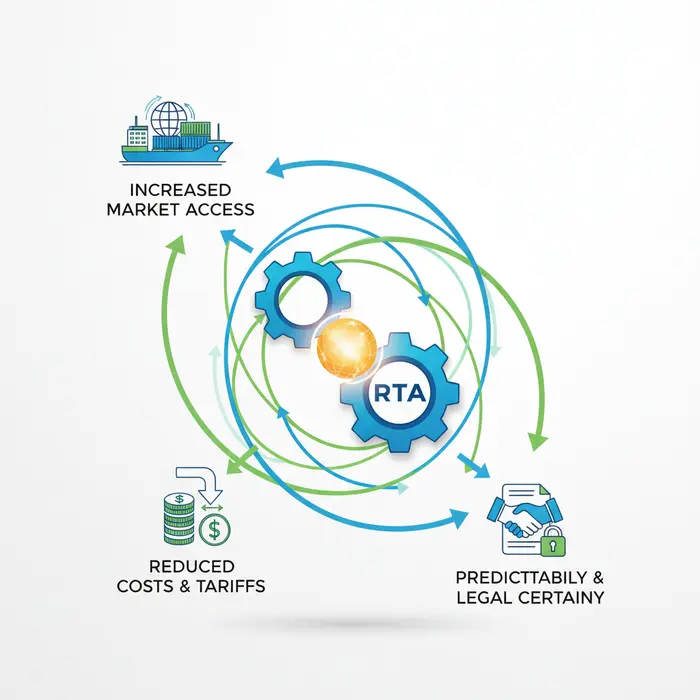
One of the primary benefits that RTAs confer upon global exporters is significantly enhanced market access. By systematically removing or reducing tariffs, quotas, and other non-tariff barriers between signatory nations, RTAs effectively open up new territories for businesses. This preferential treatment means that goods from member countries face fewer restrictions and lower costs when entering another member’s market, making them more attractive to buyers. For instance, countries like Vietnam, actively participating in numerous Vietnam trade agreements and export opportunities, have seen their products gain competitive edges in large markets through agreements like the CPTPP and EVFTA. This not only expands the potential customer base but also allows exporters to compete more effectively against local producers and non-RTA member countries, thereby strengthening their market share and overall competitiveness.
2. Reduced Trade Barriers & Costs
Beyond market access, RTAs are instrumental in implementing tariff reduction strategies through RTAs, leading to direct cost savings for exporters. Tariffs, which are essentially taxes on imported goods, can significantly inflate product prices and reduce profit margins. Through RTAs, these tariffs are either eliminated or substantially lowered, making exports more affordable and competitive. However, the benefits extend beyond just tariffs. Many RTAs also address non-tariff barriers, which can be equally burdensome. These include streamlining customs procedures, harmonizing technical standards, reducing bureaucratic red tape, and facilitating mutual recognition of certifications. Such measures simplify the export process, reduce delays, and lower administrative costs. The cumulative impact of FTAs on B2B trade is profound, as businesses can plan with greater certainty, benefiting from predictable trade rules and reduced operational expenses, which ultimately enhances their bottom line.
3. Fostering Regional Supply Chains
RTAs play a critical role in promoting economic integration and fostering the development of robust regional supply chains. As trade barriers diminish, businesses are incentivized to optimize their production and sourcing strategies across member countries. This often involves establishing intricate networks where different stages of production occur in various RTA partner nations, leveraging each country’s comparative advantages. A crucial aspect of this integration is understanding rules of origin in trade agreements. These rules specify which goods qualify for preferential treatment under an RTA, ensuring that only products substantially processed within the RTA bloc receive the benefits. This incentivizes companies to source components and raw materials from within the region, further strengthening intra-regional trade and investment. The result is more resilient, efficient, and cost-effective supply chains, reducing reliance on distant and potentially volatile global sources. This not only enhances logistical efficiency and reduces lead times but also fosters greater collaboration and economic interdependence among RTA members, creating a more stable and predictable environment for exporters.
Leveraging Tariff Reductions: A Key RTA Strategy
Regional Trade Agreements (RTAs) have reshaped the landscape of global commerce, offering a myriad of advantages for businesses looking to expand internationally. Among the most potent of these advantages is the strategic utilization of tariff reductions. For exporters, understanding and capitalizing on these reductions is not merely a bureaucratic exercise; it’s a critical strategy that directly impacts profitability, enhances competitiveness, and opens new market opportunities. By lowering or eliminating the taxes levied on imported goods, RTAs effectively reduce the cost of doing business across borders, providing a tangible edge in the marketplace. This section will delve into how exporters can strategically harness these tariff benefits to secure a more robust and profitable position in international trade.
1. Direct Cost Savings and Pricing Advantage
This section explores how the direct reduction or elimination of tariffs translates into lower landed costs for importers, which can be leveraged by exporters to achieve significant financial benefits and gain a competitive edge. Tariffs are essentially taxes imposed by a country on imported goods, acting as a significant cost component that directly inflates the final price of products for consumers or businesses in the importing market. Within the framework of RTAs, member countries agree to reduce or entirely eliminate these duties on goods originating from fellow member states. For exporters, this translates into immediate and substantial cost savings for their international buyers. For example, in Benefits of Regional Trade Agreements for Exporters, companies can see their products become significantly more affordable in partner countries. These savings offer exporters a dual advantage: they can either maintain their current pricing structure and enjoy higher profit margins on each sale, or strategically lower their prices to become more competitive, capture greater market share, and potentially outcompete exporters from non-RTA countries. This direct impact of FTAs on B2B trade fosters stronger partnerships and drives increased demand for goods qualifying under preferential tariff schemes.
2. Understanding Preferential Tariffs
This section focuses on the concept of preferential tariffs and how they differ from Most Favored Nation (MFN) tariffs, emphasizing the critical role of rules of origin in accessing these benefits. Preferential tariffs are reduced or zero duty rates applied by one country to products imported from a specific group of countries, typically those with which it has an RTA. These rates are significantly lower than the standard Most Favored Nation (MFN) tariffs, which are the normal non-discriminatory tariffs applied to imports from all World Trade Organization (WTO) members not covered by a preferential agreement. To qualify for these advantageous preferential rates, goods must adhere strictly to the “Rules of Origin” (RoO) specified within the respective trade agreement. These rules are crucial for determining where a product truly originates, preventing goods from non-member countries from simply being transshipped through an RTA member state to unfairly gain tariff benefits. For instance, companies eyeing Vietnam trade agreements and export opportunities must meticulously understand these rules, as compliance is the gateway to unlocking lower duties. Mastering the nuances of Understanding rules of origin in trade agreements is therefore paramount, as even minor deviations can result in goods being subjected to higher MFN tariffs, negating the RTA’s intended benefits.
3. Navigating Duty-Free Access
This section delves into the practicalities of achieving and utilizing duty-free access, highlighting the essential procedural aspects and strategic considerations for exporters. Duty-free access, a cornerstone of many RTAs, signifies a 0% tariff rate on eligible goods, representing the ultimate goal of tariff reduction. Achieving this, however, is contingent upon rigorous adherence to the agreement’s Rules of Origin (RoO). Exporters must be able to prove that their products meet the specific criteria, which can include being “wholly obtained” (e.g., agricultural products grown in the country) or undergoing “sufficient processing” within the RTA member country. This often involves specific value-added thresholds or changes in tariff classification. The primary documentation required to claim preferential treatment, including duty-free access, is the Certificate of Origin (COO). Without a properly completed and valid COO, goods will typically be subjected to the higher MFN tariffs. Therefore, effective Tariff reduction strategies through RTAs necessitate proactive planning, meticulous record-keeping, and often, collaboration with customs brokers or trade experts. Staying informed about the latest amendments to trade agreements and consistently reviewing production processes for RoO compliance are critical steps to continuously secure and navigate duty-free access, maximizing the competitive advantages offered by RTAs.
Mastering Rules of Origin for Compliance & Savings
In the complex landscape of global trade, Rules of Origin (ROO) are fundamental for businesses leveraging Regional Trade Agreements (RTAs) and Free Trade Agreements (FTAs). Understanding and complying with these rules is a strategic imperative for significant cost savings, enhanced market competitiveness, and seamless market access. For exporters navigating international markets, especially those eyeing Vietnam trade agreements and export opportunities, a firm grasp of ROO is essential. It enables them to effectively claim preferential tariff treatment, reducing import duties and boosting their bottom line. Without this expertise, companies risk missing out on substantial Benefits of Regional Trade Agreements for Exporters and facing penalties or customs delays. This section details the critical aspects of ROO, empowering exporters to navigate these regulations with confidence.

1. Why Rules of Origin Matter for Exporters
Rules of Origin are paramount for exporters primarily due to their direct impact on tariff reduction strategies through RTAs. FTAs and RTAs aim to lower or eliminate customs duties between member countries, but this preferential treatment is contingent upon goods originating from one of the signatory nations. Without proving origin, goods incur higher Most Favoured Nation (MFN) tariffs, eroding profit margins and competitive advantage. For B2B trade, the impact of FTAs on B2B trade through ROO compliance can be transformative, enabling competitive pricing. Accurate origin determination is also crucial for regulatory compliance in destination markets. Misrepresenting origin can lead to severe penalties, including fines, confiscation, and loss of future import privileges. Therefore, mastering ROO is not just about saving money; it’s about securing market access, mitigating risks, and building a reputation as a reliable trading partner. It unlocks the true Benefits of Regional Trade Agreements for Exporters, fostering sustained growth in international markets.
2. Types of Origin Criteria (e.g., Wholly Obtained, Change in Tariff Heading)
Understanding rules of origin in trade agreements necessitates familiarity with various origin criteria, which differ significantly across agreements. Common criteria include:
- Wholly Obtained (WO): Applicable to products entirely grown, harvested, extracted, or manufactured from such materials in a single country. For example, fresh produce cultivated and processed solely in Vietnam.
- Change in Tariff Heading (CTH) / Change in Tariff Classification (CTC): Widely used for manufactured goods with multi-country inputs. This rule requires non-originating materials to undergo sufficient transformation, resulting in the final product having a different Harmonized System (HS) tariff heading (or sub-heading/chapter) than its constituent parts. For instance, imported plastic (HS 39) transformed into plastic toys (HS 95) within an RTA member country might meet CTH.
- Value-Added Criteria (VAC) / Regional Value Content (RVC): Requires a specified percentage of the product’s value to originate within the RTA territory. This can be calculated using ‘build-up’ (originating materials + production costs) or ‘build-down’ (total value – non-originating materials) methods. An RTA might mandate 40% RVC for preferential treatment.
- Specific Process Rules: These mandate that certain manufacturing or processing operations occur within the member country for origin status. Common in sectors like textiles.
Navigating these criteria demands detailed knowledge of product composition, manufacturing processes, and the specific RTA provisions. Meticulous record-keeping is vital for proving compliance, especially for businesses with global supply chains.
3. Documentation and Verification Processes
Successful preferential tariff claims rely on robust documentation and a clear understanding of verification. Exporters must substantiate origin claims to customs authorities for export and potential post-importation audits. Key elements include:
- Certificates of Origin (CO) and Declarations: Official documents attesting to goods’ originating status. COs can be issued by authorized third parties (e.g., chambers of commerce) or through self-certification by the exporter/producer, as seen in agreements like CPTPP. For smaller shipments, a declaration on the commercial invoice may suffice. Both methods place the onus on the exporter to ensure accuracy.
- Record Keeping: Comprehensive documentation, including bills of material, invoices for all components, production records, and cost data, must be maintained. These records are crucial for supporting origin claims and should be kept for the period specified by the RTA (typically 3-5 years).
- Verification: Importing country customs authorities can request proof of origin and conduct verification checks, from desk audits to on-site visits. Non-compliance, false declarations, or insufficient documentation can lead to denial of preferential tariffs, requiring the importer to pay full MFN duty, plus potential fines. This highlights why a proactive approach to understanding rules of origin in trade agreements and internal compliance is vital for any business benefiting from Regional Trade Agreements and fostering a positive impact of FTAs on B2B trade.
Mastering Rules of Origin is an ongoing commitment requiring continuous education and adaptation. For businesses, especially those exploring Vietnam trade agreements and export opportunities, investing in this expertise is a strategic move that yields compliance, competitive advantage, and profitability.
The Transformative Impact of FTAs on B2B Trade
Free Trade Agreements (FTAs), as a specific form of Regional Trade Agreement (RTA), have fundamentally reshaped the global landscape for business-to-business (B2B) transactions. Far from merely tweaking tariffs, these comprehensive accords penetrate deeply into the operational fabric of international commerce, fostering new partnerships and efficiencies. The Benefits of Regional Trade Agreements for Exporters are profound, directly enhancing their ability to compete, innovate, and expand. This section examines the extensive impact of FTAs on B2B trade, highlighting how they dismantle barriers, optimize supply chains, and create fertile ground for deeper economic collaboration.
Streamlining Cross-Border B2B Operations
One of the most immediate and tangible effects of FTAs on B2B trade is the significant streamlining of cross-border operations. By systematically reducing or eliminating tariffs on a vast array of goods, FTAs directly lower the cost of importing and exporting intermediate goods, raw materials, and finished products. This not only reduces direct financial outlays for businesses but also simplifies pricing structures and improves predictability. Beyond tariffs, many FTAs include provisions for customs modernization, harmonized standards, and mutual recognition of conformity assessments. These measures translate into faster customs clearance, reduced administrative burdens, and fewer delays at borders, which are critical for just-in-time supply chains. Businesses can therefore deploy more effective tariff reduction strategies through RTAs, leading to greater cost savings and improved competitiveness in international markets. This enhanced operational efficiency allows B2B partners to engage in more frequent and reliable trade, fostering trust and long-term relationships.
Increased Supply Chain Resilience and Flexibility
FTAs play a crucial role in enhancing the resilience and flexibility of global supply chains, a paramount concern for B2B enterprises in an increasingly volatile world. By providing preferential access to a wider range of markets, FTAs encourage companies to diversify their sourcing and sales channels, reducing over-reliance on any single country or region. This diversification acts as a natural hedge against geopolitical risks, natural disasters, or unexpected disruptions. Furthermore, the stable regulatory environment fostered by FTAs promotes investment in logistics infrastructure and encourages the development of more sophisticated distribution networks across member countries. For example, Vietnam trade agreements and export opportunities have enabled businesses to establish robust supply links with diverse partners, leveraging preferential access to markets in North America, Europe, and Asia. This ability to pivot and adapt rapidly to changing market conditions is invaluable, allowing B2B companies to maintain continuity of supply and demand even in challenging circumstances.
Opportunities for Value Chain Integration and Collaboration
Beyond transactional trade, FTAs serve as powerful catalysts for deeper value chain integration and collaboration among B2B partners. The certainty provided by long-term preferential access encourages companies to invest in specialized production facilities, joint ventures, and strategic alliances across borders. This leads to the creation of more complex, interconnected value chains where different stages of production, research and development, and even marketing are spread across multiple countries within the FTA zone. A critical aspect for businesses leveraging these opportunities is understanding rules of origin in trade agreements. These rules dictate which goods qualify for preferential treatment, encouraging firms to source materials or perform manufacturing processes within the free trade area, thereby strengthening regional economic ties. For instance, an automotive manufacturer might source components from one FTA partner, assemble them in another, and export the finished product to a third, all while benefiting from reduced tariffs and streamlined processes. This level of integration not only optimizes efficiency and cost but also fosters innovation through shared expertise and resources, ultimately leading to superior products and services for end-users and enhanced B2B partnerships.
Vietnam’s RTAs: A Gateway to Export Growth Opportunities
Vietnam’s strategic integration into the global economy through an extensive network of Regional Trade Agreements (RTAs) presents unparalleled opportunities for businesses seeking to expand their export footprint. These agreements are not merely diplomatic accords; they are practical tools that provide tangible benefits, acting as a powerful gateway to export growth and strategic market expansion. For exporters worldwide, understanding and leveraging Vietnam’s RTAs can translate into significant competitive advantages, reduced costs, and access to new consumer bases.
The impact of FTAs on B2B trade has been transformative, fostering an environment where businesses can optimize supply chains, reduce tariff burdens, and navigate international commerce with greater predictability. Vietnam’s proactive approach to signing and implementing these agreements underscores its commitment to becoming a global manufacturing and export hub, making it an attractive partner for international businesses.

1. Key Trade Agreements Involving Vietnam (e.g., EVFTA, CPTPP)
Vietnam is a signatory to numerous pivotal RTAs, each opening distinct avenues for export growth. Among the most impactful are the EU-Vietnam Free Trade Agreement (EVFTA) and the Comprehensive and Progressive Agreement for Trans-Pacific Partnership (CPTPP). The EVFTA, in particular, has eliminated close to 99% of all tariffs between Vietnam and the EU, creating immense opportunities for Vietnamese exporters into one of the world’s largest consumer markets, and similarly, for EU businesses seeking to import from Vietnam. This agreement has significantly bolstered Vietnam trade agreements and export opportunities, especially in sectors like textiles, footwear, and agricultural products.
The CPTPP, on the other hand, connects Vietnam with a bloc of 11 Pacific Rim countries, including major economies like Canada, Australia, Japan, and Mexico. This agreement not only facilitates tariff reduction strategies through RTAs but also streamlines non-tariff barriers, enhancing regional supply chain integration. Beyond these two giants, Vietnam is also a key member of the ASEAN Free Trade Area (AFTA) and the Regional Comprehensive Economic Partnership (RCEP), further solidifying its position as a central node in Asia’s trading landscape. Understanding rules of origin in trade agreements is crucial here, as compliance is key to unlocking preferential tariff treatment across these diverse agreements.
2. Sector-Specific Export Advantages and Growth Areas
The benefits of Vietnam’s RTAs are not uniformly distributed but offer specific advantages to various sectors. For instance, the EVFTA has been a game-changer for Vietnam’s textile and garment industry, granting preferential access to the demanding European market. Similarly, the electronics sector, driven by major foreign direct investments, benefits from reduced tariffs on components and finished goods under agreements like the CPTPP and RCEP, enhancing its competitiveness in global value chains. Agricultural and aquaculture products, such as coffee, rice, shrimp, and tropical fruits, also enjoy enhanced market access, particularly in EU and CPTPP member countries, albeit with stringent requirements on quality and sustainability.
Beyond traditional manufacturing and agriculture, emerging sectors like renewable energy components, IT services, and high-tech manufacturing are increasingly finding growth opportunities. As Vietnam continues to climb the value chain, its RTAs provide the legal framework for businesses to invest in and export higher-value products and services, fostering economic diversification and resilience.
3. Strategic Considerations for Exporters Targeting Vietnam
For businesses looking to capitalize on Vietnam’s RTA network, several strategic considerations are paramount. Firstly, comprehensive market research is essential to identify specific product-market fits and understand consumer preferences within target RTA partner countries. Secondly, a deep dive into the rules of origin (RoO) for each relevant RTA is non-negotiable. RoO dictates whether a product qualifies for preferential tariffs, and misinterpretation can lead to significant penalties or loss of benefits. Businesses must ensure their supply chains and manufacturing processes meet these specific criteria.
Furthermore, engaging with local partners and understanding Vietnam’s business culture can smooth market entry and operational challenges. Leveraging digital platforms and trade facilitation services offered by various chambers of commerce and government agencies can also provide invaluable support. Ultimately, strategic planning, meticulous compliance, and a forward-looking approach to supply chain management are critical for exporters to fully harness the immense export growth opportunities presented by Vietnam’s extensive and ever-expanding network of Regional Trade Agreements.
Partner with Vietnam’s Leading Suppliers
Looking for reliable suppliers in Vietnam? Contact VietnamSuppliers.com today to connect with verified manufacturers and exporters across all industries.
—————————————
References
– WTO Regional Trade Agreements: https://www.wto.org/english/tratop_e/region_e/rta_intro_e.htm
– WTO – Rules of Origin: https://www.wto.org/english/tratop_e/roi_e/roi_e.htm
– Rules of Origin (ROO): https://www.wto.org/english/docs_e/legal_e/24-roo.pdf
– impact of FTAs on B2B trade: https://www.wto.org/english/tratop_e/region_e/region_e.htm
– World Trade Organization (WTO) – Regional Trade Agreements: https://www.wto.org/english/tratop_e/region_e/rta_e.htm