
Introduction to Preferential Trade Agreements
In an increasingly interconnected global economy, nations continually seek mechanisms to foster economic growth, enhance trade relations, and integrate into international markets. Among these mechanisms, Preferential Trade Agreements (PTAs) stand out as a foundational element, shaping the landscape of global commerce. These agreements represent a commitment by participating countries to lower trade barriers among themselves, thereby granting preferential access to their respective markets. Understanding the intricate nature of PTAs—their definition, underlying purpose, and historical evolution—is crucial for businesses, policymakers, and consumers navigating the complexities of international trade.
This section will delve into the core aspects of Preferential Trade Agreements, laying a robust foundation for appreciating their significance. We will explore what constitutes a PTA, examine the strategic goals that drive their formation, and trace their historical development from nascent forms of cooperation to the sophisticated trade blocs we observe today. By understanding these fundamentals, one can better grasp the dynamics of trade liberalization and its profound impact on economic development and international relations.
1. What is a Preferential Trade Agreement Definition?
A preferential trade agreement definition refers to a pact between two or more countries that grant special trading privileges to each other, typically through the reduction or elimination of tariffs and non-tariff barriers on certain goods and services. Unlike unilateral preferences, which are granted by one country to another without reciprocity, PTAs are inherently reciprocal arrangements. They are a step towards deeper economic integration, often seen as building blocks towards free trade areas, customs unions, common markets, or even economic unions.
The core mechanism of a PTA involves members agreeing to lower customs duties reduction for products originating from within the agreement area, compared to the duties applied to goods from non-member countries. This preferential treatment makes goods from member countries more competitive. A critical component of any PTA is its rules of origin requirements. These rules are indispensable for determining which goods qualify for preferential treatment, preventing products from non-member countries from simply being re-routed through a member country to avoid higher tariffs. Without strict rules of origin, the preferential benefits could be undermined, leading to trade deflection and unfair competition.
While often used interchangeably by some, it’s important to distinguish a PTA from a Free Trade Agreement (FTA). An FTA is a specific type of PTA where all tariffs and quotas between member countries are eliminated, but each member maintains its own external tariffs against non-members. A PTA can be broader, encompassing various levels of preference, and might not necessarily involve complete tariff elimination. Thus, an FTA is a more ambitious form of PTA, but not all PTAs are FTAs.
2. Goals and Objectives of PTAs
The establishment of Preferential Trade Agreements is driven by a multifaceted array of economic, political, and strategic objectives. Primarily, the overarching goal is to stimulate economic growth and enhance trade flows among member countries. By reducing trade barriers, PTAs aim to increase trade volume, foster specialization according to comparative advantage, and encourage cross-border investment.
Key preferential trade agreement benefits include:
- Market Access Expansion: For businesses, PTAs open up new export markets with reduced entry costs, allowing them to scale operations and achieve economies of scale.
- Increased Competitiveness: Lower tariffs on imported inputs can reduce production costs for domestic industries, making their final products more competitive both domestically and internationally.
- Investment Promotion: Stable and predictable trade environments fostered by PTAs often attract foreign direct investment (FDI), as investors gain confidence in long-term market access and policy stability within the bloc.
- Enhanced Economic Cooperation: Beyond trade, PTAs can facilitate cooperation in areas such as intellectual property rights, labor standards, environmental protection, and regulatory harmonization, leading to deeper integration.
- Political Stability and Influence: On a geopolitical level, PTAs can strengthen diplomatic ties between member states, fostering regional stability and enhancing their collective bargaining power in multilateral trade negotiations.
Furthermore, PTAs can serve as a testing ground for more ambitious liberalization efforts, providing a framework for countries to gradually adapt to increased competition and integrate into the global trading system at their own pace.
3. Historical Context and Evolution of Trade Blocs
The concept of preferential trade is not new; its roots can be traced back to historical arrangements that sought to secure market access or strategic alliances. However, the modern era of PTAs gained significant momentum post-World War II, alongside the establishment of multilateral trading systems like the General Agreement on Tariffs and Trade (GATT), now the World Trade Organization (WTO). While the WTO champions non-discriminatory trade (Most Favored Nation principle), it also includes provisions (Article XXIV for goods, GATS Article V for services) that permit the formation of PTAs under specific conditions, acknowledging their potential to liberalize trade more rapidly among groups of countries.
Initially, regional trade agreements were often formed among geographically proximate countries (e.g., the European Economic Community, NAFTA). The late 20th and early 21st centuries, however, witnessed a proliferation of PTAs, not just regional ones but also inter-continental and bilateral agreements. This phenomenon, often referred to as the "spaghetti bowl" effect, highlights the complexity arising from numerous overlapping agreements with varying rules of origin requirements and preferential tariffs. This evolution reflects countries’ growing recognition of the strategic importance of securing market access and diversifying trade partners beyond the slower pace of multilateral negotiations. The shift from simple tariff reductions to comprehensive agreements covering services, investment, intellectual property, and even environmental and labor standards signifies the deepening ambition and scope of modern PTAs, transforming them into powerful instruments of economic policy and international cooperation.
Key Benefits and Advantages of PTAs
Preferential Trade Agreements (PTAs) represent a fundamental aspect of modern international commerce, shaping economic relationships between nations. At their core, PTAs are designed to foster closer economic ties by reducing or eliminating trade barriers on specific goods and services between signatory countries. Understanding the preferential trade agreement definition reveals their strategic importance in promoting economic integration and reciprocal economic gain. These agreements offer a multitude of preferential trade agreement benefits, ranging from direct cost savings for businesses to broader national economic upliftment and increased global competitiveness, making them a crucial tool for countries seeking to enhance their standing in the international marketplace and foster sustainable growth.
Unlike more comprehensive Free Trade Agreements (FTAs), which often cover a broader scope including services, investment, and intellectual property, PTAs typically focus on specific tariff reductions for a defined set of products. While FTAs aim for deeper integration across various sectors, PTAs serve as a valuable initial step or a tailored solution for countries wishing to liberalize trade in particular areas. This targeted approach allows nations to gain significant advantages without necessarily committing to the full breadth of trade liberalization seen in FTAs, offering flexibility while still delivering substantial economic incentives. The following sections detail the primary advantages that countries and businesses can derive from participating in PTAs, underscoring their profound impact on global trade dynamics.
Customs Duties Reduction and Elimination
One of the most immediate and tangible preferential trade agreement benefits is the substantial customs duties reduction or outright elimination on eligible goods traded between member countries. For businesses engaged in import and export, this translates directly into significantly lower operational costs and increased profitability. When tariffs are lowered or removed, the final price of imported raw materials, components, or finished goods decreases, benefiting domestic industries with more affordable inputs and consumers with more competitive product prices. To qualify for these reduced tariffs, goods must typically meet specific rules of origin requirements, which rigorously dictate the criteria for determining a product’s national source or the percentage of its value added within the member states. These rules are vital to prevent non-member countries from merely transshipping goods through a member country to improperly claim tariff preferences, thereby ensuring that the economic advantages genuinely accrue solely to the signatory nations. This direct financial advantage can significantly boost bilateral trade volumes, encouraging greater cross-border commerce and fostering a more integrated regional or bilateral economy.
Enhanced Market Access and Export Opportunities
PTAs significantly enhance market access for member countries, creating new and expanded export opportunities for businesses across various sectors. By reducing trade barriers, domestic industries gain easier, often preferential, entry into partner markets, allowing them to diversify their customer base, increase sales volumes, and scale their operations more effectively. This increased market access is particularly beneficial for small and medium-sized enterprises (SMEs) that might otherwise struggle to compete internationally due to prohibitive tariff walls, complex customs procedures, or lack of competitive pricing. For instance, a country’s burgeoning technology sector might find new demand for its software or hardware in a partner country, or its traditional agricultural producers might secure a larger share of the food market abroad. The preferential treatment accorded to goods from member states can lead to a reallocation of trade flows, favoring member countries over non-members. This shift not only boosts export volumes and fosters industrial growth but also encourages businesses to innovate, enhance efficiency, and improve product quality to meet the demands of a wider, more discerning consumer base. Such expanded opportunities are critical drivers of job creation, technological advancement, and economic diversification within the exporting nation.
Economic Growth and Investment Attraction
Beyond immediate trade advantages, PTAs serve as powerful catalysts for broader economic growth and investment attraction, fundamentally reshaping national economic landscapes. The stability, predictability, and reduced uncertainty provided by these agreements create a significantly more favorable and secure environment for both domestic and foreign investors. When businesses can anticipate lower trade costs, guaranteed preferential market access, and a more streamlined regulatory framework, they are considerably more inclined to invest in production facilities, advanced technology, and human capital within member countries. This influx of foreign direct investment (FDI) and increased domestic capital formation stimulates overall economic activity, leads to the creation of new industries, fosters skill development, and drives technological innovation. Moreover, the increased trade facilitated by PTAs often results in higher gross domestic product (GDP) for participating nations, as economic output expands to meet new demand and supply chains become more efficient. As economies become more intertwined through the mechanisms of trade liberalization, they frequently experience greater efficiency, specialization, and healthy competition, all of which contribute to sustained long-term prosperity. According to the World Trade Organization, trade liberalization through agreements like PTAs can lead to significant welfare gains and improved resource allocation, reinforcing their vital role in fostering sustainable economic development and increasing national wealth. The cumulative effect of reduced duties, enhanced market access, and a more attractive, stable investment climate solidifies the fundamental importance of PTAs in achieving global economic advancement and improving living standards.
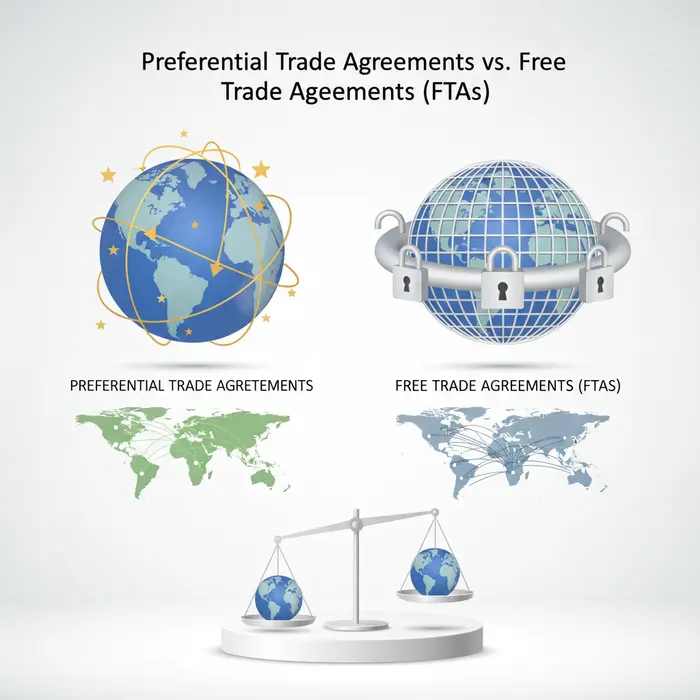
Preferential Trade Agreements vs. Free Trade Agreements (FTAs)
In the complex landscape of international trade, the terms “Preferential Trade Agreement” (PTA) and “Free Trade Agreement” (FTA) are frequently used, often interchangeably, leading to confusion. While both aim to reduce trade barriers among member countries, their scope, depth, and implications differ significantly. Understanding the nuances between a PTA and an FTA is crucial for businesses navigating global markets and for policymakers shaping trade policy. This section will clarify these distinctions, addressing the core of the FTA vs PTA debate by highlighting their varying levels of integration, commitment, and ultimate objectives.
1. Scope of Coverage: Goods vs. Services
The primary distinction between a PTA and an FTA often lies in their breadth of coverage. A preferential trade agreement definition typically refers to a trade pact where member countries agree to reduce tariffs on a limited range of products, or specific sectors. These agreements are often less comprehensive, focusing on a select list of goods that are politically or economically significant to the signatories. For instance, a PTA might only cover agricultural products or specific manufactured goods, granting them preferential access to member markets through reduced import duties. The preferential trade agreement benefits here are targeted and specific, often serving as a preliminary step to broader liberalization.
In contrast, a Free Trade Agreement (FTA) aims for a much more extensive liberalization of trade. An FTA typically seeks to eliminate tariffs and other non-tariff barriers on substantially all trade in goods among its members. This means a vast majority of product categories, sometimes exceeding 90% of tariff lines, are subject to duty-free trade. Modern FTAs also increasingly extend their scope beyond goods to include services, intellectual property rights, investment, competition policy, government procurement, and even provisions related to labor and environmental standards. This comprehensive approach signifies a deeper commitment to economic integration.
2. Levels of Integration and Commitment
The depth of commitment is another critical differentiator. PTAs, by their nature, involve a shallower level of integration. They primarily offer targeted customs duties reduction for a specific set of products, without necessarily addressing broader trade policy harmonization or regulatory alignment. The commitments are often less stringent, and the administrative requirements are generally simpler compared to FTAs. While they do offer benefits by making certain imports cheaper and exports more competitive within the preferential bloc, they do not fundamentally alter the overall trade relationship in the same comprehensive way as an FTA.
FTAs, however, demand a much higher level of commitment. The goal is to create a true free trade area where goods and services can flow with minimal governmental interference. This necessitates not only the elimination of tariffs but also the establishment of robust rules of origin requirements. These rules are vital to prevent goods from non-member countries from simply being re-exported through a member country to avoid tariffs, thus ensuring that only products genuinely originating from within the FTA bloc benefit from the preferential treatment. Beyond tariffs, FTAs often include chapters on harmonizing standards, streamlining customs procedures, protecting intellectual property, and establishing dispute resolution mechanisms. This deep integration fosters greater certainty and stability for businesses operating across borders. A notable example of a comprehensive FTA, whose structure and implications are discussed in depth by organizations like the World Trade Organization regarding Regional Trade Agreements, is the former North American Free Trade Agreement (NAFTA), now USMCA, which covers a vast array of economic activities and regulations.
3. The Evolution from PTA to FTA and Beyond
It is common for countries to begin their journey of trade liberalization with a PTA, viewing it as a practical first step. A PTA can serve as a testing ground, allowing nations to gradually build trust and experience the preferential trade agreement benefits before committing to a more extensive FTA. As economic ties deepen and the political will strengthens, a PTA can evolve into an FTA, expanding its product coverage and incorporating services and other regulatory aspects.
An FTA, in turn, can be a precursor to even deeper forms of economic integration, such as a customs union (where members adopt a common external tariff policy), a common market (allowing free movement of labor and capital), or an economic union (harmonizing economic policies). Thus, the FTA vs PTA discussion is not just about static definitions but also about a dynamic spectrum of integration. While a PTA focuses on selective tariff reductions, an FTA strives for near-total elimination of trade barriers across a broad spectrum of goods and services, underpinned by more sophisticated regulatory frameworks like rules of origin. For businesses, distinguishing between these agreements is crucial for understanding market access, compliance costs, and strategic opportunities.
Understanding Rules of Origin and Compliance
Understanding Rules of Origin (RoO) is paramount for businesses seeking to leverage the advantages offered by Preferential Trade Agreements (PTAs). These agreements, designed to foster trade among member countries, typically involve significant customs duties reduction. However, simply being a member country isn’t enough; goods must meet specific rules of origin requirements to qualify for this preferential treatment. Without a clear understanding and meticulous adherence to these regulations, companies risk denied benefits, costly delays, and potential penalties, undermining the very purpose of engaging in international trade under a PTA. This section delves into the critical role of RoO, their different types, and the essential documentation needed for compliance.
1.
Why Rules of Origin Matter for PTAs
A preferential trade agreement definition typically describes a pact between two or more partners to reduce or eliminate tariffs and non-tariff barriers on goods and services. While often used interchangeably, understanding the nuances between an FTA vs PTA is less critical than appreciating that both types of agreements offer substantial preferential trade agreement benefits. The core objective of RoO within these agreements is to prevent “trade deflection.” Without them, goods from a non-member country could be routed through a member country with low or no tariffs, simply to gain preferential access to another member country’s market. RoO ensure that only goods genuinely originating from a participating country receive the agreed-upon customs duties reduction, thereby safeguarding the economic interests and industrial base of the member states. They promote fair trade, encourage local production, and ensure that the intended economic advantages of the agreement benefit the actual producers and economies within the bloc.
2.
Types of Rules of Origin (Wholly Obtained, Substantial Transformation)
The rules of origin requirements vary significantly across different PTAs and for different products. Generally, RoO fall into two primary categories:
Wholly Obtained Goods: These are products entirely grown, produced, or manufactured in a single country without incorporating any non-originating materials. Examples include agricultural products harvested from the soil, minerals extracted from mines, live animals born and raised within the territory, and products made exclusively from such items (e.g., flour from wheat grown in the country). Such goods inherently qualify for preferential treatment as their origin is unambiguous.
Substantial Transformation: Most manufactured goods involve materials or components from various countries, making “wholly obtained” status impossible. For these, goods must undergo a “substantial transformation” in the exporting country to confer origin. This can be determined by several criteria:
- Change in Tariff Classification (CTC): This is one of the most common methods. It requires that the non-originating materials used in production undergo a change in their Harmonized System (HS) tariff classification at a specific level (e.g., Chapter, Heading, Subheading). For instance, if imported fabric (HS Chapter 52) is used to make a shirt (HS Chapter 62), a change in Chapter would generally confer origin.
- Value-Added (VA) or Regional Value Content (RVC): This criterion stipulates that a certain percentage of the final product’s value must originate within the exporting country or the PTA zone. This is often calculated using a formula, such as the direct method (value of originating materials + direct labor + overheads) or the build-down method (total value – value of non-originating materials).
- Specific Manufacturing or Processing Operations: For certain products, specific processing operations are deemed sufficient to confer origin, regardless of tariff classification changes or value content. Examples might include specific chemical reactions, assembly operations for complex machinery, or textile processing steps.
Understanding which specific rule applies to a product within a given PTA is critical for compliance.
3.
Documentation and Certification Requirements
Compliance with RoO isn’t just about meeting the production criteria; it also involves meticulous documentation and proper certification. To claim customs duties reduction under a PTA, exporters must provide evidence that their goods meet the stipulated rules of origin requirements.
The primary document for this purpose is often a Certificate of Origin (CoO). This official document attests that the goods in a particular export shipment have met the specified origin criteria. CoOs can be issued by authorized bodies (e.g., Chambers of Commerce, government agencies) or, in some modern PTAs, may take the form of an exporter’s self-declaration, provided the exporter is registered and authorized.
Beyond the CoO, businesses must maintain comprehensive records to substantiate their origin claims. This includes invoices for raw materials, production records, bills of lading, and other relevant commercial documents that can demonstrate how the goods were produced and where their components originated. Importers, too, have a responsibility to exercise due diligence, verifying the validity of origin claims and retaining necessary documentation.
Failure to comply with these documentation requirements, or providing inaccurate information, can lead to severe consequences. These include the denial of preferential tariffs, imposition of full customs duties, penalties, fines, and even goods detention or forfeiture. Therefore, investing in robust internal compliance procedures and understanding the specific requirements of each target market’s PTA is indispensable for successful international trade.
Implementing and Leveraging PTAs for Business
Navigating the complexities of international trade requires strategic foresight and a deep understanding of available mechanisms to optimize operations and reduce costs. Preferential Trade Agreements (PTAs) stand out as powerful tools for businesses looking to gain a competitive edge. These agreements are crucial for unlocking customs duties reduction and streamlining supply chains, ultimately enhancing profitability.
A preferential trade agreement definition refers to a pact between two or more countries that grant preferential treatment, typically in the form of lower tariffs or duty-free access, to certain products originating from participating countries. Unlike broader Free Trade Agreements (FTAs) which aim for comprehensive liberalization, PTAs can be more targeted, focusing on specific sectors or offering varying degrees of tariff reductions. Understanding the nuances of PTAs is essential for businesses, particularly those engaged in global sourcing and exporting.

Identifying Relevant PTAs for Your Business
The first step in leveraging PTAs is to thoroughly identify which agreements are most beneficial for your specific business model and supply chain. This involves a comprehensive analysis of your target markets, product lines, and the countries involved in your sourcing and distribution networks. Businesses must research existing PTAs and assess their applicability, considering factors such as product classification (HS codes) and the specific tariff concessions offered. For instance, a Vietnamese manufacturer exporting textiles to a country with a PTA in place might enjoy significantly lower import duties compared to a competitor in a non-PTA country. This strategic identification process can dramatically influence your cost structure and market competitiveness. Understanding the core preferential trade agreement definition in relation to your trade lanes is paramount to making informed decisions.
Strategies for Maximizing Customs Duties Reduction
Once relevant PTAs are identified, the next critical phase is to implement strategies that maximize customs duties reduction. The cornerstone of utilizing any PTA effectively lies in adhering to its specific rules of origin requirements. These rules dictate whether a product genuinely originates from a PTA member country and is thus eligible for preferential treatment. Compliance with rules of origin can be complex, often involving detailed documentation such as certificates of origin, declarations, and comprehensive record-keeping of materials and manufacturing processes. Businesses should invest in robust compliance systems, potentially utilizing origin management software, and train their teams on the intricacies of each PTA’s requirements. Proactive engagement with customs brokers and trade consultants can also help navigate these complexities, ensuring eligibility and preventing costly penalties. For example, understanding if your product meets the “wholly obtained” or “sufficiently transformed” criteria is vital.
Navigating Import/Export Procedures Under PTAs
Successful implementation of PTAs extends beyond merely identifying the right agreements and understanding origin rules; it also involves adept navigation of the practical import and export procedures. This includes accurate customs declarations, ensuring all required documentation (such as invoices, bills of lading, and certificates of origin) is correctly prepared and submitted on time. Businesses should establish clear internal protocols for managing PTA-related paperwork and communication with customs authorities. It’s also advisable to stay updated on any changes or amendments to existing agreements, as these can impact eligibility and procedures. Leveraging PTAs offers significant preferential trade agreement benefits beyond just tariffs, including potentially faster customs clearance and reduced administrative burdens, provided all procedures are meticulously followed. A proactive and diligent approach to procedural compliance can transform potential savings into tangible competitive advantages, underscoring the importance of a clear preferential trade agreement definition in practice.
In conclusion, strategically implementing and leveraging Preferential Trade Agreements offers a pathway to substantial cost savings and enhanced competitiveness for businesses operating in the global market. By diligently identifying relevant agreements, meticulously adhering to rules of origin, and navigating import/export procedures with precision, companies can unlock significant customs duties reduction and optimize their international trade operations.
Partner with Vietnam’s Leading Suppliers
Looking for reliable suppliers in Vietnam? Contact VietnamSuppliers.com today to connect with verified manufacturers and exporters across all industries.
—————————————
References
– WTO | Tariffs: https://www.wto.org/english/tratop_e/tariffs_e/tariffs_e.htm
– World Trade Organization (WTO) – Benefits of Trade: https://www.wto.org/english/thewto_e/whatis_e/tif_e/fact2_e.htm
– World Trade Organization discussion on Regional Trade Agreements: https://www.wto.org/english/thewto_e/whatis_e/tif_e/agrm7_e.htm
– World Trade Organization (WTO) – Rules of Origin: https://www.wto.org/english/tratop_e/roi_e/roi_e.htm
– rules of origin requirements: https://www.wto.org/english/tratop_e/roi_e/roi_e.htm

