Introduction to Cash Against Documents (CAD)
Cash Against Documents (CAD) stands as a pivotal international trade payment method, offering a balanced approach to risk management for both exporters and importers. In the intricate world of global commerce, selecting the right payment mechanism is crucial for ensuring smooth transactions and mitigating potential financial exposures. This section delves into the essence of CAD, defining its operational framework, and elucidating its fundamental role within the broader spectrum of international trade payment methods. Understanding Cash Against Documents Payment Terms is indispensable for businesses looking to optimize their export payment terms for buyers while safeguarding their interests as sellers.
1. What is Cash Against Documents (CAD)?
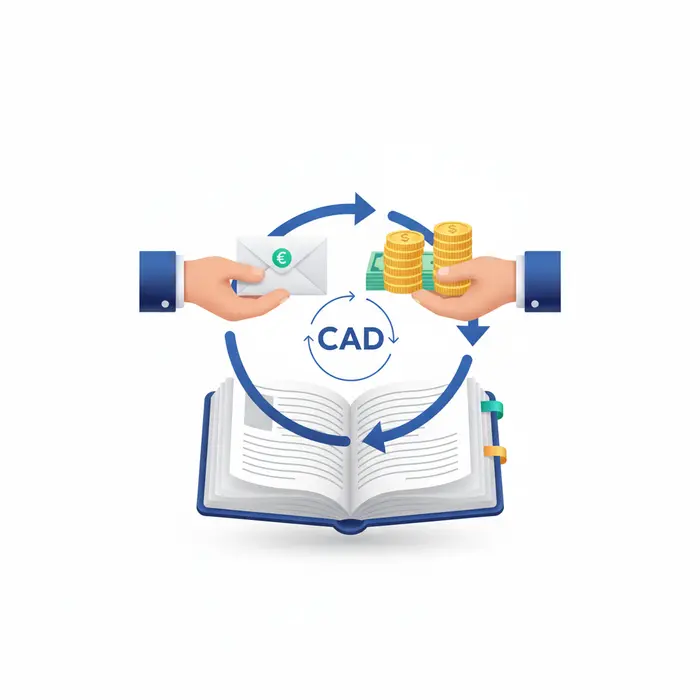
Cash Against Documents (CAD) is a payment arrangement where an importer (buyer) pays for goods only when the shipping documents are presented to them or their bank. Unlike prepayment, where the buyer pays upfront, or open account, where the seller extends credit, CAD ensures that the buyer has proof that the goods have been shipped before payment is released. This method requires the exporter (seller) to ship the goods and then submit the relevant shipping documents – such as the bill of lading, commercial invoice, packing list, and certificate of origin – to their bank. This bank, known as the remitting bank, then forwards these documents to the importer’s bank, the collecting or presenting bank. Upon receipt of these documents, the importer’s bank notifies the importer. The importer then makes the payment to their bank, which subsequently releases the documents. With these documents, the importer can clear the goods from customs and take possession. The payment then travels back through the banks to the exporter. This “Cash Against Documents Payment Terms” structure offers a degree of security to the buyer by linking payment directly to the shipment of goods, while still providing the seller with assurance that payment is due upon document presentation.
2. How CAD Fits into International Trade Payment Methods
In the diverse landscape of international trade payment methods, CAD occupies a middle ground concerning risk and cost, making it a viable option for many transactions. It provides more security for the exporter than an open account, as the buyer cannot access the goods without the documents, which are only released upon payment. Simultaneously, it is less restrictive and often less expensive for the importer than a Letter of Credit (LC). While a Letter of Credit offers the highest level of security for the seller due to a bank’s guarantee of payment, it involves more complex procedures and higher banking fees. The CAD vs Letter of Credit discussion often centers on the balance between cost, complexity, and risk tolerance. For established trading partners with a history of trust, or for transactions where the cost of an LC is prohibitive, the Cash Against Documents procedure serves as an efficient alternative. It’s particularly relevant when considering export payment terms for buyers who might be hesitant to pay upfront but require assurance of shipment before committing funds. CAD helps facilitate trade by offering a clear, conditional payment pathway that relies on the banking system for document handling rather than payment guarantee.
3. Key Parties Involved in a CAD Transaction
A successful Cash Against Documents transaction involves several distinct parties, each playing a crucial role in the seamless flow of documents and funds. Understanding these roles is key to grasping the full scope of the Cash Against Documents procedure:
- The Exporter (Seller/Drawer): This is the party who ships the goods and originates the demand for payment. They prepare the shipping documents and present them to their bank.
- The Importer (Buyer/Drawee): The party who agrees to purchase the goods and whose responsibility it is to make the payment upon presentation of the required documents.
- The Exporter’s Bank (Remitting Bank): This bank acts on behalf of the exporter. It receives the shipping documents from the exporter and sends them to the importer’s bank for collection. It also receives payment from the collecting bank and remits it to the exporter.
- The Importer’s Bank (Collecting/Presenting Bank): Acting on behalf of the importer, this bank receives the documents from the remitting bank. It notifies the importer of the arrival of the documents and collects payment from them. Once payment is received, it releases the documents to the importer and forwards the funds to the remitting bank.
Together, these parties ensure that the goods are shipped, documents are handled securely through banking channels, and payment is made in accordance with the agreed-upon Cash Against Documents Payment Terms, fostering trust and efficiency in international trade.
The Cash Against Documents Procedure: A Step-by-Step Guide
In the complex world of international trade, selecting the right payment mechanism is crucial for mitigating risks and ensuring smooth transactions. Among the various international trade payment methods, Cash Against Documents (CAD) stands as a popular choice, particularly for businesses seeking a balance between the security of a Letter of Credit (LC) and the simplicity of open account terms. While less secure for the seller than an LC, CAD offers more protection than an open account, as the buyer cannot access the goods until payment or acceptance is made. Understanding the intricate Cash Against Documents Payment Terms and the operational flow of this procedure is vital for both importers and exporters. This guide details the step-by-step process of a CAD transaction, highlighting the pivotal role banks play in facilitating this exchange.
1. Initiating the CAD Transaction: Seller’s Role
The journey of a Cash Against Documents (CAD) transaction begins with the exporter (seller) and importer (buyer) agreeing upon the Cash Against Documents Payment Terms as part of their sales contract. This agreement typically specifies that the buyer will pay for the goods only after the shipping documents are presented by a bank, ensuring they have legal title to the merchandise. Once the goods are manufactured and ready for shipment, the seller prepares them for dispatch according to the agreed shipping terms (e.g., Incoterms). The most critical aspect of the seller’s role at this stage involves assembling all the necessary shipping and commercial documents. These typically include the commercial invoice, packing list, bill of lading (or air waybill), certificate of origin, insurance certificate, and any other specific documents required by the buyer or the importing country’s regulations. The seller then presents this complete set of documents to their bank, known as the remitting bank, along with specific instructions for collection. These instructions will detail the amount to be collected, the currency, and the conditions under which the documents are to be released to the buyer (e.g., against payment or against acceptance of a draft).
2. Document Presentation and Negotiation by Banks
Upon receiving the documents and instructions from the seller, the remitting bank verifies that all specified documents are present and correctly filled out as per the seller’s instructions. It then forwards these documents, along with a collection order, to a bank in the buyer’s country, referred to as the collecting bank. The collecting bank, typically chosen for its relationship with the buyer or its presence in the buyer’s location, plays a crucial intermediary role. Once the documents arrive, the collecting bank notifies the buyer of their arrival and the payment obligation. This is where the core principle of CAD comes into play: the buyer cannot take possession of the goods without these documents, and they cannot obtain the documents without fulfilling the payment terms. The buyer inspects the documents to ensure they match the contract’s specifications. Unlike a Letter of Credit, where banks guarantee payment if documents comply, in a CAD procedure, banks act primarily as facilitators for document and fund exchange. They do not assume any payment risk but ensure that the seller’s instructions for document release are strictly followed. This mechanism provides a layer of security for the seller, as they retain control over the goods until the buyer commits to payment, while offering the buyer reassurance that the goods have been shipped as per their order before payment is made.
3. Payment and Document Release Flowchart
The final stage of the Cash Against Documents procedure culminates in the buyer making payment and receiving the vital shipping documents. This process can be visualized as a clear sequence of actions:
- Buyer’s Payment: Upon satisfactory review of the documents, and ensuring they comply with the terms of the sales contract, the buyer makes the payment to the collecting bank. This payment covers the value of the goods as stipulated in the commercial invoice.
- Document Release: Immediately upon receiving the payment (or acceptance of a draft, if applicable, though less common for strict CAD), the collecting bank releases the original shipping documents to the buyer. These documents are essential for the buyer to claim the goods from the shipping carrier and clear them through customs.
- Goods Clearance and Possession: Armed with the original bill of lading (or other transport documents), the commercial invoice, and other required certificates, the buyer can now approach the shipping company, pay any local charges, and arrange for the customs clearance of the goods. Once cleared, the buyer takes physical possession of the merchandise.
- Fund Transfer: Simultaneously, the collecting bank initiates the transfer of the collected funds, less any banking charges, back to the remitting bank in the seller’s country.
- Seller’s Receipt: Finally, the remitting bank credits the seller’s account with the funds, completing the financial transaction.
This structured flow ensures that the seller retains control over the goods until payment is secured, providing an efficient and relatively secure method for export payment terms for buyers and sellers, facilitating international trade with a defined operational framework.
CAD vs. Letter of Credit (LC): Key Differences and When to Choose
In the intricate world of international trade, selecting the appropriate payment method is crucial for managing risk, ensuring timely payments, and fostering reliable business relationships. Two prominent methods often considered are Cash Against Documents (CAD) and the Letter of Credit (LC). While both facilitate secure transactions by involving banks and documents, they differ significantly in their mechanics, risk allocation, and suitability for various trade scenarios. Understanding these distinctions is key for both exporters and importers when deciding on export payment terms for buyers.
1. Risk Allocation: Buyer vs. Seller Perspective
The fundamental difference between CAD and LC lies in how they allocate and mitigate risk for the parties involved. In a Cash Against Documents procedure, the exporter (seller) ships the goods, then presents shipping documents (such as bill of lading, commercial invoice, packing list) to their bank. This bank forwards the documents to the importer’s (buyer’s) bank. The buyer’s bank releases the documents to the buyer only upon payment. From the seller’s perspective, the primary risk is that the buyer might refuse to pay for the documents, leaving the goods stranded at the destination port with associated demurrage costs. From the buyer’s perspective, the risk is paying for goods they haven’t inspected, relying solely on the documents to accurately represent the shipment. While their bank acts as a collection agent, it does not guarantee payment.
Conversely, a Letter of Credit (LC) offers a much higher level of security, particularly for the exporter. An LC is a bank’s undertaking to make a payment to the seller on behalf of the buyer, provided that the seller presents specified documents that comply with the terms and conditions of the LC. This means the seller has a bank’s guarantee of payment, significantly reducing the risk of non-payment. For the buyer, the risk of receiving non-conforming goods is also mitigated to an extent, as the bank only releases payment against documents that strictly match the LC’s requirements. However, this scrutiny is document-based, not goods-based, meaning the buyer still relies on the seller to ship the correct goods, but the bank ensures the paperwork is in order. In essence, LC shifts the payment risk from the buyer to the issuing bank, making it a more secure payment method for the seller.
2. Complexity and Cost Comparison
The enhanced security of an LC comes with increased complexity and higher costs compared to CAD. The Cash Against Documents Payment Terms are relatively straightforward. It involves fewer parties (exporter, importer, and their respective banks acting as collection agents) and less paperwork. The banks’ role is limited to handling and forwarding documents and receiving payment, resulting in lower banking fees and administrative overhead. This simplicity makes CAD an attractive option for transactions where the risk is deemed low, or when trading partners have an established relationship built on trust.
A Letter of Credit, on the other hand, is a more intricate financial instrument. It requires detailed documentation, precise adherence to strict terms and conditions, and involvement of multiple banks (issuing bank, advising bank, and sometimes a confirming bank). Each stage of the LC process, from issuance to advising, amendment, and presentation of documents, incurs banking fees. These fees, along with the increased administrative burden of ensuring document compliance, make LCs significantly more expensive. The cost often includes an opening fee, advising fees, confirmation fees (if applicable), and discrepancy fees if documents do not strictly conform. For businesses engaging in international trade payment methods, these costs can add up, making LCs less suitable for smaller transactions or where margins are tight.
3. When is CAD Preferable over LC for Export Payment Terms?
Deciding between CAD and LC largely depends on the specific circumstances of the trade deal, including the relationship between the buyer and seller, the value of the transaction, and the perceived risk of the trading environment. CAD vs Letter of Credit often boils down to balancing security with cost and convenience.
CAD is generally preferred in scenarios where:
- Established Trust: The exporter and importer have a long-standing business relationship, built on mutual trust and a history of successful transactions.
- Lower Value Goods: For transactions involving goods of relatively lower monetary value, where the cost of an LC might disproportionately outweigh the benefits of enhanced security.
- Stable Markets: When trading with buyers in politically and economically stable countries with robust legal systems, where the risk of non-payment or commercial disputes is low.
- Buyer’s Strong Creditworthiness: The exporter has high confidence in the buyer’s financial stability and ability to make payment upon presentation of documents.
- Simplicity Desired: Both parties prefer a simpler, faster, and less bureaucratic Cash Against Documents procedure to reduce administrative burdens and costs.
Conversely, LCs are typically favored for:
- New Trading Partners: When dealing with new or unknown buyers, especially in the initial stages of a relationship, an LC provides essential payment assurance.
- High Value Shipments: For high-value transactions where the financial exposure is significant, the added security of a bank’s payment guarantee justifies the higher cost.
- High-Risk Countries: When trading with countries that have unstable political or economic conditions, or where currency controls and legal recourse might be challenging.
- Buyer’s Limited Creditworthiness: If the buyer’s financial standing is uncertain, or if they are unable to obtain open account terms, an LC provides a critical layer of bank assurance.
- Specific Contractual Requirements: When a contract explicitly mandates the use of an LC due to its robust nature in managing international trade payment methods.
In conclusion, while CAD offers simplicity and cost-effectiveness, it places more risk on the seller regarding payment assurance. An LC, while more complex and costly, provides unparalleled security, especially for the seller, by substituting the buyer’s credit risk with that of a bank. The optimal choice between these two international trade payment methods hinges on a careful assessment of risk, cost, and the specific dynamics of each international transaction.
Benefits and Risks of Cash Against Documents Payment Terms
In the complex world of international trade, selecting the appropriate payment method is crucial for ensuring smooth transactions, managing risk, and optimizing cash flow for both buyers and sellers. Among the various international trade payment methods, Cash Against Documents Payment Terms (CAD) offers a middle ground between the high risk of open account terms and the high cost and complexity of Letters of Credit. Understanding the nuances of CAD, including its advantages, disadvantages, and the specific Cash Against Documents procedure, is essential for any participant in global commerce, particularly when considering export payment terms for buyers.
Under CAD, an exporter ships goods to an importer and then presents shipping documents (such as the bill of lading, commercial invoice, packing list, and certificate of origin) to their bank. This bank then forwards these documents to the importer’s bank, which in turn notifies the importer. The importer must pay the stipulated amount or accept a draft (a promise to pay at a future date) to receive these documents, which are necessary to take possession of the goods at the destination port. This method provides a degree of security for the seller while offering payment flexibility for the buyer.
1. Advantages for Exporters (Sellers)
For exporters, utilizing Cash Against Documents Payment Terms presents several appealing benefits, particularly when dealing with established buyers or in markets with manageable risks. The primary advantage lies in the exporter maintaining control over the goods until payment or acceptance of a draft is secured. Unlike open account terms, where goods are released before payment, CAD ensures that the importer cannot claim the merchandise without first fulfilling their financial obligation. This significantly reduces the risk of non-payment post-shipment.
Furthermore, CAD transactions generally incur lower bank charges compared to Letters of Credit (L/C), making it a more cost-effective option for many businesses. The Cash Against Documents procedure is also less complex and cumbersome than that of an L/C, leading to quicker processing times and reduced administrative burdens. This simplification can translate into faster cash flow for the exporter, as funds are typically received shortly after documents are presented and accepted by the importer’s bank. For exporters seeking to balance security with efficiency and lower costs, CAD can be a highly effective payment solution.
2. Advantages for Importers (Buyers)
Importers also find compelling advantages in Cash Against Documents Payment Terms, particularly concerning financial flexibility and control over documentation. A significant benefit for buyers is the absence of an upfront payment requirement before shipment. Unlike advance payment methods, CAD allows importers to retain their working capital for longer periods, only needing to make payment or accept a draft once the goods have been shipped and the relevant documents are presented. This improves the buyer’s liquidity and cash flow management.
Moreover, CAD offers importers the crucial opportunity to inspect all shipping documents (such as the bill of lading, commercial invoice, packing list, and certificates) before making payment or accepting the draft. This pre-payment review provides a vital layer of assurance, allowing the buyer to verify that the documentation aligns with the terms of the sales contract and the expected shipment details. While this doesn’t guarantee the quality of the physical goods, it does confirm the legitimacy and completeness of the shipment’s paperwork. The relatively lower transaction costs compared to an L/C also make CAD an attractive and economical choice for importers, especially those with trusted trading relationships.
3. Navigating the Risks Associated with CAD
Despite its advantages, Cash Against Documents Payment Terms inherently carry risks for both exporters and importers, necessitating careful management and mitigation strategies. For exporters, the paramount risk is the importer’s refusal to pay or accept the documents upon their arrival. This leaves the exporter with goods stranded at the destination port, potentially incurring substantial costs for demurrage, customs, storage, re-exportation, or the challenging task of finding an alternative buyer. Unlike an L/C, CAD does not provide a bank’s payment guarantee, meaning the exporter’s security hinges solely on the importer’s integrity and financial capability. Furthermore, if the importer delays payment, it can disrupt the exporter’s cash flow projections.
For importers, the main concern arises from the potential discrepancy between the documents and the actual goods. While importers can inspect documents before payment, there is no guarantee that the physical goods, once cleared, will match the quality, quantity, or specifications outlined in the paperwork. If the goods are found to be defective or not as described after payment, the importer’s recourse might be limited to contractual claims against the exporter, which can be complex and costly in international trade. Delays in document processing or minor discrepancies can also hold up the release of goods, leading to additional storage charges at the port.
To mitigate these risks, both parties should conduct thorough due diligence on their trading partners. Exporters can consider obtaining trade credit insurance to protect against buyer default, while importers may arrange for pre-shipment inspections by independent third parties to verify the goods’ quality and quantity before loading. Clear, comprehensive sales contracts detailing terms, conditions, and dispute resolution mechanisms are also vital. For higher-value or higher-risk transactions, evaluating alternatives such as a CAD vs Letter of Credit comparison might reveal that the enhanced security of an L/C justifies its higher cost. Ultimately, a deep understanding of the Cash Against Documents Payment Terms and the mutual trust between trading partners are critical for successful transactions using this method.
Best Practices for Using Cash Against Documents in 2025
In the dynamic landscape of international trade, businesses constantly seek secure yet efficient payment methods. Cash Against Documents (CAD), also known as Documents Against Payment (D/P), remains a popular choice for many exporters and importers. This method offers a middle ground between open account terms and Letters of Credit, providing a degree of security for the seller without the complexity and cost associated with an LC. As we navigate 2025, understanding and implementing the best practices for Cash Against Documents Payment Terms is crucial for smooth and successful transactions amidst evolving global trade dynamics and regulatory frameworks. This section provides practical advice for businesses utilizing or considering CAD, covering essential legal considerations and tips for achieving seamless operations.

1. Ensuring Clear Contractual Agreements and Documentation
The bedrock of any successful CAD transaction is a meticulously drafted contractual agreement. Unlike a Letter of Credit, which involves a bank’s undertaking, CAD relies heavily on the exporter’s trust in the importer to honor payment upon presentation of documents. Therefore, precision in the sales contract is paramount. Businesses must clearly define all aspects of the transaction, including the goods, quantity, quality, price, currency, and crucially, the payment terms. This includes specifying the exact documents required for presentation (e.g., commercial invoice, packing list, bill of lading, certificate of origin, insurance certificate) and the timeframe for payment after the documents are presented. Furthermore, clearly stipulating the Incoterms (e.g., FOB, CIF, EXW) defines responsibilities for freight, insurance, and risk transfer, preventing disputes. Legal counsel should review these agreements to ensure compliance with international trade laws and to incorporate robust dispute resolution mechanisms. For exporters, understanding the specific export payment terms for buyers is vital to align expectations and minimize risks, particularly in new markets. Comprehensive and unambiguous documentation is not merely a formality; it’s the primary defense against potential misunderstandings or non-payment.
2. The Role of Reliable Banks and Intermediaries
While CAD offers less bank involvement than a Letter of Credit, the role of reliable banks and intermediaries remains critical for secure and efficient execution. In a Cash Against Documents procedure, the exporter’s bank (remitting bank) sends the shipping documents to the importer’s bank (collecting bank). The collecting bank then presents these documents to the importer, who must pay before receiving them, allowing them to take possession of the goods. Choosing a reputable and experienced bank for both the remitting and collecting roles is essential. These banks act as trusted intermediaries, ensuring the proper handling and presentation of documents, and facilitating the transfer of funds. Their expertise in international trade finance can help navigate complexities and ensure adherence to established protocols like the Uniform Rules for Collection (URC 522) published by the International Chamber of Commerce (ICC). While CAD does not offer the same payment guarantee as a CAD vs Letter of Credit, a reliable bank ensures that documents are only released upon payment, significantly mitigating the risk for the exporter once the goods have been shipped. Building strong relationships with your banking partners will prove invaluable in streamlining these transactions.
3. Adapting to Global Trade Dynamics and Regulations
The global trade environment in 2025 is characterized by rapid shifts, from geopolitical tensions and supply chain vulnerabilities to evolving environmental and digital regulations. Businesses using CAD must be agile and adapt their strategies accordingly. Thorough due diligence on trading partners is more critical than ever, especially when dealing with new markets or volatile regions. This involves assessing their financial stability, track record, and compliance with anti-money laundering (AML) and sanctions regulations. Staying informed about the latest developments in international trade payment methods and regulations is paramount. The increasing digitalization of trade documents also presents opportunities for greater efficiency and reduced fraud risk. Exploring electronic document presentation systems, where legally recognized, can significantly speed up the overall process and reduce logistical overheads. Businesses should also consider political risk insurance for transactions in high-risk countries. Proactive adaptation to these dynamics ensures that CAD remains a viable and secure option for facilitating international commerce.
By prioritizing clear contracts, leveraging reliable banking partners, and remaining adaptable to the evolving global landscape, businesses can effectively utilize Cash Against Documents Payment Terms to support their international trade endeavors in 2025 and beyond. These best practices not only mitigate risks but also foster trust and efficiency, paving the way for sustainable growth in the competitive global marketplace.
Partner with Vietnam’s Leading Suppliers
Looking for reliable suppliers in Vietnam? Contact VietnamSuppliers.com today to connect with verified manufacturers and exporters across all industries.
—————————————
References
– ICC Uniform Rules for Collections (URC 522): https://iccwbo.org/content/uploads/sites/3/2016/11/ICC-Uniform-Rules-for-Collections-URC-522.pdf
– JPMorgan Chase Trade Finance Instruments: https://www.jpmorgan.com/commercial-banking/insights/global-trade-challenges/trade-finance-instruments
– Letter of Credit: https://www.investopedia.com/terms/l/letterofcredit.asp
– International Trade Payment Methods: https://www.investopedia.com/terms/i/international-payments.asp
– Uniform Rules for Collections (URC 522): https://www.iccwbo.org/trade-facilitation/trade-finance/uniform-rules-for-collections-urc-522/