Understanding the Landscape of Global Trade Regimes
In today’s interconnected global economy, businesses are increasingly looking beyond domestic borders for growth opportunities. However, expanding internationally means entering a complex web of regulations, agreements, and policies collectively known as global trade regimes. This section introduces what global trade regimes are, their historical evolution, and why understanding them is crucial for businesses operating in the international arena. For any enterprise engaged in cross-border commerce, effectively Navigating Global Trade Regimes is not just advantageous—it’s essential for sustainable success and competitive advantage.

1. Defining Global Trade Regimes and Their Components
Global trade regimes encompass the comprehensive set of rules, institutions, and agreements that govern international commerce. These frameworks are designed to facilitate trade, resolve disputes, and ensure a degree of predictability and fairness in the global marketplace. Key components include multilateral agreements, such as those overseen by the World Trade Organization (WTO), regional trade blocs like the European Union (EU) or the Association of Southeast Asian Nations (ASEAN), and bilateral free trade agreements (FTAs). Understanding the WTO rules and international trade law is fundamental, as the WTO provides the foundational principles for a significant portion of global trade. These regimes dictate everything from tariffs and quotas to customs procedures, intellectual property rights, and technical standards. The international trade policy impact extends to virtually every aspect of a business’s global operations, influencing supply chain strategies, market entry decisions, and pricing models.
2. Historical Context and Evolution of Trade Policies
The concept of governing international trade is not new; it has evolved significantly over centuries, from early mercantilist policies focused on national wealth accumulation through trade surpluses, to the post-World War II era’s push for liberalized trade. The establishment of the General Agreement on Tariffs and Trade (GATT) in 1947, which later transformed into the WTO, marked a pivotal shift towards reducing Customs duties and trade barriers and promoting non-discrimination. This evolution has led to a proliferation of free trade agreements (FTAs), designed to eliminate tariffs and non-tariff barriers between member countries. For importers, understanding the nuances of these agreements is paramount, as Free trade agreements benefits for importers can include reduced costs, simplified customs procedures, and greater market access. However, the landscape is ever-changing, with ongoing negotiations, emerging protectionist sentiments in some regions, and new digital trade regulations constantly reshaping the environment for businesses.
3. Why Compliance is Key for International Businesses
For any enterprise engaged in international trade, strict adherence to global trade regimes is not merely a legal obligation but a strategic imperative. Non-compliance can lead to severe penalties, including hefty fines, confiscation of goods, and significant reputational damage. Beyond punitive measures, navigating these regimes effectively allows businesses to leverage opportunities such as preferential market access offered by FTAs, optimize their supply chains, and mitigate risks associated with geopolitical shifts. Furthermore, demonstrating a commitment to ethical and compliant trade practices can enhance a company’s standing with partners, customers, and regulatory bodies. In an era where supply chain resilience and ethical sourcing are increasingly prioritized, mastery of global trade regulations becomes a cornerstone of responsible and profitable international business operations. Staying informed about changes in international trade policy impact and developing robust compliance frameworks are critical for sustained success.
In conclusion, the global trade landscape is a dynamic and intricate tapestry of rules and relationships. For businesses aiming to thrive in international markets, a deep understanding of global trade regimes, their historical underpinnings, and the implications of compliance is indispensable. It empowers companies to make informed decisions, capitalize on trade opportunities, and effectively manage risks, ensuring a smoother and more profitable journey when Navigating Global Trade Regimes.
International Trade Policy Impact on Businesses
International trade policies are dynamic forces that profoundly shape the global economic landscape, dictating the operational parameters and strategic decisions for businesses worldwide. From unilateral national governmental decisions to complex multilateral agreements, these policies influence market access, optimize or disrupt supply chains, and redefine competitive advantage. Understanding and navigating global trade regimes is no longer optional but a critical imperative for sustained business success. The World Trade Organization (WTO) outlines the foundational principles of international trade law, demonstrating the intricate web of regulations businesses must contend with. This section explores the multi-faceted international trade policy impact on commercial entities, delving into governmental roles, economic implications across sectors, and essential adaptation strategies.
Governmental Influence on Trade Flows and Tariffs
Governments are primary architects of trade policy, wielding tools like tariffs, quotas, subsidies, and non-tariff barriers to protect domestic industries, manage trade deficits, or foster international relations. Tariffs, essentially taxes on imported goods, directly increase the cost of foreign products, making domestic alternatives more competitive. Conversely, subsidies lower production costs for local businesses, enabling them to compete more effectively internationally. Customs duties and trade barriers can significantly inflate operational costs for importers and exporters, sometimes rendering certain markets inaccessible or unprofitable. Bilateral and multilateral trade agreements, such as free trade agreements (FTAs), aim to reduce or eliminate these barriers between participating nations, fostering greater trade flows. However, geopolitical tensions often lead to the imposition of new tariffs or sanctions, which can swiftly alter market dynamics and necessitate immediate strategic adjustments for businesses dependent on international trade. For instance, recent trade disputes have seen swift tariff hikes on specific goods, forcing companies to re-evaluate sourcing countries and production locations to mitigate increased costs.
Economic Implications for Specific Industries and Sectors
The economic repercussions of trade policies are rarely uniform; they vary significantly across different industries and sectors. Industries heavily reliant on imports for raw materials or components, such as electronics manufacturing, are particularly sensitive to tariff changes and supply chain disruptions. Conversely, exporters in sectors benefiting from preferential access due to free trade agreements benefits for importers may experience increased demand and profitability. For example, agricultural sectors can be profoundly affected by subsidies in competing nations or by import quotas designed to protect local farmers. Service industries, too, face policy hurdles related to data localization, professional licensing, and cross-border data flows. While FTAs generally reduce trade barriers, they also intensify competition, forcing domestic businesses to innovate and improve efficiency to remain viable. A textile manufacturer might benefit from lower duties on imported cotton under an FTA but simultaneously face stiffer competition from more cost-effective foreign finished goods entering the domestic market. Businesses must conduct thorough policy analyses to understand both the opportunities and threats posed by evolving trade landscapes.
Adapting Business Strategies to Policy Shifts
In an era of fluid trade policies, businesses must cultivate agility and foresight to maintain competitive advantage. Proactive adaptation strategies are crucial. This includes diversifying supply chains to reduce reliance on single countries or regions, thus mitigating risks associated with sudden tariff changes or political instability. Companies might explore nearshoring or reshoring production to bring manufacturing closer to end markets or back to their home country, reducing exposure to international trade policy volatility. Engaging in strategic partnerships or joint ventures can also provide access to new markets or circumvent certain trade barriers. Furthermore, staying abreast of WTO rules and international trade law is fundamental. This knowledge empowers businesses to navigate disputes, leverage existing agreements, and anticipate future policy directions. Investing in robust compliance frameworks and sophisticated risk management systems is essential. Ultimately, successful businesses will be those that view trade policy shifts not merely as obstacles but as complex variables requiring continuous monitoring, strategic planning, and the ability to pivot rapidly in response to a perpetually evolving global trade environment.
Free Trade Agreements: Benefits for Importers & Exporters
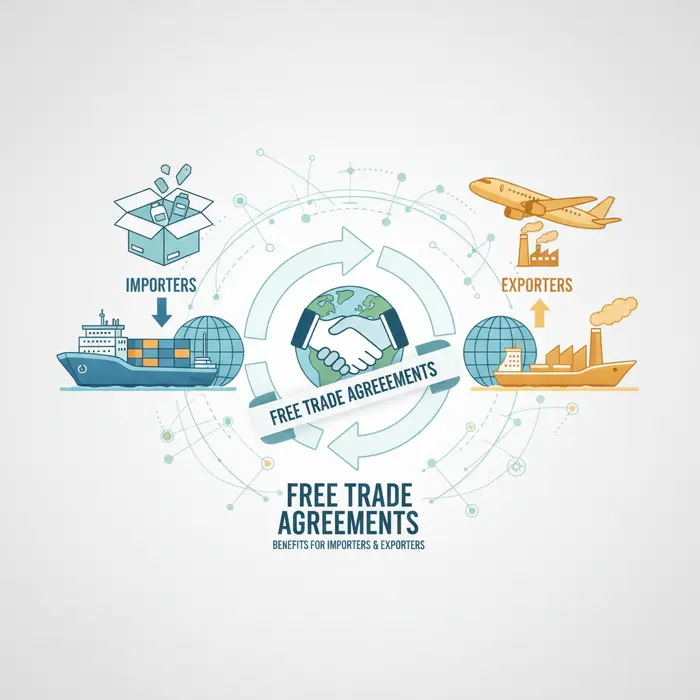
Free trade agreements (FTAs) have become indispensable tools for businesses looking to expand their global reach and optimize supply chains. These bilateral or multilateral accords are designed to reduce barriers to trade, fostering a more interconnected and efficient international marketplace. For companies involved in importing and exporting, understanding and leveraging FTAs can translate into significant competitive advantages, directly impacting profitability and operational fluidity. This section delves into the profound advantages that FTAs offer, particularly focusing on how they can reduce costs and streamline operations for importers and enhance market access for exporters, highlighting the crucial impact of International trade policy impact on global commerce.
1.
Reducing Customs Duties and Preferential Tariffs
Perhaps the most direct and tangible benefit of FTAs for importers is the reduction or outright elimination of Customs duties and trade barriers. Before an FTA, goods crossing international borders are subject to tariffs, which are taxes levied by the importing country. These duties directly increase the cost of goods, making them more expensive for consumers or reducing profit margins for businesses. FTAs systematically dismantle these tariff walls, allowing goods originating from signatory countries to enter partner markets at significantly lower, or even zero, duty rates. This creates a powerful incentive for businesses to source components or finished products from FTA partner countries, leading to substantial cost savings. For exporters, this means their products become more competitive in foreign markets, as the final price to the consumer or business is lowered, effectively expanding market share. Understanding these WTO rules and international trade law provisions is fundamental for maximizing these benefits, as they often underpin the preferential treatment offered by FTAs.
2.
Streamlining Trade Procedures and Bureaucracy
Beyond tariff reductions, FTAs often include provisions aimed at simplifying and standardizing customs procedures, thereby significantly reducing administrative burdens and delays. This streamlining encompasses various aspects, such as harmonizing customs forms, implementing single-window systems for document submission, and promoting electronic data exchange. The goal is to make the movement of goods across borders faster, more predictable, and less costly. For importers, this means quicker customs clearance, reduced demurrage charges, and improved supply chain efficiency. Exporters benefit from a smoother export process, ensuring that their goods reach international markets promptly and reliably. This reduction in red tape is a critical aspect of Free trade agreements benefits for importers and exporters alike, contributing to a more efficient global logistics network and allowing businesses to focus more on innovation and market expansion rather than administrative hurdles.
3.
Navigating Rules of Origin and Compliance Requirements
While FTAs offer numerous advantages, accessing preferential tariffs is not automatic; it hinges on compliance with specific Rules of Origin (ROO). Rules of Origin are criteria used to determine the national source of a product. To qualify for reduced or zero tariffs under an FTA, goods must typically originate entirely within a signatory country or undergo substantial transformation there. This might involve a specific percentage of local content, a change in tariff classification, or certain manufacturing processes. Navigating Global Trade Regimes effectively requires a thorough understanding of these complex rules, as missteps can lead to disqualification for preferential treatment and potential penalties. Importers must diligently verify their suppliers’ compliance, often requiring Certificates of Origin or specific declarations. Exporters, in turn, must ensure their production processes meet the ROO requirements to provide their international buyers with the necessary documentation. Despite their complexity, many FTAs include provisions for technical assistance and capacity building to help businesses understand and comply with these rules, ensuring the benefits are accessible to a wider range of participants. This critical aspect underscores the importance of robust internal compliance systems and expert guidance when engaging in international trade under FTA frameworks. For further insights into managing these complexities, businesses can explore resources on Navigating Global Trade Regimes.
In conclusion, Free Trade Agreements are powerful instruments that reshape the landscape of international commerce. By systematically lowering Customs duties and trade barriers, streamlining administrative processes, and creating clear frameworks for market access, they provide tangible benefits for both importers and exporters. While the intricacies of International trade policy impact, including WTO rules and international trade law and Rules of Origin, demand careful attention, the strategic advantages gained in terms of cost savings, increased efficiency, and expanded market opportunities make FTAs an essential component of any globally oriented business strategy. Businesses that proactively understand and leverage these agreements are better positioned to thrive in the dynamic and competitive global marketplace.
Customs Duties and Other Trade Barriers Explained
In the complex world of international commerce, businesses routinely encounter regulations and costs that significantly impact supply chains and profitability. Among the most prevalent are customs duties, often referred to as tariffs, and a diverse range of non-tariff barriers. Understanding these elements is crucial for Navigating Global Trade Regimes effectively. This section provides a comprehensive look at these trade impediments, explaining their purpose, impact on global trade, and strategic approaches for mitigating their effects, thereby enhancing global trade efficiency.
1. Types of Customs Duties: Ad Valorem, Specific, and Compound
Customs duties are taxes levied on goods crossing international borders, primarily to generate revenue and protect domestic industries. They typically fall into three categories:
- Ad Valorem Duties: Calculated as a percentage of the declared value of imported goods. For example, a 10% ad valorem duty on goods valued at $10,000 results in a $1,000 duty. This method requires accurate valuation, which can sometimes be complex.
- Specific Duties: A fixed monetary amount charged per unit of measure, regardless of the goods’ value (e.g., $2.00 per kilogram). Simple to calculate, but can disproportionately affect lower-value goods.
- Compound Duties: Combine both ad valorem and specific duties, offering targeted protection or revenue generation. An example is a 5% ad valorem duty plus $0.50 per unit. This structure can add complexity to calculations but offers greater policy flexibility.
The choice of duty type often reflects specific policy objectives, influencing international trade policy impact and industry competitiveness.
2. Understanding Non-Tariff Barriers (Quotas, Regulations, Standards)
Beyond financial levies, non-tariff barriers (NTBs) are restrictions governments use to limit imports. More subtle than tariffs, they can be equally impactful. NTBs often serve legitimate purposes like protecting public health or the environment, but can also be disguised protectionism. Key types include:
- Quotas: Quantitative restrictions on the volume or value of goods imported or exported during a specified period. Import quotas limit product entry, protecting domestic producers and potentially raising consumer prices.
- Regulations: A wide array of governmental rules, from import licensing to environmental laws. These can be significant trade barriers if foreign producers find it difficult or costly to comply with host country rules, often requiring extensive documentation.
- Standards: Technical, health, safety, and sanitary/phytosanitary (SPS) measures. These dictate product specifications, packaging, testing, and labeling. Divergent national standards create hurdles for exporters, requiring product adaptation and increasing costs. WTO rules and international trade law aim to minimize trade-distorting effects of such measures while allowing legitimate protections.
Navigating these NTBs demands thorough market research and deep understanding of local compliance requirements, making them critical aspects of global trade strategy.
3. Strategies for Tariff Mitigation and Duty Avoidance
Proactively addressing customs duties and other trade barriers is essential for maintaining competitive pricing and market access. Several strategies can help mitigate these complexities:
- Leveraging Free Trade Agreements (FTAs): FTAs eliminate or significantly reduce tariffs on goods traded between member nations. Businesses can benefit from Free trade agreements benefits for importers by qualifying products for preferential treatment, reducing or eliminating duties.
- Duty Drawback Programs: Many countries refund customs duties paid on imported materials that are subsequently re-exported (original form or as components). This significantly reduces costs for re-exporters.
- Bonded Warehouses and Foreign Trade Zones (FTZs): Importing goods into these zones allows businesses to defer or avoid duties until goods enter the domestic market. They offer flexibility for inventory management and re-export without immediate duty payments.
- Proper Classification and Valuation: Accurate Harmonized System (HS) classification and correct valuation of goods are paramount. Misclassification leads to overpayment or penalties. Consulting with customs brokers or trade compliance experts helps navigate these regulations.
- Supply Chain Optimization: Strategic sourcing and optimizing supply chain routes can reduce exposure to high-tariff regions or leverage lower duty rates from specific origins.
- Compliance Expertise for NTBs: For non-tariff barriers, continuously monitoring regulatory changes, investing in compliance expertise, and designing products to meet multiple international standards from the outset can minimize delays and costs. Engaging with local partners is often invaluable.
By implementing these strategies, businesses can effectively manage the financial and operational challenges posed by customs duties and non-tariff barriers, fostering more efficient and profitable international trade.
WTO Rules and the Future of International Trade Law
The World Trade Organization (WTO) stands as the cornerstone of the multilateral trading system, providing a framework for Navigating Global Trade Regimes through a comprehensive set of rules and principles. Its mission is to ensure that trade flows as smoothly, predictably, and freely as possible, thereby fostering economic growth and development worldwide. The WTO’s pivotal role extends from establishing fundamental principles that govern global commerce to providing a robust mechanism for resolving trade disputes among its member states. However, like any evolving international institution, it faces ongoing challenges that necessitate adaptation and reform to remain relevant in a rapidly changing global economy.
1. Core Principles of the WTO: MFN and National Treatment
At the heart of the WTO’s regulatory framework lie its foundational principles: Most-Favoured-Nation (MFN) treatment and National Treatment. The MFN principle dictates that a WTO member must treat all other members equally. If a country grants a special favour, such as a lower customs duty rate for a particular product, to one trading partner, it must extend that same treatment to all other WTO members. This principle is crucial for preventing discriminatory trade practices and promoting a level playing field across the global economy, directly influencing the international trade policy impact for all participants.
The National Treatment principle, on the other hand, requires that once imported goods, services, or intellectual property have entered a country’s market, they must be treated no less favourably than domestically produced goods, services, or intellectual property. This means that internal taxes, regulations, and other domestic policies should not discriminate against imports. Together, MFN and National Treatment serve as powerful tools to dismantle protectionist barriers and facilitate fair competition, making them indispensable for effective global trade management and reducing the potential for arbitrary customs duties and trade barriers.
2. The WTO’s Dispute Settlement Body and Its Effectiveness
One of the WTO’s most significant achievements is its robust Dispute Settlement Body (DSB), often hailed as the cornerstone of the rules-based multilateral trading system. The DSB provides a legal mechanism for member countries to resolve trade disputes in a structured and impartial manner, rather than resorting to unilateral actions. The process typically begins with consultations between the disputing parties, followed by the establishment of a panel to hear the case and issue a report. If appealed, the case goes to the Appellate Body, which reviews legal aspects of the panel’s findings. This system ensures that WTO rules and international trade law are enforced consistently.
Historically, the DSB has been highly effective in depoliticizing trade conflicts and ensuring compliance with WTO agreements. It has resolved hundreds of disputes, leading to the removal of discriminatory practices and illegal customs duties and trade barriers, thereby fostering greater predictability in international trade. However, the DSB has faced significant challenges in recent years, particularly with the paralysis of its Appellate Body due to a lack of appointments. This impasse threatens the binding nature of its rulings and is a major hurdle for maintaining a stable international trading environment, highlighting the urgent need for reform to preserve its vital role.
3. Challenges and Reforms for Global Trade Governance in 2025
As the global economy evolves, the WTO faces a myriad of challenges that test its adaptability and the very foundation of international trade policy impact. The rise of protectionism, the increasing prevalence of unilateral trade measures, and the ongoing geopolitical tensions threaten the multilateral trading system. Additionally, new issues such as digital trade, climate change, and global supply chain resilience demand updated rules and innovative approaches that the current WTO framework struggles to address adequately. The perceived benefits of free trade agreements benefits for importers are often highlighted, prompting discussions on how these regional agreements can complement or complicate the global WTO system.
Looking ahead to 2025, there is a strong consensus among many member states that significant reforms are needed to strengthen the WTO and ensure its continued relevance. This includes revitalizing the dispute settlement mechanism, updating the rulebook to cover 21st-century trade issues, and enhancing the organization’s deliberative functions. Successfully Navigating Global Trade Regimes in the coming years will depend on members’ willingness to engage in constructive dialogue and compromise. The future of international trade law hinges on the WTO’s ability to evolve, providing a credible and effective platform for reimagining how nations approach complex trade challenges and foster a truly inclusive global trading system.
Partner with Vietnam’s Leading Suppliers
Looking for reliable suppliers in Vietnam? Contact VietnamSuppliers.com today to connect with verified manufacturers and exporters across all industries.
—————————————
References
– About the WTO: https://www.wto.org/english/thewto_e/whatis_e/whatis_e.htm
– World Trade Organization (WTO) outlines the foundational principles of international trade law: https://www.wto.org/english/thewto_e/whatis_e/tif_e/fact4_e.htm
– WTO rules and international trade law: https://www.wto.org/english/thewto_e/whatis_e/tif_e/agrm7_e.htm
– WTO rules and international trade law: https://www.wto.org/english/thewto_e/whatis_e/tif_e/agrm7_e.htm
– Maintaining a stable international trading environment: https://www.wto.org/english/thewto_e/whatis_e/tif_e/disp1_e.htm