
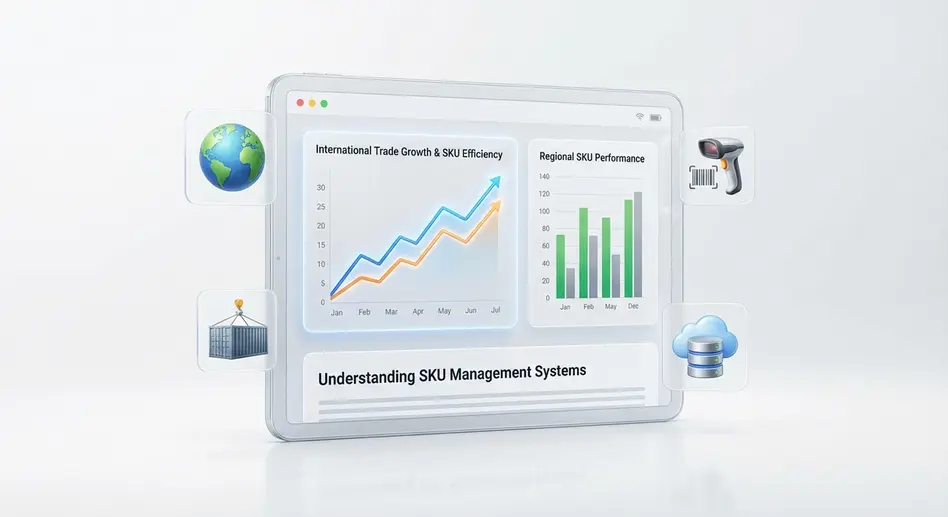
Understanding SKU Management Systems for International Trade
In the complex landscape of global commerce, maintaining visibility over inventory is often the primary differentiator between profitability and logistical failure. For companies operating across diverse borders, a robust SKU management system serves as the central nervous system of the supply chain. It allows businesses to track products across various digital platforms and international markets, ensuring that every variant—whether it differs by color, size, or regional compliance—is accounted for in real-time. Without a structured system, the friction of international trade can quickly lead to overstocking, stockouts, and dissatisfied B2B partners.
1. Core functions of a SKU management system
A sophisticated SKU management system does much more than just list items; it organizes data to facilitate rapid decision-making. For exporters, the primary function is the synchronization of stock levels across multiple warehouses and various e-commerce channels. Effective B2B inventory management for Vietnam suppliers involves tracking raw materials and finished goods through various production stages to meet the demands of international buyers.
Key functions include automated replenishment alerts, sales trend analysis, and variant tracking. By leveraging these tools, businesses can achieve SKU optimization for global logistics, reducing carrying costs while ensuring high-demand items never go out of stock. For instance, understanding the lifecycle of Stock Keeping Units (SKUs) help managers identify which specific product configurations are underperforming in certain regions, allowing for more strategic inventory allocation and improved cash flow management.
2. SKU vs UPC for international trade: Choosing the right identifier
One of the most common points of confusion for new exporters is the distinction between SKU vs UPC for international trade. While both are essential identifiers, they serve very different purposes. A UPC (Universal Product Code) is a standardized, external identifier regulated by global organizations, intended for retail point-of-sale systems worldwide. In contrast, a SKU is an internal code unique to your specific business operations.
While the UPC remains constant regardless of who sells the product, your internal SKU can be customized to include vital metadata such as manufacturer codes, material types, or specific warehouse locations. For exporters, reconciling these two systems is vital for operational efficiency. A UPC ensures your product can be scanned in a warehouse in Hamburg or a retail store in Los Angeles, but your SKU management system is what tracks the internal lifecycle, manufacturing batch, and profitability of that same item across your entire enterprise.
3. Why exporters need customized internal tracking
Standardized codes often fall short when dealing with the nuances of international shipping and localized marketing requirements. This is where looking at stock keeping unit examples for exporters becomes highly illustrative. Consider a Vietnam-based electronics manufacturer exporting to both the European Union and the United Kingdom. While the physical device might be identical, the packaging, power adapters, and warranty documentation must differ to meet regional regulations.
Customized SKUs allow the exporter to differentiate these versions internally. A code like “VN-ELC-ADPT-EU-01” tells the logistics team immediately that this is a Vietnam-made electronic item with a European adapter. Without this level of granular detail, inventory mix-ups become inevitable, leading to costly international returns and damaged brand reputations. Furthermore, customized tracking supports better financial reporting, as it allows for the analysis of landed costs and profit margins on a per-market basis, rather than relying on a generic, product-wide average that might hide regional losses.
Stock Keeping Unit Examples for Global Exporters
For global exporters, operational efficiency begins at the identification level. A Stock Keeping Unit (SKU) is more than just a random string of numbers; it is a unique alphanumeric identifier used to track inventory internally. Unlike universal barcodes, a robust SKU management system allows businesses to categorize products based on specific attributes like origin, material, and destination market, providing the granularity needed for high-volume trade.
1. Common stock keeping unit examples for exporters
When discussing SKU vs UPC for international trade, the primary difference lies in the scope and customization. While a UPC is a standardized barcode meant for retail point-of-sale globally, an SKU is tailored to a company’s internal needs. For instance, a textile exporter might use stock keeping unit examples for exporters such as “SILK-BLU-LRG-VN” to represent a Blue Silk garment in Large size manufactured in Vietnam.
In the realm of SKU vs UPC for international trade, having a clear internal code helps in customs documentation and warehouse sorting. For B2B inventory management for Vietnam suppliers, these codes often incorporate batch numbers or production years (e.g., “COF-ROB-2023-B1”) to ensure first-in, first-out (FIFO) logistics and compliance with international traceability standards. This level of detail is vital when shipping perishable goods or fashion items that cycle through seasons quickly.
2. How to structure alphanumeric SKU codes
A logical SKU structure is the backbone of SKU optimization for global logistics. The goal is to create a code that is “human-readable” yet compatible with warehouse management software. A standard hierarchy usually moves from broad to specific attributes:
- Brand/Line: The first 2-3 characters (e.g., “NK” for Nike).
- Product Category: The next segment (e.g., “SH” for Shoes).
- Variant Details: Color, size, or material (e.g., “RD-10” for Red, Size 10).
- Warehouse/Region: Essential for exporters to track inventory across global hubs (e.g., “US” or “EU”).
An example of a structured code would be “NK-SH-RD-10-US”. By following this logic, teams can identify products without needing to scan a database, reducing picking errors in large fulfillment centers. Effective SKU optimization for global logistics involves keeping these codes under 12 characters to avoid confusion during manual entry and ensuring they do not begin with a zero, which can cause formatting issues in spreadsheet software.
3. Managing product variants across different regions
Scaling globally requires a sophisticated SKU management system to handle regional variants. A product sold in Japan might have different packaging, voltage requirements, or language instructions than the same product sold in the United States. Managing these as distinct SKUs is critical to prevent fulfillment errors that lead to costly international returns.
For B2B inventory management for Vietnam suppliers, segmenting SKUs by region allows for more accurate demand forecasting. If the “VN-Mkt” variant is selling faster than the “EU-Mkt” variant, the supplier can adjust production schedules accordingly. Furthermore, a centralized management system ensures that inventory levels are updated in real-time across multiple sales channels, from Alibaba and Amazon Global Store to local distributors. By mastering SKU architecture, exporters can minimize stockouts, reduce overhead costs, and ensure that the right product reaches the right market every time.
B2B Inventory Management for Vietnam Suppliers
Vietnam has emerged as a premier global manufacturing powerhouse, attracting significant foreign investment and becoming a critical hub for electronics, textiles, and furniture. However, as orders scale in volume and complexity, the challenges of tracking goods across vast supply chains become more apparent. Implementing a robust SKU management system is no longer an optional upgrade; it is a fundamental necessity for maintaining operational efficiency and meeting the rigorous demands of international trade partners.
1. Challenges in B2B inventory management for Vietnam suppliers
Vietnamese manufacturers often encounter unique hurdles when transitioning from domestic production to high-volume B2B exports. One of the primary challenges is the fragmentation of raw material sourcing. Many suppliers in regions like Binh Duong or Bac Ninh rely on a mix of local and imported components, which can lead to inconsistencies in inventory tracking. Without a tailored approach to B2B inventory management for Vietnam suppliers, businesses often suffer from either overstocking—which ties up valuable capital—or stockouts, which can result in heavy penalties from international buyers.
Furthermore, the physical infrastructure of many traditional warehouses in Vietnam is still catching up to modern logistics demands. The lack of standardized labeling across different production lines often leads to confusion during the fulfillment process. This is particularly problematic when managing SKU optimization for global logistics, where every minute spent searching for a misplaced pallet adds to the shipping lead time and reduces the overall competitiveness of the supplier.

2. Integrating manufacturing outputs with global SKU systems
To successfully compete on a global stage, Vietnamese exporters must bridge the gap between internal production codes and international identification standards. A common point of confusion for many local firms is the distinction between SKU vs UPC for international trade. While a UPC (Universal Product Code) is a standardized barcode assigned to a product for retail sale globally, a SKU (Stock Keeping Unit) is an internal alphanumeric code that helps a business track its specific inventory variations, such as size, color, and material.
Effective stock keeping unit examples for exporters often involve a hierarchical naming convention. For instance, a garment manufacturer might use a code like “COT-TSH-BLU-LG-001” to immediately identify a cotton t-shirt, blue, size large, from batch one. By standardizing these identifiers, suppliers can provide much-needed transparency to their logistics partners. According to GS1 Global Standards, utilizing standardized identification systems is the bedrock of visibility across the entire supply chain, ensuring that products are traceable from the factory floor in Vietnam to a retail shelf in Europe or North America.
3. Digital transformation for Vietnamese export warehouses
As the Industry 4.0 movement gains momentum across Southeast Asia, the push for digital transformation in Vietnamese export warehouses is accelerating. Moving away from manual spreadsheets and paper-based tracking toward a centralized digital platform allows for real-time data synchronization. This shift is vital for managing the complex demands of B2B relationships where buyers expect instant updates on order status and stock availability.
Digital systems significantly reduce human error during the picking and packing process, which is often where the most costly mistakes occur in international shipping. By leveraging cloud-based inventory software, Vietnam-based suppliers can offer their clients real-time inventory visibility. This not only builds trust but also allows for more agile production planning. When manufacturers can see exactly how much raw material is on hand and where finished goods are located in the warehouse, they can optimize their throughput and ensure that they are meeting the strict delivery windows required by global retail giants. In the long run, investing in these technologies is the most effective way for Vietnamese suppliers to solidify their position in the global supply chain.
SKU Optimization for Global Logistics Efficiency
In the high-stakes world of international trade, efficiency is the difference between a profitable quarter and a logistical nightmare. For exporters operating across borders, managing thousands of individual items requires more than just basic tracking; it demands a sophisticated SKU management system. By refining how products are categorized, labeled, and tracked, companies can significantly reduce overhead costs and streamline the movement of goods through complex global supply chains.
1. Eliminating ‘SKU creep’ in multi-market operations
As businesses scale into new territories, they often fall victim to ‘SKU creep’—the unnecessary and uncontrolled expansion of product variations that clutter warehouses and complicate logistics. In the realm of B2B inventory management for Vietnam suppliers, this often occurs when localized packaging or minor regional adjustments lead to duplicate database entries. To combat this, exporters must clearly define the roles of their identifiers. Understanding the distinction of SKU vs UPC for international trade is vital: while a UPC is a universal barcode for retail, a SKU is an internal tool that should be optimized for operational logic. Effective stock keeping unit examples for exporters include alphanumeric codes that incorporate size, material, and destination indicators without creating redundant data points. By auditing these codes, suppliers can consolidate their inventory, ensuring that only high-demand variations occupy valuable warehouse space and administrative bandwidth.
2. SKU optimization for global logistics and port transit
Logistics bottlenecks at major global ports are often exacerbated by poor inventory documentation and fragmented data. SKU optimization for global logistics is not merely about reducing the number of items in a catalog; it is about ensuring that every unit is mapped accurately to international shipping manifests and customs declarations. When a shipping container holds a clean, optimized set of SKUs, the customs clearance process becomes faster and more predictable. This is particularly crucial for Southeast Asian trade hubs where throughput speed determines the viability of perishable or time-sensitive goods. According to industry insights on global supply chain resilience, streamlining product portfolios can reduce logistics costs by up to 15%. A lean SKU list minimizes the risk of mislabeling and reduces the time spent on manual inspections during port transit, allowing for a more fluid movement of goods from the factory floor to the final international destination.
3. Using data analytics to identify high-performing units
The final pillar of modern inventory control is the application of data analytics to perform ‘SKU rationalization.’ Not all products contribute equally to the bottom line; typically, the Pareto principle applies, where 20% of SKUs drive 80% of the revenue. By integrating an advanced SKU management system, exporters can identify ‘dead stock’—items that have not moved in over six months—and liquidate them to free up capital and shelf space. For those engaged in B2B inventory management for Vietnam suppliers, this data-driven approach allows for more accurate forecasting of seasonal demand fluctuations. By focusing resources on high-performing units, companies can optimize their container loads, ensuring that every cubic meter of shipping space is utilized for products with high turnover rates. This strategic pruning ensures that the logistics chain remains agile, cost-effective, and prepared for the inherent volatility of the global market.
Implementing Your SKU Management System for 2025
In the rapidly evolving landscape of international trade, the efficiency of your SKU management system determines your ability to scale and maintain a competitive edge. As global supply chains become more complex, transitioning from manual spreadsheets to a centralized digital roadmap is no longer optional—it is a strategic necessity. For exporters looking to penetrate new markets in 2025, the distinction between internal tracking and external identification is crucial. Understanding SKU vs UPC for international trade is the first step toward building a unified inventory logic that works across different regulatory environments and logistics networks.

1. Key features to look for in 2025 trade software
Selecting the right software requires a forward-looking approach. By 2025, top-tier platforms must offer more than just basic quantity tracking. They should provide granular data fields that support stock keeping unit examples for exporters, such as Harmonized System (HS) codes, country of origin, and sustainability certifications. These features allow businesses to automate customs documentation and ensure compliance at every border.
Additionally, look for AI-driven demand forecasting and multi-currency valuation. A robust system should allow you to categorize items based on velocity, value, and lead times, ensuring that your capital isn’t tied up in stagnant inventory while high-demand items face stockouts.
2. Automating SKU updates across global marketplaces
For modern traders, manually updating stock levels across Amazon, Alibaba, and regional B2B platforms is an invitation for error. Automation is the cornerstone of effective B2B inventory management for Vietnam suppliers who need to synchronize data between manufacturing hubs and international distribution centers. When an order is placed in Europe, your system should instantly reflect that change in your Asian warehouse records.
Automated SKU updates eliminate the risk of overselling and improve customer trust. By integrating your management software with API connectors, you can ensure that product descriptions, pricing, and availability remain consistent across all digital touchpoints, regardless of time zones or regional market fluctuations.
3. Best practices for SKU data integrity and security
As you digitize your inventory, protecting the integrity of your data becomes paramount. Implementing a standardized naming convention is the foundation of SKU optimization for global logistics. A well-structured SKU should be alphanumeric and follow a logical hierarchy—starting with broad categories (like material or product type) and moving toward specific attributes (like size or color).
Security is equally vital. In 2025, your management system must feature role-based access controls to prevent unauthorized changes to product data. Regular audits and cloud-based backups ensure that your trade operations remain resilient against cyber threats or hardware failures. By maintaining high data standards, you simplify the audit process for international trade partners and logistics providers, ultimately speeding up the movement of goods across the global stage.
Partner with Vietnam’s Leading Suppliers
Looking for reliable suppliers in Vietnam? Contact VietnamSuppliers.com today to connect with verified manufacturers and exporters across all industries.
—————————————
References
– Stock Keeping Units (SKUs) definition and importance: https://www.investopedia.com/terms/s/skunit.asp
– GS1 Standards for Barcodes and UPC: https://www.gs1.org/standards/barcodes/ean-upc
– GS1 Global Standards: https://www.gs1.org/standards/get-involved/sectors/logistics
– global supply chain resilience: https://www.mckinsey.com/capabilities/operations/our-insights/how-to-build-a-more-resilient-supply-chain
– SKU vs UPC for international trade: https://www.gs1.org/standards/barcodes/ean-upc

