
Understanding FOB Shipping Terms in International Trade
In the intricate world of global commerce, precise communication and clear allocation of responsibilities are paramount. Among the various shipping terms, FOB (Free On Board) stands out as one of the most widely used and fundamentally important. This section will introduce what FOB means in international trade, its fundamental principles, and why it’s a critical term for businesses engaged in importing and exporting, shaping how goods move across borders and oceans.
1.
What is FOB (Free On Board)?
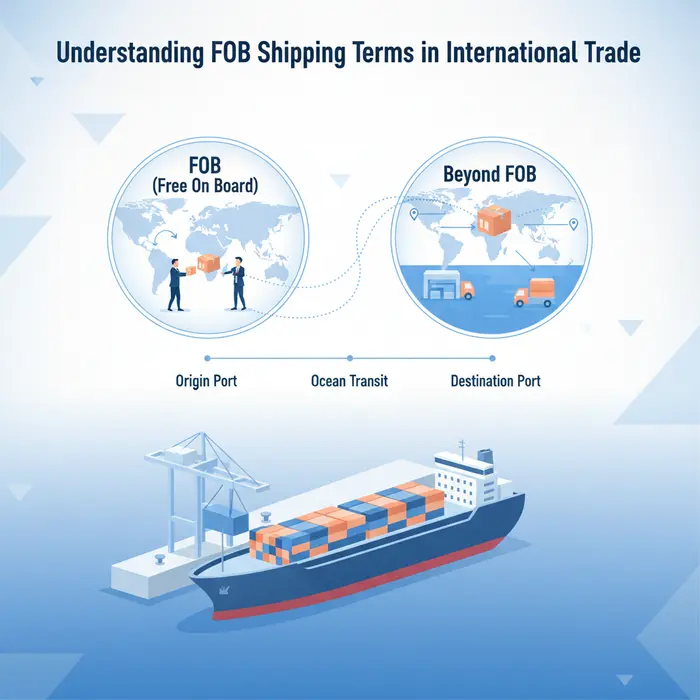
FOB, which stands for “Free On Board,” is an Incoterm (International Commercial Term) that defines the point at which the responsibility and risk for goods transfer from the seller to the buyer. Specifically, under FOB, the seller fulfills their obligation to deliver when the goods are placed on board the vessel nominated by the buyer at the named port of shipment. From this moment onwards, the buyer bears all costs and risks of loss of or damage to the goods.
The current framework, known as FOB Incoterms 2020, solidifies these definitions, ensuring a globally recognized standard for trade. This term is exclusively used for sea and inland waterway transport. It signifies a clear delineation, making it easier for both parties to understand their obligations and manage their logistics. Without such clarity, international transactions would be fraught with ambiguity, leading to disputes and delays.
2.
The Core Principles of FOB Shipping
The essence of FOB shipping lies in its clear allocation of two primary elements: cost and risk. Understanding these allocations is crucial for effective supply chain management and financial planning.
- Transfer of Risk: The most significant principle of FOB is the point of risk transfer. Once the goods are loaded onto the designated vessel at the port of shipment, the risk of loss or damage shifts entirely from the seller to the buyer. This means that if anything happens to the cargo during transit – say, it’s damaged in a storm or lost overboard – the buyer is responsible for filing a claim with their insurance provider.
- Transfer of Cost: Along with risk, costs also transfer at the same point. The seller is responsible for all costs incurred to get the goods to the named port of shipment and load them onto the vessel. This includes packaging, inland transport to the port, loading charges, and any export customs formalities and duties. Once the goods are on board, the buyer assumes responsibility for all subsequent costs, including ocean freight, marine insurance, import customs clearance, duties, taxes, and inland transportation from the destination port to their final warehouse. This clear definition of FOB responsibilities buyer seller allows for precise budgeting and cost control.
Essentially, FOB empowers the buyer to control the main carriage and insurance, often leading to better freight rates and more predictable logistics, which can be particularly advantageous when dealing with high-volume shipments or specific carrier preferences.
3.
Why FOB is Crucial in Global Supply Chains
FOB plays a pivotal role in international trade for several reasons, impacting decision-making for both importers and exporters globally.
- Buyer Control and Cost Efficiency: For buyers, especially those with established logistics networks or significant purchasing power, FOB offers greater control over the shipping process. By managing the main carriage, buyers can negotiate freight rates directly with carriers, choose their preferred shipping lines, and often secure more competitive FOB prices Vietnam or from other sourcing regions. This direct control can lead to substantial cost savings and greater predictability in their supply chain.
- Clarity and Risk Management: The clear cut-off point for risk and cost transfer minimizes misunderstandings and potential disputes between trading partners. Both parties know precisely when their responsibilities begin and end, allowing for appropriate insurance coverage and proactive risk management strategies. This transparency is invaluable in complex global transactions.
- Strategic Procurement: Many experienced importers strategically opt for FOB over other terms like CIF (Cost, Insurance, and Freight). While CIF might seem simpler as the seller handles more, FOB gives the buyer autonomy. For instance, when comparing FOB vs CIF, FOB allows buyers to select their insurance provider, potentially securing better coverage or rates tailored to their specific goods and routes. This strategic choice helps businesses optimize their procurement processes and overall supply chain resilience.
In essence, understanding and correctly applying FOB Shipping Terms International Trade is not just about adhering to international standards; it’s about making informed strategic decisions that impact profitability, risk exposure, and operational efficiency for businesses worldwide.
FOB Incoterms® 2020: Rules and Buyer/Seller Clarity
FOB (Free On Board) remains one of the most widely used Incoterms® rules for international trade, particularly when goods are transported by sea or inland waterway. Under Incoterms® 2020, FOB clearly delineates the precise moments of risk and cost transfer from seller to buyer, providing a critical framework for commercial transactions worldwide. Understanding these specific rules is paramount for both parties to mitigate disputes, streamline logistics, and ensure transparent pricing, especially when dealing with complex supply chains like those involving FOB Shipping Terms International Trade from regions like Vietnam.
1. The Role of Incoterms in Defining FOB
Incoterms®, published by the International Chamber of Commerce (ICC), are globally recognized rules defining seller and buyer responsibilities for the delivery of goods under sales contracts. They cover payment, shipment, insurance, documentation, and customs clearance. For FOB, these rules specify that the seller delivers goods on board the vessel nominated by the buyer at the named port of shipment. This marks the exact point where the risk of loss or damage transfers from seller to buyer. Without Incoterms®, interpreting these responsibilities could vary significantly based on national laws or trade customs, leading to ambiguity. FOB is strictly limited to situations where goods are shipped via sea or inland waterway, reinforcing its maritime-centric nature.
2. Key Changes and Clarifications in Incoterms 2020 for FOB
While some other Incoterms rules saw significant revisions in the 2020 edition, the core principles and obligations associated with FOB remained largely consistent with its Incoterms® 2010 predecessor. The ICC’s primary aim with Incoterms® 2020 was to enhance clarity, improve usability, and provide more detailed guidance on security-related requirements for carriage and the allocation of costs. For FOB, these general enhancements mean clearer cost allocation, especially regarding terminal handling charges and security requirements during loading onto the vessel. Emphasis is also placed on ensuring “on-board” bills of lading are issued correctly and timely, facilitating smooth payment processes. These clarifications ultimately aim to reduce misunderstandings and facilitate smoother international trade, impacting everything from small consignments to large-scale FOB prices Vietnam.
3. Specific Point of Delivery and Risk Transfer under FOB
Under FOB Incoterms® 2020, the specific point of delivery and, consequently, the transfer of risk is precisely defined: when the goods are loaded on board the vessel nominated by the buyer at the named port of shipment.
Seller’s Obligations: The seller is responsible for bringing the goods to the named port of shipment, clearing them for export (including licenses and customs formalities), and loading them onto the buyer’s nominated vessel. All costs and risks up to the moment goods are “on board” the vessel are borne by the seller. This includes pre-carriage, origin terminal charges, and loading costs. The seller must also provide proof of delivery, such as a clean “on board” bill of lading.
Buyer’s Obligations: Once goods are safely loaded on board the vessel, the risk of loss or damage transfers entirely to the buyer. From this point, the buyer is responsible for all subsequent costs and risks. This includes main carriage freight, marine insurance (buyer advised to arrange), unloading costs at destination, import customs clearance, and onward transportation. The buyer is also responsible for nominating the vessel and informing the seller of its details timely.
This clear distinction is critical for insurance, claims, and cost accounting. For instance, if goods are damaged during loading, it is the seller’s responsibility. If damage occurs once stowed on board or during the voyage, responsibility lies with the buyer. This precise definition makes FOB popular for traders seeking clear separation of responsibilities at a defined point, differing significantly from terms like CIF (Cost, Insurance and Freight) where the seller also arranges and pays for insurance and freight to the destination port, even though risk still transfers at the port of shipment.
By adhering to these rules, both buyers and sellers ensure their contracts align with Incoterms® 2020, promoting efficiency and reducing disputes in the complex landscape of international trade.
FOB Responsibilities: A Detailed Breakdown for Buyer and Seller
In the complex world of FOB Shipping Terms International Trade, Free On Board (FOB) stands as one of the most widely used and fundamental Incoterms. Defined and standardized by the International Chamber of Commerce (ICC) under Incoterms 2020, FOB delineates the precise point at which responsibility, costs, and risks transfer from the seller to the buyer. This clarity is paramount for businesses, especially those engaging in cross-border transactions, whether sourcing components or finished goods, for example, navigating FOB prices Vietnam. Understanding the distinct FOB responsibilities buyer seller is critical for smooth operations, cost predictability, and effective risk management from the moment cargo is loaded onto a vessel until its arrival at the final destination.

1. Seller’s Obligations: Loading, Customs, and Pre-Shipment Costs
Under FOB shipping terms, the seller’s obligations primarily revolve around ensuring the goods are ready for export and delivered to the named port of shipment, loaded onto the buyer’s designated vessel. Specifically, the seller is responsible for:
- Production and Packaging: Manufacturing the goods as per the contract and ensuring they are appropriately packed for international transport, capable of withstanding the journey.
- Pre-carriage to Port: Arranging and paying for the transportation of goods from their factory or warehouse to the agreed-upon port of loading.
- Export Customs Formalities: Handling all necessary export licenses, permits, security clearances, and customs declarations required by the exporting country. This includes paying any associated export duties or taxes.
- Loading on Board: Crucially, the seller must bear the costs and risks of loading the goods onto the vessel nominated by the buyer at the named port of shipment. The point at which the goods are successfully placed on board is the moment the seller’s primary responsibilities end.
All costs incurred up to and including the loading of the goods onto the vessel are typically included in the FOB price quoted by the seller.
2. Buyer’s Obligations: Freight, Insurance, and Import Clearance
Once the goods are loaded onto the vessel at the port of origin, the buyer assumes the majority of the subsequent responsibilities, costs, and risks. The buyer’s obligations under FOB Incoterms 2020 include:
- Vessel Nomination and Main Carriage: The buyer is responsible for contracting and paying for the main freight – the sea (or inland waterway) transport from the port of loading to the destination port. This includes nominating the vessel and ensuring its timely arrival at the loading port.
- Marine Insurance: While not strictly mandatory under FOB rules (unlike FOB vs CIF where the seller usually arranges it), it is highly advisable for the buyer to procure marine insurance to cover potential loss or damage to the goods during the main carriage. Since the risk shifts at the loading port, any incidents during transit are the buyer’s liability.
- Unloading at Destination: Paying for the costs associated with unloading the goods from the vessel at the destination port.
- Import Customs Clearance: Handling all import formalities in the destination country, including securing import licenses, permits, and paying import duties, taxes, and other charges.
- On-carriage to Final Destination: Arranging and paying for the transportation of the goods from the destination port to their final inland delivery point.
Essentially, the buyer manages and pays for everything from the moment the goods clear the ship’s rail at the origin port.
3. Managing Risk and Liability: When Does Responsibility Shift?
The definitive characteristic of FOB, and arguably its most critical aspect, is the precise point of risk transfer. Under FOB terms, the risk of loss of or damage to the goods passes from the seller to the buyer when the goods are on board the vessel nominated by the buyer at the named port of shipment. This means that once the goods are safely loaded, any subsequent damage, loss, or delay becomes the buyer’s responsibility.
This clear demarcation means that if the goods are damaged during transit on the main vessel, it is the buyer who must pursue a claim with their insurance provider or the carrier, not the seller. The seller’s liability ends once the goods are loaded. This is a fundamental difference when comparing FOB vs CIF, where under CIF, the seller typically covers insurance to the destination port, even though risk still transfers at the loading port. For global trade, particularly for businesses importing from manufacturing hubs, a robust understanding of this shift in liability is essential for managing supply chain resilience and avoiding costly disputes.
FOB vs. CIF: Choosing the Right Term for Your Shipments
In the complex world of international trade, understanding various shipping terms is crucial for managing costs, risks, and responsibilities. Among the most commonly used Incoterms are Free On Board (FOB) and Cost, Insurance, and Freight (CIF). These terms, defined by the International Chamber of Commerce (ICC) rules, dictate the precise point at which responsibility for goods—and associated costs—transfers from the seller to the buyer. Making an informed choice between FOB and CIF can significantly impact a business’s profitability, control over logistics, and exposure to risk. This guide will delve into the fundamental differences between these two vital FOB Shipping Terms International Trade, providing insights to help businesses, particularly those engaged in global sourcing or sales, make the right decision. Understanding these nuances is especially important when dealing with diverse markets, such as navigating FOB prices Vietnam, where local customs and infrastructure can influence logistical decisions.
1. Fundamental Differences in Cost and Risk Transfer
The core distinction between FOB and CIF lies in the allocation of costs and risks between the seller and the buyer.
FOB (Free On Board): Under FOB Incoterms 2020, the seller is responsible for delivering the goods on board the vessel nominated by the buyer at the named port of shipment. Once goods pass the ship’s rail, risk of loss or damage transfers from the seller to the buyer. This means the buyer is responsible for all subsequent costs, including ocean freight, insurance, and costs incurred from the port of loading to the final destination. The seller handles export customs clearance, while the buyer manages import customs and duties. This term is typically used for sea and inland waterway transport.
CIF (Cost, Insurance, and Freight): With CIF, the seller has greater responsibilities. The seller arranges and pays for main carriage (freight) to the named port of destination and provides minimum insurance coverage against the buyer’s risk during transit. However, the risk transfer still occurs when goods are loaded on board the vessel at the port of shipment (same as FOB responsibilities buyer seller). The buyer bears the risk during the main carriage, even though the seller pays for freight and insurance. The buyer is responsible for unloading costs, import customs, duties, and any further transport from the destination port. CIF is also specifically for sea and inland waterway transport.
A key takeaway: while cost responsibilities differ, the point of risk transfer for both FOB and CIF is the same – on board the vessel at the port of shipment. For official guidance on Incoterms, refer to the ICC Incoterms rules.
2. When to Opt for FOB: Advantages for the Buyer
Choosing FOB often provides significant advantages for the buyer, giving them greater control and potentially better cost management.
Control over Shipping: Under FOB, the buyer dictates the choice of freight forwarder and shipping line. This allows them to negotiate freight rates directly, consolidate shipments, and integrate logistics with their existing supply chain. This control can lead to cost savings, especially for experienced buyers with established relationships with carriers.
Transparency and Cost Efficiency: Buyers pay directly for main freight and insurance, offering transparency on these costs. They can compare quotes from multiple providers, potentially securing more competitive rates than a seller might offer. This is particularly relevant for businesses importing from regions like Vietnam, where understanding specific freight markets can yield considerable savings.
Insurance Management: With FOB, the buyer is responsible for arranging their own cargo insurance from the point of risk transfer. This allows them to choose their preferred insurer, select the exact coverage level (e.g., “all-risk” coverage), and manage claims directly, often leading to a smoother process if damage or loss occurs.
3. When to Consider CIF: Advantages for the Seller
While FOB often favors the buyer, CIF terms can be advantageous for sellers, especially in specific scenarios.
Simplified Logistics for Buyers (Easier Sales): For buyers who prefer a “hassle-free” purchase or lack international shipping experience, CIF simplifies the process. The seller handles shipping arrangements to the destination port, presenting an all-inclusive price. This can be a strong selling point for new or less experienced importers.
Negotiating Power and Cost Control for Sellers: Sellers often have established relationships with freight forwarders, allowing them to secure bulk rates or favorable terms. By arranging freight and insurance, sellers can sometimes mark up these costs, potentially adding a small profit margin to the overall CIF price. This also gives the seller control over carrier choice and routes, ensuring preferred, reliable partners are used.
Competitive Edge in Pricing: Offering CIF prices can be a competitive advantage, as it presents a single, comprehensive cost to the buyer up to their port of destination. This can make the seller’s offer appear more attractive and straightforward compared to an FOB price, simplifying the buyer’s decision-making process.
Conclusion:
The decision between FOB and CIF ultimately depends on a company’s internal capabilities, risk appetite, and strategic objectives. Buyers with strong logistics teams and a desire for cost control often prefer FOB, while sellers looking to offer a more comprehensive service or leverage their shipping relationships might lean towards CIF. Thoroughly evaluating the implications of each term on cost, responsibility, and control is essential for successful international trade operations.
Navigating FOB Prices: Focus on Vietnam and Negotiation Tips
Understanding Free On Board (FOB) pricing is pivotal for international trade, especially when sourcing from dynamic markets like Vietnam. FOB shipping terms international trade define where the seller’s responsibility ends and the buyer’s begins – typically when goods are loaded onto a vessel at the origin port. This section explores factors influencing FOB pricing, specifically for Vietnamese goods, and offers practical strategies for negotiating favorable terms.
1. Factors Influencing FOB Pricing from Source Countries
FOB, a core Incoterms 2020 rule, encompasses costs up to loading goods onto the buyer’s vessel. Key influencing factors include:
- Raw Material Costs: Fluctuations in global commodity markets directly impact product pricing.
- Labor Costs: Competitive wages in source countries significantly reduce manufacturing expenses.
- Manufacturing Overheads: Factory expenses, utilities, and management contribute to per-unit costs.
- Local Transportation (Drayage): Costs for moving goods from factory to port, influenced by proximity and infrastructure.
- Export Documentation & Customs: Fees for essential paperwork and clearance.
- Supplier’s Profit Margin: Varies based on market demand, competition, and business strategy.
- Exchange Rates: Currency fluctuations can affect the final price in the buyer’s currency.
- Production Volume: Larger orders typically benefit from economies of scale, lowering per-unit costs.
Grasping these components is vital for effective cost analysis.
2. Case Study: Understanding FOB Prices for Goods from Vietnam
Vietnam’s rise as a manufacturing hub makes understanding its FOB dynamics crucial. When analyzing FOB prices Vietnam, consider:
- Competitive Labor & Skilled Workforce: Vietnam offers attractive labor costs, particularly in sectors like textiles, footwear, and electronics, directly impacting the labor component of FOB prices.
- Strategic Location & Infrastructure: Major ports like Ho Chi Minh City and Hai Phong, coupled with ongoing infrastructure investments, ensure efficient maritime logistics and reasonable drayage costs.
- Raw Material Sourcing: While strong in manufacturing, Vietnam often imports raw materials. The cost and logistics of these inputs can influence the final FOB price. Inquire about material origins.
- Government Policies & FTAs: Numerous Free Trade Agreements enhance the overall competitiveness of Vietnamese products, indirectly offering suppliers pricing flexibility.
- Product Specialization: Industries with established supply chains and expertise (e.g., apparel, furniture) often yield more competitive FOB responsibilities buyer seller due to optimized local networks.
These nuances allow buyers to better interpret quotes and engage in informed discussions with suppliers.

3. Strategies for Negotiating Favorable FOB Terms with Suppliers
Effective negotiation is key to optimizing your procurement. Employ these strategies to secure favorable FOB terms:
- Understand Cost Breakdown: Request an itemized FOB price to identify negotiation points across materials, labor, and overhead.
- Leverage Volume: Higher order quantities often unlock volume discounts, benefiting from economies of scale.
- Build Relationships: Strong, long-term partnerships can lead to greater flexibility in pricing and payment terms.
- Compare Multiple Quotes: Obtain quotes from several suppliers to benchmark fair pricing and gain leverage.
- Negotiate Payment Terms: Seek lower upfront deposits or extended payment windows to improve cash flow.
- Clarify FOB Incoterms 2020 Responsibilities: Prevent unexpected costs by ensuring mutual understanding of loading costs, port charges, and risk transfer.
- Consider Lead Times: Flexibility with delivery schedules might secure better rates, especially during off-peak production periods.
- Understand FOB vs CIF: Opting for FOB gives you control over freight and insurance, potentially allowing you to secure better rates through your own forwarders than a supplier might offer under CIF.
These strategies streamline your procurement, securing competitive and transparent FOB terms.
Partner with Vietnam’s Leading Suppliers
Looking for reliable suppliers in Vietnam? Contact VietnamSuppliers.com today to connect with verified manufacturers and exporters across all industries.
—————————————
References
– Incoterms Rules by ICC: https://iccwbo.org/resources-for-business/incoterms-rules/
– Incoterms 2020 introduction by ICC: https://iccwbo.org/publication/incoterms-2020-introduction/
– Incoterms 2020 Rules by ICC: https://iccwbo.org/publication/incoterms-2020-rules/
– ICC Incoterms rules: https://iccwbo.org/resources-for-business/incoterms-rules/
– :

