
Understanding the Landscape: FDA Import Regulations USA
Navigating the complexities of international trade, especially when targeting the lucrative American market, necessitates a profound understanding of the U.S. Food and Drug Administration (FDA) import regulations. For businesses looking to Export to USA FDA requirements are not merely bureaucratic hurdles but fundamental safeguards ensuring product safety and quality for American consumers. Adherence to these rigorous standards is not optional; it is the cornerstone of a successful US market entry FDA strategy, preventing costly delays, penalties, and reputational damage. This overview will delineate the FDA’s pivotal role, key product categories under its purview, and the critical consequences of non-compliance, providing a foundational understanding for every exporter.

1. What is the FDA and Its Role in Imports?
The U.S. Food and Drug Administration (FDA) is a federal agency of the Department of Health and Human Services, responsible for protecting public health by ensuring the safety, efficacy, and security of human and veterinary drugs, biological products, medical devices, the nation’s food supply, cosmetics, and products that emit radiation. Its mandate extends significantly beyond domestic products to encompass virtually all imported goods falling within these categories. For importers, the FDA acts as the primary gatekeeper, scrutinizing every shipment to verify compliance with U.S. health and safety standards. This includes evaluating product formulations, manufacturing processes, labeling, and ensuring that facilities adhere to Good Manufacturing Practices (GMP) or other relevant quality standards. The FDA’s robust oversight aims to prevent unsafe, misbranded, or adulterated products from reaching American consumers, making robust FDA import regulations USA knowledge indispensable for international trade. Exporters must be prepared with comprehensive International trade FDA documentation to facilitate smooth customs clearance.
2. Key FDA-Regulated Product Categories (Food, Drugs, Medical Devices)
The FDA’s regulatory reach is broad, covering a vast array of products critical to public health. Understanding which category your product falls into is the first step towards achieving FDA compliance checklist for exporters.
- Food Products: This category encompasses everything from raw agricultural commodities to processed, packaged foods, dietary supplements, and beverages. Key regulations include facility registration under the Food Safety Modernization Act (FSMA), hazard analysis and preventive controls (HARPC), and stringent labeling requirements. Importers of food must ensure their foreign suppliers are registered with the FDA and that their products meet U.S. food safety standards.
- Drugs: Both prescription and over-the-counter medications are subject to rigorous FDA approval processes. This involves extensive clinical trials, adherence to Current Good Manufacturing Practices (CGMPs), facility registration, and product listing. New drugs typically require a New Drug Application (NDA), while generic drugs follow an Abbreviated New Drug Application (ANDA) pathway. Foreign drug manufacturers must register their establishments and list their drug products with the FDA.
- Medical Devices: Ranging from simple bandages and syringes to complex pacemakers and diagnostic imaging equipment, medical devices are classified by risk (Class I, II, or III). Depending on the classification, devices may require pre-market notification (510(k)), pre-market approval (PMA), or simply general controls. Manufacturers must establish and maintain a Quality Management System (QMS) compliant with FDA’s Quality System Regulation (QSR) and register their establishments.
While food, drugs, and medical devices represent the most heavily regulated sectors, the FDA also regulates cosmetics and products that emit radiation, each with its own specific set of FDA import regulations USA.
3. Consequences of Non-Compliance: Detentions, Refusals, and Penalties
Failure to adhere to FDA regulations carries severe consequences that can jeopardize your US market entry FDA strategy and lead to significant financial losses.
- Detention: One of the most common outcomes of non-compliance is product detention. The FDA can detain imported goods at the port of entry if they appear to violate U.S. law. During detention, products cannot be moved into U.S. commerce, incurring storage costs and potential expiration. The importer is given an opportunity to present evidence of compliance, but this process can be lengthy and costly.
- Refusal of Admission: If a detained product is ultimately deemed inadmissible – for reasons such as being adulterated, misbranded, or manufactured in a non-compliant facility – it will be refused admission. The product must then either be re-exported out of the U.S. or destroyed under Customs and Border Protection (CBP) supervision, at the importer’s expense.
- Penalties and Legal Actions: Beyond detentions and refusals, the FDA has the authority to impose significant civil penalties, issue injunctions, seize products, and even pursue criminal prosecution in cases of serious or repeated violations. Non-compliant firms or individuals could face substantial fines, imprisonment, and disbarment from importing into the U.S.
- Brand and Reputation Damage: Perhaps less tangible but equally devastating, non-compliance can severely damage a brand’s reputation, erode consumer trust, and lead to a permanent loss of market access. The costs associated with rebuilding a damaged brand can far exceed any direct penalties.
To mitigate these risks, a thorough FDA compliance checklist for exporters and a proactive approach to understanding and fulfilling Export to USA FDA requirements are absolutely paramount. Engaging with regulatory experts and staying updated on the latest FDA guidance are crucial steps for any international business eyeing the U.S. market.
Building Your US Market Entry FDA Strategy
Venturing into the US market presents immense opportunities, but successfully navigating its regulatory landscape is paramount. For international businesses, understanding and adhering to the Export to USA FDA requirements is not merely a compliance task but a strategic imperative. A robust US market entry FDA strategy from the outset ensures not only seamless operations but also builds trust and credibility. This guide outlines essential steps and considerations for developing a strategic approach that guarantees FDA compliance from the very beginning of your export journey, minimizing delays and potential pitfalls associated with FDA import regulations USA.
1. Product Classification and Premarket Pathways (e.g., 510(k), PMA)
One of the foundational steps in your US market entry FDA strategy is accurately classifying your product. The FDA regulates a vast array of goods, from food and dietary supplements to pharmaceuticals, medical devices, and cosmetics, each with its own set of rules. For medical devices, pharmaceuticals, and certain biologics, classification dictates the specific premarket pathway you must follow. This could range from exemptions for low-risk devices, the 510(k) Premarket Notification for substantially equivalent devices, De Novo classification for novel low-to-moderate risk devices, to the rigorous Premarket Approval (PMA) for high-risk, life-sustaining devices. Misclassification can lead to significant delays or even rejection of your product. Therefore, it’s crucial to consult FDA guidance and potentially seek expert advice to determine the correct classification and navigate the appropriate premarket submission process. For instance, understanding how the FDA classifies medical devices is a critical first step for device manufacturers.
2. Foreign Supplier Verification Program (FSVP) and Preventive Controls for Food
For exporters of food and beverage products, the Foreign Supplier Verification Program (FSVP) and the Preventive Controls for Human Food rule, established under the FDA Food Safety Modernization Act (FSMA), are non-negotiable. FSVP mandates that US importers are responsible for verifying that their foreign suppliers meet US food safety standards. This means that if you’re exporting food to the USA, your US importer will need to perform risk-based verification activities to ensure the food you produce is safe. These activities might include on-site audits, sampling and testing, or a review of your food safety records. Similarly, if your product falls under the Preventive Controls for Human Food rule, you must implement and maintain a comprehensive food safety plan, including hazard analysis and risk-based preventive controls. Developing an FDA compliance checklist for exporters that addresses these FSMA requirements is vital for a smooth customs clearance process and avoiding potential import alerts or detentions.
3. Selecting and Utilizing a Qualified US Agent
For most foreign facilities manufacturing food, drugs, medical devices, or certain other FDA-regulated products for export to the US, appointing a US Agent is a mandatory requirement. The US Agent acts as a crucial communication link between your foreign establishment and the FDA. They are responsible for responding to FDA inquiries, assisting with facility registration, and often receiving information and inspection reports from the FDA. A qualified US Agent must reside or maintain a place of business in the United States and be available to the FDA during business hours. Choosing a knowledgeable and reliable US Agent is a key component of your US market entry FDA strategy, as they can significantly impact the efficiency of your communication with the agency and ensure critical regulatory information is promptly addressed. Their expertise in International trade FDA documentation and procedures can prove invaluable.
Developing a comprehensive US market entry FDA strategy requires diligent research, meticulous planning, and often, collaboration with regulatory experts. By proactively addressing product classification, adhering to food safety mandates like FSVP, and establishing a robust communication channel through a qualified US Agent, exporters can significantly enhance their chances of successful and sustained access to the American market. This strategic approach transforms potential hurdles into manageable steps, paving the way for long-term success.
The Essential FDA Compliance Checklist for Exporters
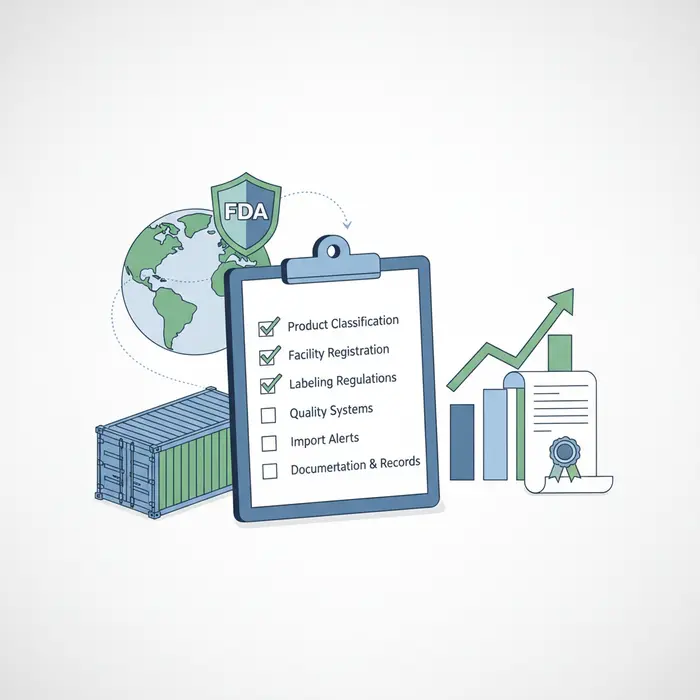
A practical, step-by-step checklist to guide exporters through the mandatory FDA compliance requirements, ensuring no crucial detail is overlooked.
To successfully navigate the complexities of international trade and tap into the lucrative American market, understanding and adhering to the U.S. Food and Drug Administration (FDA) regulations is paramount. Non-compliance can lead to detained shipments, product recalls, significant financial penalties, and irreversible damage to your brand’s reputation. This comprehensive guide provides an essential FDA compliance checklist for exporters, detailing critical steps to ensure your products meet all US market entry FDA strategy requirements. By meticulously following these guidelines, you can streamline your export to USA FDA requirements process and foster a smooth entry for your goods.
1. Facility Registration and Product Listing Requirements
The first foundational step for any exporter aiming for the U.S. market involves proper facility registration with the FDA and, in many cases, listing your products. This requirement applies to various categories, including food facilities, drug establishments, medical device manufacturers, and some cosmetic producers. For food facilities, registration is mandatory and must be renewed biennially between October 1 and December 31 of even-numbered years. Failure to register or renew promptly can result in your products being detained at the U.S. border under FDA import regulations USA.
For medical device manufacturers, registration involves both the establishment and the specific devices intended for sale. This process is detailed in 21 CFR Part 807 and requires annual re-registration. Similarly, drug establishments must register and list their drug products, providing detailed information about ingredients, manufacturing processes, and labeling. Even some dietary supplement manufacturers, while not requiring pre-market approval, fall under food facility registration rules and specific labeling requirements. Maintaining up-to-date registration and accurate product listings is a non-negotiable aspect of international trade FDA documentation and crucial for a successful US market entry FDA strategy. These records serve as the FDA’s primary method for tracking facilities and products, ensuring traceability and accountability within the supply chain.
2. Labeling and Packaging Compliance Standards (e.g., Nutrition Facts, IFU)
Once your facility and products are registered, the next critical hurdle is ensuring your product labeling and packaging meet stringent FDA standards. Labeling is not merely about aesthetics; it’s a vital communication tool that informs consumers and healthcare professionals about the product’s identity, ingredients, usage, and safety. Different product categories have distinct requirements:
- Food Products: Must include a Nutrition Facts panel, ingredient list (with allergens highlighted), net quantity of contents, manufacturer/distributor name and address, and country of origin. Health claims are highly regulated and must be scientifically substantiated.
- Dietary Supplements: Require a “Supplement Facts” panel, list of ingredients, net quantity, and clear identification as a dietary supplement.
- Cosmetics: Need an ingredient list (in descending order of predominance), net quantity, and manufacturer/distributor details. Certain claims (e.g., therapeutic effects) can classify a cosmetic as a drug, triggering stricter regulations.
- Drugs (OTC & Prescription): Follow highly specific formats, including “Drug Facts” panels for OTC drugs, active ingredients, warnings, directions for use, and expiration dates.
- Medical Devices: Require specific labeling that includes the manufacturer’s name, address, unique device identifier (UDI), warnings, and often Instructions For Use (IFU) documents. The IFU provides detailed information on how to safely and effectively use the device.
All labeling must be truthful, non-misleading, and presented in English. Understanding these intricate export to USA FDA requirements is essential, as incorrect labeling is a common reason for product rejection. For more detailed insights into navigating these regulations, especially for a smooth US market entry FDA strategy, refer to our comprehensive guide on Export to USA FDA requirements.
3. Quality Management Systems (QMS) & Good Manufacturing Practices (GMP)
Beyond registration and labeling, the FDA places immense importance on how products are manufactured, processed, and packed. This is where robust Quality Management Systems (QMS) and adherence to Good Manufacturing Practices (GMP) become indispensable. GMPs are a set of regulations designed to ensure that products are consistently produced and controlled according to quality standards. They minimize risks involved in any pharmaceutical, food, medical device, or cosmetic production that cannot be eliminated through testing the final product.
- Food and Dietary Supplements: The FDA’s Current Good Manufacturing Practices (CGMP) for food (21 CFR Part 117) and dietary supplements (21 CFR Part 111) dictate requirements for personnel, plant and grounds, sanitary operations, equipment and utensils, production and process controls, and warehousing and distribution. A strong QMS ensures these GMPs are consistently met, providing documented evidence of compliance.
- Drugs: Drug manufacturers must comply with comprehensive CGMP regulations (21 CFR Parts 210 and 211), covering everything from facility design to quality control laboratories and distribution records.
- Medical Devices: Medical device manufacturers must establish and maintain a Quality System (QS) as outlined in 21 CFR Part 820. This “Quality System Regulation” (QSR) covers design controls, purchasing controls, process controls, acceptance activities, and corrective and preventive actions (CAPA).
Implementing a robust QMS and adhering to relevant GMPs demonstrates your commitment to product safety, quality, and efficacy. It’s not just a regulatory hurdle but a fundamental business practice that protects consumers and your brand. The FDA routinely inspects facilities, both domestic and foreign, and thorough documentation of your QMS and GMP compliance is critical during these inspections. For further detailed information on FDA’s expectations for quality and manufacturing, you can consult the official FDA Regulated Products section, which offers guidance across various industries. Proactively building and maintaining these systems is a cornerstone of any successful FDA compliance checklist for exporters.
Navigating International Trade FDA Documentation
Entering the lucrative U.S. market requires more than just a quality product; it demands meticulous adherence to the U.S. Food and Drug Administration (FDA) regulations. For businesses looking to export to USA FDA requirements are stringent, encompassing a labyrinth of critical paperwork, precise record-keeping, and timely electronic filings. This comprehensive guide focuses on the essential international trade FDA documentation necessary for smooth FDA clearance and efficient customs processes, forming the bedrock of a successful US market entry FDA strategy.
1. Prior Notice and Entry Filings (e.g., ACE System Integration)
One of the foundational elements of FDA import regulations USA is the requirement for Prior Notice. This crucial step mandates that most food products, and certain other regulated commodities such as medical devices, must have advance notification submitted to the FDA before arrival at a U.S. port of entry. The purpose of Prior Notice is to give the FDA sufficient time to assess potential risks and deploy resources for inspection, thereby enhancing food security and public health protection. Accurate and timely submission is paramount; errors or omissions can lead to delays, refusal of entry, or even penalties.
Integral to this process, and indeed to overall customs clearance, is the Automated Commercial Environment (ACE) system. ACE serves as the primary electronic gateway for the trade community to report imports and exports to U.S. Customs and Border Protection (CBP) and other partner government agencies, including the FDA. Exporters, or their appointed U.S. importers/customs brokers, must submit comprehensive entry data through ACE, which includes details about the product, manufacturer, importer, and origin. For FDA-regulated products, ACE facilitates the simultaneous submission of required FDA data elements, streamlining what was once a multi-step process. Understanding ACE integration is a critical component of any FDA compliance checklist for exporters, ensuring that your international trade FDA documentation meets electronic filing standards and prevents costly hold-ups at the border.
2. Certificates of Analysis (COA), Sanitary Certificates, and Health Certificates
Beyond basic entry filings, specific products often require additional certifications to attest to their safety, quality, and regulatory compliance. These documents are vital pieces of international trade FDA documentation, verifying that products meet established standards before they can enter the U.S. market.
- Certificates of Analysis (COA): A COA is a document typically issued by the manufacturer or an accredited laboratory, detailing the results of specific quality control tests performed on a product batch. For example, a COA for a dietary supplement might list the active ingredients, purity levels, and absence of contaminants, demonstrating compliance with specified product specifications and good manufacturing practices. For food products, COAs might verify nutritional content, allergen information, or the absence of heavy metals or pathogens.
- Sanitary Certificates: Predominantly required for certain food products, especially those derived from animals (e.g., dairy, meat, seafood) or from specific plant sources, a Sanitary Certificate attests that the product has been produced, processed, and handled in accordance with sanitary conditions and standards deemed acceptable by the U.S. FDA. These are often issued by the competent authority in the exporting country, assuring that the product is fit for human consumption and free from communicable diseases or harmful contaminants.
- Health Certificates: Similar to Sanitary Certificates, Health Certificates are often required for specific agricultural products, live animals, or certain food items to confirm they are free from particular diseases or pests, and meet U.S. public health standards. Both Sanitary and Health Certificates are critical for demonstrating compliance with FDA import regulations USA, often requiring specific language, formats, and issuing authorities recognized by the FDA. Securing these official government-issued documents is a non-negotiable step in your FDA compliance checklist for exporters, directly impacting your ability to successfully navigate the U.S. market entry FDA strategy.
3. Record Keeping Requirements and Traceability Protocols
The FDA mandates robust record-keeping for virtually all regulated products, a cornerstone of consumer protection and regulatory oversight. This goes beyond the initial international trade FDA documentation for entry; it involves maintaining comprehensive records throughout the product lifecycle. For food products, the Food Safety Modernization Act (FSMA) significantly strengthened these requirements, emphasizing traceability from farm to fork. Exporters must be prepared to demonstrate a thorough understanding of their supply chain, including records related to raw material sourcing, production processes, packaging, storage, and distribution. These records serve as a critical defense in the event of a recall or regulatory investigation, allowing for rapid identification and removal of unsafe products from the market.
Traceability protocols involve the ability to track a product’s movement backward and forward through the supply chain. This means maintaining records that can identify the immediate previous source of all ingredients and the immediate subsequent recipient of the finished product. For example, for a processed food item, records should show where each ingredient came from, when it was received, where it was processed, and to whom the finished product was sold. The FDA recognizes that robust traceability systems are essential for effective incident management and maintaining consumer confidence. Establishing and meticulously adhering to these record-keeping and traceability protocols is a fundamental aspect of meeting FDA import regulations USA and forms a key part of your FDA compliance checklist for exporters, providing the necessary transparency and accountability demanded by the U.S. market.
Overcoming Common Challenges and Future-Proofing Compliance
Navigating the complex landscape of U.S. Food and Drug Administration (FDA) regulations is often one of the most significant hurdles for international businesses looking to export to USA FDA requirements. While the American market offers immense opportunities, it demands an unwavering commitment to stringent compliance. Exporters frequently encounter challenges ranging from product detentions at the border to receiving warning letters, all of which can severely impact market access and brand reputation. This section addresses typical hurdles and outlines strategic approaches to ensure sustained adherence to FDA import regulations USA, thereby future-proofing your business for long-term success.

1. Responding to FDA Detentions, Refusals, and Warning Letters
One of the most immediate and impactful challenges exporters face is dealing with FDA actions such as detentions, refusals, and warning letters. A product detention means your goods are held at the port of entry because the FDA suspects a violation of U.S. law. This requires a swift and informed response, often involving providing detailed International trade FDA documentation and corrective action plans to demonstrate compliance. A refusal, on the other hand, signifies that your product is denied entry into the U.S. entirely, often due to uncorrected violations or a failure to meet FDA import regulations USA. Both scenarios lead to significant delays, financial losses, and potential damage to supply chain relationships.
More severe are FDA Warning Letters, which indicate significant violations that, if not promptly addressed, can lead to enforcement actions like import alerts, injunctions, or even criminal prosecution. Responding effectively to these requires a comprehensive understanding of the alleged violations, thorough investigation, and the development of robust corrective and preventive actions (CAPAs). It is crucial to engage with the FDA professionally, providing clear evidence of remediation and a commitment to ongoing compliance. A proactive approach, including a meticulous FDA compliance checklist for exporters, can significantly mitigate the risk of these adverse outcomes by ensuring products meet all requirements before shipment.
2. Staying Updated on Evolving Regulations and Guidance Documents
The regulatory landscape governed by the FDA is not static; it is a dynamic environment continually evolving with new scientific understanding, public health concerns, and legislative changes. What was compliant yesterday might not be compliant tomorrow. For exporters, this necessitates a proactive and continuous monitoring strategy to stay abreast of updated regulations and guidance documents. Key resources include the official FDA website, the Federal Register (where proposed and final rules are published), and industry-specific publications or associations.
Ignoring these updates can lead to inadvertent non-compliance, resulting in detentions or refusals at the border. Developing a robust US market entry FDA strategy must, therefore, incorporate a mechanism for regulatory intelligence. This involves regularly reviewing FDA’s announcements, understanding the implications of new guidance documents (which clarify the FDA’s current thinking on regulatory requirements), and integrating these changes into your production processes and quality management systems. Continuous education and training for your compliance team are indispensable for maintaining long-term market access.
3. Leveraging Technology and Expert Consultants for Ongoing Compliance
In today’s complex global trade environment, relying solely on manual processes for FDA compliance is often insufficient and prone to error. Forward-thinking exporters are increasingly leveraging technology and expert consultants to streamline their compliance efforts and enhance their US market entry FDA strategy. Technology solutions, such as compliance management software, robust document control systems, and supply chain traceability platforms, can automate routine tasks, ensure accurate record-keeping, and provide real-time visibility into compliance status across the product lifecycle. These tools can flag potential issues before they become critical, manage your FDA compliance checklist for exporters, and ensure all necessary International trade FDA documentation is readily accessible and correct.
Complementing technological solutions with the expertise of seasoned FDA consultants offers an unparalleled advantage. These specialists possess in-depth knowledge of export to USA FDA requirements, can perform gap analyses of your current operations, assist in developing comprehensive quality systems, and provide guidance on responding to FDA communications. They can also conduct mock audits to prepare you for actual FDA inspections and help interpret complex regulations specific to your product category. This dual approach of technology and expert human insight creates a resilient framework for ongoing compliance, minimizing risks and ensuring uninterrupted access to the lucrative U.S. market.
Ultimately, overcoming challenges in FDA compliance for exporters is about proactive engagement, continuous learning, and strategic investment. By understanding potential pitfalls, staying informed about regulatory shifts, and utilizing modern tools and expertise, businesses can transform compliance from a hurdle into a competitive advantage, securing their position in the U.S. market for years to come.
Partner with Vietnam’s Leading Suppliers
Looking for reliable suppliers in Vietnam? Contact VietnamSuppliers.com today to connect with verified manufacturers and exporters across all industries.
—————————————
References
– FDA’s Food Safety Modernization Act (FSMA) Imports: https://www.fda.gov/food/food-safety-modernization-act-fsma/fsma-imports
– how the FDA classifies medical devices: https://www.fda.gov/medical-devices/device-advice-comprehensive-regulatory-assistance/how-determine-if-your-product-medical-device
– FDA Regulated Products: https://www.fda.gov/industry/regulated-products
– FDA Importing Information: https://www.fda.gov/industry/import-program-food-and-drug-administration/importing-fda-regulated-products
– FDA Laws, Regulations, and Guidance: https://www.fda.gov/regulatory-information/laws-regulations-and-guidance

