
Understanding Bills of Exchange
In the complex and often high-stakes world of global commerce, secure payment mechanisms are paramount. Among the most venerable and effective instruments facilitating international trade transactions, particularly those involving credit, are Bills of Exchange. These legally binding documents serve as crucial tools for managing risk, extending credit, and ensuring timely payments between parties situated across different countries and legal jurisdictions. Understanding their definition, key players, and operational framework is essential for businesses engaged in importing and exporting.
1. Definition & Core Principles in Global Trade
A Bill of Exchange, often simply referred to as a “bill,” is a legally binding written order issued by one party (the drawer) instructing another party (the drawee) to pay a definite sum of money to a third party (the payee) at a fixed or determinable future date, or on demand. It is a fundamental negotiable instrument, meaning it can be transferred from one party to another, often by endorsement, providing liquidity and flexibility in trade finance. This mechanism is particularly vital for Bills of Exchange in International Trade, where trust and immediate payment are not always possible due to geographical distance and varying legal systems.
The core principle of a Bill of Exchange is to establish a clear, documented obligation for payment, thereby reducing commercial risks for exporters and providing credit terms for importers. Unlike a promissory note, where the maker promises to pay themselves, a Bill of Exchange involves a third party (the drawee) who is ordered to pay. This distinction is crucial when comparing Bills of Exchange vs Promissory Note: a promissory note is a two-party instrument (maker and payee), while a bill of exchange is typically a three-party instrument (drawer, drawee, and payee). Its function in global trade is to bridge the gap between delivery of goods and receipt of payment, offering a structured and enforceable financial instrument.

2. Key Parties Involved: Drawer, Drawee, Payee
To fully grasp the utility of a Bill of Exchange, it’s important to identify the distinct roles of the parties involved:
- Drawer: This is the party who issues or “draws” the Bill of Exchange. In an international trade context, the drawer is typically the exporter or seller of goods. They are the party who wants to receive payment and who mandates the drawee to pay.
- Drawee: The party on whom the Bill of Exchange is drawn. This is usually the importer or buyer of the goods, or their bank. The drawee is the party who is instructed to make the payment. Once the drawee “accepts” the bill, they become legally bound to pay.
- Payee: The party to whom the payment is to be made. The payee can be the drawer themselves, or a third party, such as the drawer’s bank or another financial institution. This flexibility allows for various payment arrangements and financing options.
For instance, an exporter in Vietnam (the drawer) ships goods to an importer in Germany (the drawee). The Vietnamese exporter draws a bill ordering the German importer to pay a specified sum to the exporter’s bank (the payee) within 60 days of sight. This clearly delineates responsibilities and ensures a structured payment process.
3. Legal Framework, Acceptance, and Negotiation
Bills of Exchange operate within a robust legal framework, typically governed by national laws (such as the Bills of Exchange Act 1882 in the UK or relevant articles of the Uniform Commercial Code in the US) and international conventions like the United Nations Convention on International Bills of Exchange and International Promissory Notes. This legal backing provides certainty and enforceability, which are critical for cross-border transactions.
A pivotal step in the life of a Bill of Exchange is its acceptance. When the drawee signs the bill, usually across its face, they formally agree to honor the payment obligation. This act transforms the drawee into an “acceptor,” making them primarily liable for payment. An accepted bill is a highly secure instrument, often referred to as a trade acceptance when used in commercial dealings.
Post-acceptance, the bill becomes a highly liquid asset that can be easily transferred through negotiation. This means the payee can endorse the bill over to another party, often a bank, in exchange for immediate funds (albeit usually at a discount). This process is central to Bills of Exchange in Export Finance, enabling exporters to receive cash well before the actual due date from the importer, thereby improving their cash flow and reducing working capital requirements. This practice highlights one of the significant Advantages of Bills of Exchange in Trade: their ability to facilitate short-term financing.
There are generally two main Types of Bills of Exchange: “Sight Bills” (or Demand Bills), which require payment immediately upon presentation, and “Usance Bills” (or Term Bills), which allow for payment at a future date, providing a credit period to the importer. The flexibility, security, and negotiability offered by Bills of Exchange make them indispensable instruments for mitigating risks and streamlining payments in the dynamic landscape of international trade.
Types of Bills of Exchange Explained
Bills of Exchange are indispensable financial instruments in international commerce, facilitating secure and timely payments. Their versatility and legal enforceability make them a cornerstone of global trade finance, offering clear payment terms and a structured legal framework. Understanding the various classifications of Bills of Exchange is paramount for businesses engaged in global trade, enabling them to navigate payment terms, manage risks effectively, and ensure smooth international transactions. This guide details the primary Types of Bills of Exchange, distinguishing them based on their payment terms, associated documents, and geographical scope, all crucial for effective Bills of Exchange in International Trade.
1.
Sight Bills vs. Usance (Time) Bills
The distinction between Sight and Usance Bills hinges on their payment schedules, reflecting different credit arrangements between the buyer and seller.
- Sight Bills: Payable “on sight” or “on presentation,” requiring immediate payment from the drawee upon receipt. These are used when the drawer requires prompt payment, minimizing the credit period once the bill is presented.
- Usance (Time) Bills: These allow for deferred payment, specifying a future date or a period after sight or date (e.g., “60 days after sight”). This offers credit to the buyer, allowing time to receive and process goods before payment. Once accepted by the drawee, it becomes an “accepted bill” or “trade acceptance,” a common practice in Bills of Exchange in Export Finance.
2.
Clean Bills vs. Documentary Bills
This classification highlights whether the Bill of Exchange is accompanied by other trade documents, directly impacting the level of security for the seller.
- Clean Bills: A Clean Bill of Exchange is a standalone financial instrument not accompanied by any documents of title to goods (e.g., bills of lading, insurance certificates). They are typically used when there’s high trust between parties or goods are already delivered, with banks only handling the financial aspect of the bill.
- Documentary Bills: These are accompanied by essential shipping and commercial documents (e.g., bill of lading, invoice, insurance certificate) required for the buyer to take possession of the goods. Payment (or acceptance) is conditional upon the presentation and surrender of these documents. This provides significant security for the seller, ensuring the buyer cannot access goods without first paying or committing to pay, making them fundamental in Bills of Exchange in International Trade.
3.
Inland Bills vs. Foreign Bills of Exchange
The geographical scope of the parties involved determines whether a Bill of Exchange is classified as inland or foreign, affecting its legal framework and procedural requirements.
- Inland Bills: An Inland Bill of Exchange is one where both the drawer and the drawee reside in the same country, and the bill is also payable within that same country. Governed solely by national laws, their legal interpretation and enforcement are straightforward domestically.
- Foreign Bills of Exchange: These involve parties residing in different countries or are drawn in one country and payable in another. For instance, a bill drawn by an exporter in Vietnam on an importer in Germany is a Foreign Bill. These often require more stringent formalities (e.g., being drawn in sets) and are subject to a complex interplay of different national laws and international conventions. Understanding this distinct legal framework for Bills of Exchange in an international context is crucial for their enforceability and compliance across borders.
The careful selection and understanding of these various types of Bills of Exchange are vital for effective financial management and risk mitigation in global commerce. They remain a versatile and essential tool for businesses worldwide.
Bills of Exchange vs. Promissory Notes
In the world of finance, Bills of Exchange and Promissory Notes are two fundamental negotiable instruments facilitating credit transactions, especially in trade. While both promise future payment, their structure, parties, and suitability for various scenarios, particularly in Bills of Exchange in International Trade, differ significantly. Grasping these distinctions is crucial for optimizing financial operations and managing risk.
1. Fundamental Differences: Parties and Obligation
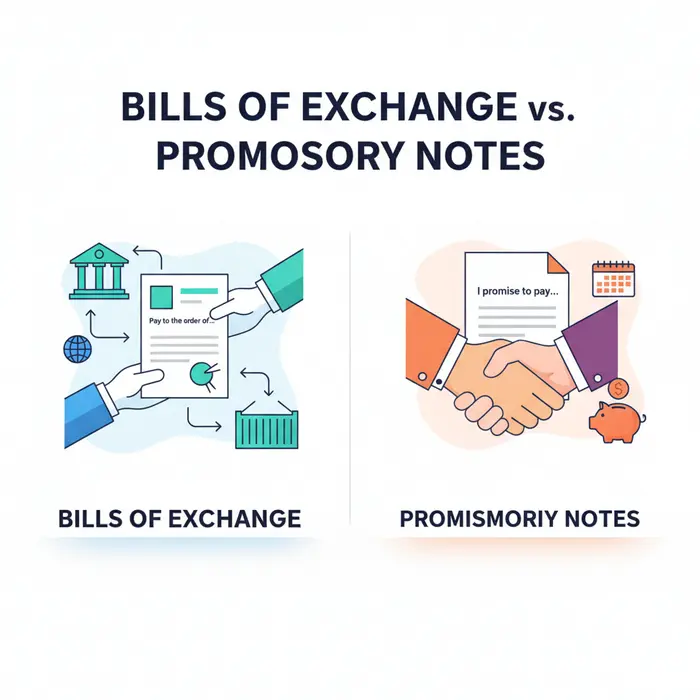
At their core, the primary distinction between a Bill of Exchange and a Promissory Note lies in their nature and the parties involved. A Bill of Exchange is an unconditional order in writing, issued by one party (the drawer) to another (the drawee), instructing payment to a third party (the payee) on demand or at a fixed future time. In international trade, the drawer is often the exporter, the drawee the importer or their bank, and the payee the exporter or their bank. It essentially “orders” someone else to pay.
Conversely, a Promissory Note is an unconditional promise in writing, made by one party (the maker) to another (the payee), engaging to pay a definite sum on demand or at a fixed future time. Here, the maker is the debtor promising to pay the creditor (payee). It involves only two primary parties. The critical difference is the nature of the obligation: a Bill of Exchange is an order to pay (three-party), while a Promissory Note is a promise to pay (two-party). This distinction profoundly impacts legal liabilities. The drawee of a Bill of Exchange only becomes primarily liable upon “acceptance,” whereas the maker of a Promissory Note is primarily liable from issuance.
2. Similarities and Situational Overlaps
Despite fundamental differences, Bills of Exchange and Promissory Notes share key characteristics classifying them as negotiable instruments. Both must be in writing, signed by the maker or drawer, contain an unconditional order or promise for a definite sum, be payable on demand or at a fixed future time, and be payable to order or bearer. These attributes enable transfer by endorsement and delivery, allowing the transferee to sue. This negotiability makes them liquid and useful in commercial transactions, acting as cash substitutes and facilitating credit.
Both are vital for short-term financing and trade credit, providing structured legal frameworks for deferred payments. They can also be discounted at banks for early funds. In simpler, often domestic, transactions between trusted parties, a Promissory Note might suffice if a third-party bank’s involvement isn’t critical.
3. Choosing the Right Instrument for Your Transaction
The choice between a Bill of Exchange and a Promissory Note largely depends on transaction nature, parties, and desired security. For complex, multi-party, and especially cross-border trade, the Bill of Exchange is often superior. Its three-party structure allows greater flexibility and risk distribution. When an exporter (drawer) issues a bill on an importer’s bank (drawee), and the bank accepts it, the bank becomes primarily liable, significantly enhancing exporter security. This makes Bills of Exchange indispensable in Bills of Exchange in Export Finance, offering secure payment and importer credit. Involving banks as acceptors provides an independent payment guarantee, crucial for international counterparties. Discounting Bills of Exchange also offers immediate liquidity.
Conversely, Promissory Notes are preferred for simpler, direct debtor-creditor relationships, often domestic or between trusted parties. They are straightforward to draft, suitable for personal loans or smaller business transactions where a borrower directly promises payment without a third-party. Their simplicity reduces overhead but lacks the enhanced security of a bank’s acceptance. In summary, if your transaction involves international trade, demands enhanced security, or requires bank involvement for collection or financing (as with Advantages of Bills of Exchange in Trade), a Bill of Exchange is generally more robust. For direct, less complex credit where the payer’s promise suffices, a Promissory Note is a simpler, effective solution. Understanding these nuances empowers businesses to select the correct financial tool, safeguarding interests and streamlining commercial dealings.
Role in Export Finance and Risk Mitigation
In the intricate landscape of international trade, Bills of Exchange in International Trade stand as a cornerstone of payment and financing mechanisms, providing a crucial framework for managing inherent risks for both exporters and importers. Essentially a written order by one party (the drawer) to another (the drawee) to pay a specified sum of money to a third party (the payee) on a predetermined date or upon presentation, Bills of Exchange are indispensable instruments in facilitating cross-border transactions. They offer a blend of flexibility, legal enforceability, and liquidity, making them vital tools in export finance strategies.
Unlike a Bills of Exchange vs Promissory Note, which is a two-party instrument, a Bill of Exchange typically involves at least three parties, uniquely suited for the complexities of international trade where goods traverse borders. Their widespread acceptance and standardized procedures, governed by international conventions, underpin their effectiveness in mitigating payment and credit risks. Understanding the various Types of Bills of Exchange and their application is key to leveraging their full potential in securing international sales and optimizing cash flow.
1. Facilitating Documentary Collections & L/Cs
This section explains how Bills of Exchange serve as the primary payment instrument within structured trade finance mechanisms like documentary collections and Letters of Credit (L/Cs), enabling conditional release of goods and documents.
Bills of Exchange are integral to the mechanisms of documentary collections and Letters of Credit, acting as the critical link between the shipment of goods and the assurance of payment. In a documentary collection, the exporter (drawer) entrusts their bank with the Bill of Exchange, along with shipping documents, to be sent to the importer’s bank. The importer (drawee) is then required to either pay the Bill of Exchange (for a sight bill) or accept it (for a usance bill, promising to pay at a future date) before gaining access to the shipping documents needed to clear the goods. This ensures the exporter retains control over the goods until the importer fulfills their payment obligation, significantly reducing payment risk. For instance, a sight Bill demands immediate payment, while a usance Bill specifies a future payment date, allowing the importer credit terms.
In the context of Letters of Credit (L/Cs), the Bill of Exchange takes on an even more secure role. An L/C is a commitment by a bank (the issuing bank) to pay the exporter, provided the exporter presents stipulated documents, including a Bill of Exchange, that comply with the L/C’s terms. When the Bill of Exchange is drawn under an L/C and accepted by the issuing bank or a confirming bank, it transforms into a bank-guaranteed payment obligation, offering the highest level of payment security to the exporter. This mechanism is particularly beneficial in transactions involving new trading partners or volatile markets, providing robust protection against commercial risks.
2. Discounting and Negotiation for Liquidity
This section details how Bills of Exchange can be “discounted” or “negotiated” with financial institutions, allowing exporters to receive immediate payment (less a discount fee) before the bill’s maturity date, thereby enhancing cash flow and liquidity.
One of the most significant Advantages of Bills of Exchange in Trade is their utility as a negotiable instrument that can be sold or “discounted” for immediate funds. For exporters dealing with usance Bills of Exchange (payment at a future date, e.g., 30, 60, or 90 days), waiting for maturity can tie up valuable capital. To circumvent this, an exporter can approach a bank or financial institution to discount the Bill of Exchange. The bank purchases the bill at a value less than its face value – the difference being the discount or interest for the period until maturity. This provides the exporter with instant liquidity, enabling them to reinvest funds, manage operational costs, and take on new orders without delay.
The process of Bills of Exchange in Export Finance extends to negotiation, particularly under Letters of Credit. A negotiating bank, usually in the exporter’s country, can purchase the Bill of Exchange (and other compliant documents) from the exporter without recourse (meaning the bank bears the risk of non-payment by the issuing bank), providing immediate payment. This not only enhances the exporter’s working capital but also transfers the payment collection risk to the financial institution, streamlining the export process and making it more attractive for businesses of all sizes. This feature makes Bills of Exchange an invaluable tool for managing cash flow effectively in international transactions.
3. Mitigating Payment and Credit Risks for Exporters
This section focuses on how Bills of Exchange provide exporters with a legally binding instrument that obligates the importer (drawee) to pay, offering a structured framework for managing the credit risk associated with international sales.
Perhaps the most critical role of Bills of Exchange in international trade is their ability to mitigate payment and credit risks for exporters. By their very nature, Bills of Exchange are legally enforceable documents. Once a Bill of Exchange is accepted by the drawee (importer), it becomes a firm commitment to pay, providing the exporter with a legal recourse in case of default. This legal backing offers a significant layer of security compared to open account transactions, where goods are shipped without prior payment or formal payment promise.
Moreover, when used in conjunction with a Letter of Credit, the Bill of Exchange’s risk-mitigating properties are amplified. An L/C shifts the payment obligation from the importer to a reputable bank, and if that bank is located in a stable jurisdiction, the exporter faces minimal credit risk. Even in documentary collections, the requirement for the importer to accept or pay the Bill of Exchange before receiving documents creates a strong incentive for payment, as failure to do so means they cannot take possession of their goods. This structured approach, supported by international commercial practices and laws, ensures that exporters have a clear and actionable path to payment, making Bills of Exchange a cornerstone of secure and efficient global commerce. For further details on the legal framework governing these instruments, resources like Investopedia’s explanation of Bills of Exchange can provide deeper insights into their legal standing and usage.
Advantages of Bills of Exchange in Trade
In the dynamic world of international commerce, efficient payment mechanisms are paramount for fostering trust and facilitating seamless transactions. Among the various financial instruments, Bills of Exchange in International Trade stand out as a time-tested and widely adopted tool. A Bill of Exchange (BOE) is a written order, signed by the drawer (exporter), directing the drawee (importer or their bank) to pay a specific sum of money to a third party (payee) on demand or at a predetermined future date. These instruments enhance liquidity by providing a structured framework for credit and payment, making them invaluable for both exporters and importers across borders. They serve as a bridge, ensuring that sellers receive payment and buyers gain necessary time to manage their finances, thus streamlining global trade operations.

1. Benefits for Exporters (Security, Finance Access)
For exporters, the utilization of Bills of Exchange offers significant advantages, primarily revolving around enhanced payment security and improved access to financing.
Payment Security: A BOE provides a legally binding promise of payment. When an importer or their bank “accepts” a bill, they commit to paying the specified amount on the due date. This significantly reduces the risk of non-payment for the exporter compared to open account terms. The legal framework surrounding Bills of Exchange means there are clear recourses in case of default, adding a layer of trust and security. Exporters can differentiate between “sight bills,” payable immediately upon presentation, and “usance bills,” which allow for deferred payment, offering flexibility depending on the trade agreement.
Access to Export Finance: One of the most compelling benefits is the ability for exporters to obtain pre-shipment or post-shipment finance. An exporter can discount a usance Bill of Exchange with their bank. This means they can sell the bill to the bank at a slight discount and receive immediate funds, drastically improving their cash flow. This is a vital component of Bills of Exchange in Export Finance, allowing businesses to finance subsequent orders or cover operational costs without waiting for the importer’s payment. This access to capital is particularly beneficial for SMEs looking to expand their international reach.
Reduced Risk: Compared to other forms of payment, especially in unfamiliar markets, a bank-accepted Bill of Exchange offers a higher degree of certainty. It provides formal documentation that can be easily processed and tracked.
2. Advantages for Importers (Payment Deferral)
While often viewed from the exporter’s perspective, Bills of Exchange also offer distinct advantages for importers, most notably the crucial benefit of payment deferral.
Deferred Payment Terms: The primary draw for importers is the ability to delay payment until a later date, typically 30, 60, 90, or even 120 days after the acceptance of the bill or shipment. This deferred payment allows the importer to receive, inspect, and even sell the goods before the payment is due, significantly easing their working capital requirements. This is particularly advantageous for goods with longer sales cycles or for importers operating with tight liquidity. By leveraging usance Bills of Exchange in International Trade, importers can optimize their cash flow and manage inventory more effectively.
Building Trust and Credibility: By accepting a Bill of Exchange, an importer demonstrates their commitment to the transaction and their financial reliability. This helps in building a stronger and more trustworthy relationship with the exporter, potentially leading to more favorable terms in future dealings.
Flexibility and Cost-Effectiveness: In certain scenarios, using a Bill of Exchange can be less costly and more flexible than opening a Letter of Credit, which often involves upfront fees and collateral. While a Letter of Credit offers greater security, a well-established trading relationship might find a Bill of Exchange to be a more practical and economical alternative. Understanding the nuances between Bills of Exchange vs Promissory Note is also important, as BOEs involve three parties and an order to pay, while promissory notes are a two-party promise to pay.
3. Potential Challenges and Mitigation Strategies
Despite their numerous benefits, the use of Bills of Exchange in International Trade is not without its potential challenges. However, most of these can be effectively managed with proper planning and due diligence.
Risk of Non-Acceptance or Non-Payment: The primary risk is that the drawee (importer or their bank) might refuse to accept the bill or fail to pay it on the due date.
Mitigation: Exporters can mitigate this by working with reputable importers, obtaining credit insurance, or requiring bank acceptance (where a bank guarantees payment). Due diligence on the importer’s financial standing is crucial.
Legal Complexities and Jurisdictional Differences: The legal framework governing Bills of Exchange can vary between countries, leading to potential complications in enforcement, especially in case of disputes.
Mitigation: Parties should clearly specify the governing law in their contract and be aware of the specific regulations of the countries involved. Consulting legal experts specializing in international trade law is advisable to navigate these complexities. The International Chamber of Commerce (ICC) provides guidelines and rules like the Uniform Customs and Practice for Documentary Credits (UCP 600) that often interact with documentary bills.
Exchange Rate Fluctuations: If the Bill of Exchange is denominated in a currency different from the exporter’s or importer’s local currency, changes in exchange rates between the transaction date and the payment date can lead to losses.
Mitigation: Both parties can use hedging instruments such as forward exchange contracts to lock in an exchange rate, thereby minimizing currency risk.
Cost of Discounting: While discounting provides immediate liquidity for the exporter, it comes at a cost (the discount fee), which impacts the overall profitability of the transaction.
Mitigation: Exporters should factor this cost into their pricing strategy. Negotiating favorable discounting rates with their bank or exploring alternative financing options can also help.
By understanding both the significant Advantages of Bills of Exchange in Trade and their potential pitfalls, businesses can strategically leverage these instruments to optimize their international trade operations, enhance financial stability, and build stronger global partnerships. Their flexibility and legal enforceability make them an indispensable tool in the global economy, facilitating countless transactions daily.
Partner with Vietnam’s Leading Suppliers
Looking for reliable suppliers in Vietnam? Contact VietnamSuppliers.com today to connect with verified manufacturers and exporters across all industries.
—————————————
References
– What is a Negotiable Instrument?: https://www.investopedia.com/terms/n/negotiable-instrument.asp
– Bills of Exchange: https://www.investopedia.com/terms/b/billofexchange.asp
– Investopedia – Negotiable Instrument: https://www.investopedia.com/terms/n/negotiableinstrument.asp
– Investopedia’s explanation of Bills of Exchange: https://www.investopedia.com/terms/b/billofexchange.asp
– Bill of Exchange: https://www.investopedia.com/terms/b/billofexchange.asp