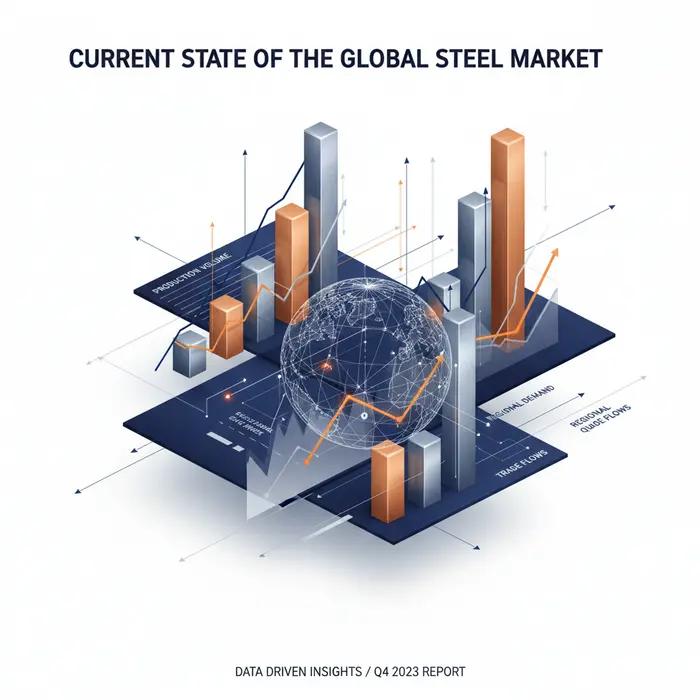
Current State of the Global Steel Market
The global steel industry has navigated a complex and often volatile landscape in recent years, marked by shifting demand patterns, significant supply chain disruptions, and evolving geopolitical tensions. Following a robust recovery in 2021 driven by post-pandemic stimulus, the market began to experience headwinds in 2022 and 2023. High energy costs, persistent inflation, and aggressive interest rate hikes by central banks have collectively dampened manufacturing output and construction activity worldwide. These factors, alongside trade protectionist measures and the imperative for decarbonization, are profoundly shaping the current Global Steel Market Outlook. Major international bulk steel suppliers are constantly adjusting their strategies to cope with fluctuating demand and commodity prices, which remain highly sensitive to macroeconomic indicators and regional stability.
1. Key Drivers and Challenges for Steel Demand
Steel demand is fundamentally tied to economic growth, with primary drivers including infrastructure development, residential and commercial construction, automotive manufacturing, and renewable energy projects. Countries investing heavily in urban development, transportation networks, and green technologies continue to provide a baseline for consumption. However, these drivers face significant counteracting forces. Elevated inflation and interest rates have increased the cost of capital, delaying or scaling back new projects. Furthermore, geopolitical uncertainties, such as ongoing conflicts and trade disputes, disrupt supply chains and create hesitations in investment. Overcapacity in certain regions, coupled with stringent environmental regulations and the high cost of decarbonization initiatives, presents substantial operational challenges for steel producers. The Global Steel Market Outlook remains cautiously optimistic, but continuous monitoring of global crude steel production and demand trends is crucial. The constant ebb and flow of raw material costs, particularly iron ore and coking coal, further complicates the predictability of steel price trends analysis, making strategic purchasing and hedging essential for market participants.
2. Regional Production & Consumption Snapshots
The global steel landscape is characterized by distinct regional dynamics. China remains the dominant force, accounting for over half of global crude steel production and consumption. However, its domestic market has faced a slowdown, primarily due to struggles in its property sector and a shift towards higher-quality growth. This has led to increased steel exports from China, impacting global prices and trade balances. In contrast, emerging economies in Southeast Asia and India continue to exhibit robust demand, fueled by rapid urbanization and industrialization. Europe and North America, while having mature markets, are witnessing renewed investment in infrastructure and manufacturing, partially driven by re-shoring initiatives. However, high energy costs in Europe and stringent environmental regulations pose challenges to their steelmakers. The trade in products like hot rolled coil import export data vividly illustrates these shifts, with traditional importing regions sometimes seeing increased domestic production or diversified import sources in response to geopolitical and economic pressures. Steel producers globally are increasingly focusing on efficiency and value-added products to compete effectively in a saturated market.
3. Impact of Global Economic Slowdown
The global economic slowdown, characterized by decelerating GDP growth across major economies, has inevitably cast a shadow over the steel market. Reduced consumer spending, lower manufacturing output, and a more cautious approach to capital expenditure directly translate into weaker demand for steel across various sectors. The automotive industry, a significant consumer of high-grade steel, has been particularly affected by supply chain issues and softer consumer demand. Similarly, the construction sector, sensitive to interest rate hikes, has seen project delays and cancellations. This deceleration impacts steel price trends analysis, often leading to downward pressure on prices and reduced profitability for steel companies. Governments and central banks are attempting to balance inflation control with growth stimulation, but the delicate equilibrium means continued uncertainty. Furthermore, the interplay of tariffs and other metal commodity trade regulations adds another layer of complexity, influencing import-export flows and regional pricing disparities. Companies are prioritizing cost control, diversification of markets, and innovation in greener steel production to navigate these turbulent economic waters and prepare for future recovery.
Decoding Global Steel Price Trends Analysis
In-depth analysis of factors influencing steel prices, historical trends, and forecast methodologies for 2025, including raw material and energy costs.
The global steel market is a complex ecosystem, constantly influenced by a myriad of interconnected factors ranging from raw material costs to geopolitical shifts. Understanding these dynamics is crucial for Global Steel Market Outlook, allowing stakeholders to anticipate future movements and strategize effectively. This analysis delves into the principal drivers behind steel price volatility, examines historical trends, and outlines methodologies for forecasting the market through 2025, providing insights into the evolving landscape for international bulk steel suppliers and buyers alike.
1. Raw Material Costs (Iron Ore, Coking Coal) Volatility
The foundation of steel production lies in its primary raw materials: iron ore and coking coal. Their price volatility is arguably the most significant determinant of the final steel price. Iron ore, the key ingredient, experiences fluctuations driven by supply disruptions from major producing regions like Australia and Brazil, coupled with demand shifts, particularly from China, which accounts for a substantial portion of global steel output. Coking coal, essential for blast furnace operations, also sees its prices swayed by mining capacity, environmental regulations, and global trade dynamics. Any upward movement in these commodity prices directly translates into higher production costs for steelmakers, inevitably pushing steel prices upwards. Conversely, a surplus or weakened demand can lead to price declines. Monitoring these raw material markets is therefore paramount for accurate steel price trends analysis.
2. Energy Prices, Carbon Costs & Geopolitical Impact
Energy constitutes a significant operational cost for steel mills, especially those utilizing energy-intensive blast furnaces or electric arc furnaces. Fluctuations in prices for electricity, natural gas, and other fuels directly impact profitability and, consequently, steel pricing. Beyond traditional energy costs, the increasing global emphasis on decarbonization is introducing “carbon costs.” Steel producers in many regions face carbon taxes or emissions trading schemes, adding another layer of expense that can be passed on to consumers. Furthermore, geopolitical events wield considerable power over both energy markets and steel trade. Conflicts, trade wars, sanctions, and political instability in key producing or consuming regions can disrupt supply chains, inflate energy costs, and alter global demand patterns. For instance, disruptions in the Middle East or Eastern Europe can cause oil and gas prices to surge, cascading into higher steel production costs. The World Steel Association’s Short Range Outlook often highlights how such external factors shape the industry’s trajectory, impacting metal commodity trade regulations and the overall global steel market.
3. Supply-Demand Dynamics and Inventory Levels
At the heart of any commodity market are the fundamental forces of supply and demand. Global steel supply is influenced by production capacity, new mill constructions, mill closures, and capacity utilization rates across different regions. Demand, on the other hand, is intricately linked to global economic growth, infrastructure spending, automotive production, construction activity, and manufacturing output. When demand outpaces supply, prices tend to rise, and vice versa. Inventory levels – across producers, distributors, and end-users – serve as a crucial barometer of this balance. High inventory levels typically signal an oversupplied market, putting downward pressure on prices, while low inventories can indicate strong demand and potential for price hikes. The trade flow of specific products like Hot rolled coil import export also provides granular insights into regional supply-demand imbalances, further informing steel price trends analysis. Understanding these intricate relationships is vital for forecasting the future direction of the global steel market.
Forecasting methodologies for 2025 must integrate these multifaceted factors. Econometric models analyze historical data to predict future trends in raw materials and energy. Market intelligence from international bulk steel suppliers and expert consensus on global economic indicators inform demand projections. Ultimately, a holistic approach that considers both microeconomic cost drivers and macroeconomic demand indicators, alongside geopolitical risks and evolving metal commodity trade regulations, will offer the most robust outlook for the global steel market in the coming years. As the industry navigates the complexities of decarbonization and fluctuating global economics, continuous monitoring and agile strategy will remain key.
Mapping International Bulk Steel Suppliers & Trade
Identifying major global steel producers, key importing/exporting nations, and the role of international bulk steel suppliers in the global supply chain.
The global steel market is a colossal and intricate ecosystem, constantly reshaped by geopolitical shifts, technological advancements, and macroeconomic cycles. Understanding its complex web of producers, consumers, and intermediaries is crucial for businesses operating within this vital sector. This section delves into the dynamics of the Global Steel Market Outlook, highlighting the critical role of international bulk steel suppliers and the myriad factors influencing trade patterns, from material sourcing to final delivery.
The demand for steel, an essential material for infrastructure, manufacturing, and automotive industries, dictates a continuous flow of bulk steel across continents. Navigating this landscape requires a deep understanding of production capacities, trade routes, regulatory frameworks, and the ever-fluctuating steel price trends analysis. Let’s explore the key facets of this global trade.
Leading Exporting Nations and Their Strategies
The global steel trade is dominated by a handful of powerful exporting nations, each employing distinct strategies to maintain and expand their market share. China, the world’s largest steel producer, exerts significant influence through its immense production capacity and competitive pricing, often impacting global supply-demand balances. Other major players include India, Japan, South Korea, Russia, and the European Union bloc. These nations often specialize in specific steel products, such as high-grade alloys or hot rolled coil for export, catering to diverse international demands. Their strategies encompass significant investment in advanced manufacturing technologies, fostering cost efficiencies, and strategically positioning their products in high-growth markets. For instance, countries like Japan and South Korea focus on high-quality, specialized steel for industries like automotive and electronics, while Russia leverages its natural resources for competitive bulk steel offerings. The cumulative impact of these nations’ output can be observed in the global steel production statistics, which are pivotal for international bulk steel suppliers in forecasting supply.
Emerging Markets for Steel Demand & Supply
While established economies continue to be significant consumers, emerging markets are rapidly becoming pivotal for both steel demand and supply. Regions like Southeast Asia, Africa, and Latin America are experiencing robust growth driven by rapid urbanization, infrastructure development, and industrialization. Countries such as Vietnam, Indonesia, and Turkey are not only increasing their domestic steel consumption but are also steadily building their own production capacities, potentially altering traditional import-export dynamics. This rise in local production in emerging economies creates both opportunities and challenges for international bulk steel suppliers. They must adapt their strategies to cater to burgeoning local demand while also identifying new supply sources as these markets mature. The shift in demand centers directly influences hot rolled coil import export routes and overall steel price trends analysis, making these regions critical for the future global steel market outlook.
Logistics, Shipping Challenges, and Capacity
The movement of bulk steel across international borders is a monumental logistical undertaking, fraught with challenges. Efficient and cost-effective transportation is paramount for international bulk steel suppliers, given the sheer weight and volume of the commodity. Key considerations include the availability of suitable vessel types (e.g., bulk carriers), port infrastructure capable of handling large cargo, and the management of freight costs, which can significantly impact the final steel price trends analysis. Global supply chain disruptions, often caused by geopolitical events, natural disasters, or pandemics, can lead to substantial delays and increased shipping expenses. Moreover, stringent metal commodity trade regulations and customs procedures in various countries add layers of complexity, requiring meticulous planning and compliance. Ensuring sufficient shipping capacity and optimizing logistics routes are continuous challenges that bulk steel suppliers must address to maintain competitive pricing and reliable delivery schedules in a volatile global market.
Hot Rolled Coil: Import/Export & Metal Commodity Trade Regulations
The Global Steel Market Outlook for Hot Rolled Coil (HRC) remains a critical indicator of industrial health worldwide. As a fundamental building block for manufacturing, construction, and infrastructure projects, HRC’s trade flows are subject to complex dynamics driven by demand, supply, and a web of metal commodity trade regulations. Understanding the intricacies of hot rolled coil import export patterns and their regulatory environment is crucial for businesses operating within the international bulk steel suppliers network.
1. Global HRC Production & Consumption Trends
Global HRC production is heavily concentrated, with Asia, particularly China and India, leading the charts due to robust domestic demand and export capabilities. Other significant producers include Japan, South Korea, Russia, the European Union, and the United States. Consumption trends are intrinsically linked to industrial activity, with the automotive, construction, machinery, and pipe & tube sectors being primary drivers. Emerging economies, undergoing rapid urbanization and infrastructure development, continue to fuel strong demand for HRC. Conversely, mature markets often see demand fluctuations tied to manufacturing output and cyclical economic shifts. Analyzing these supply and demand dynamics is essential for accurate steel price trends analysis, as imbalances can lead to significant market volatility. The capacity utilization rates of major steel mills, coupled with their strategic export decisions, heavily influence the availability and pricing of HRC in international markets, shaping the competitive landscape for international bulk steel suppliers.
2. Impact of Tariffs, Quotas, and Anti-Dumping Measures
The HRC market is frequently impacted by various protectionist trade measures implemented by nations seeking to safeguard their domestic steel industries or address perceived unfair trade practices. Tariffs, such as the US Section 232 duties on steel and aluminum, directly increase the cost of imported HRC, making domestic products more competitive. Quotas impose quantitative limits on the volume of HRC that can be imported from specific countries, thereby restricting supply and potentially driving up prices. Anti-dumping duties are levied when foreign steel is sold at prices below its fair market value, harming domestic producers. These trade remedy measures, while intended to create a level playing field, often disrupt global supply chains, lead to trade diversion, and increase uncertainty for both producers and consumers. They can cause significant shifts in hot rolled coil import export routes, forcing international bulk steel suppliers to re-evaluate their market strategies and adjust to new regulatory landscapes. Monitoring these policy changes is vital for understanding steel price trends analysis and forecasting market movements.
3. Environmental & Sustainability Regulations on Steel Trade
A burgeoning area of influence on the global steel market is the increasing focus on environmental and sustainability regulations. As countries commit to decarbonization goals, the steel industry, a significant emitter of greenhouse gases, faces immense pressure to reduce its carbon footprint. This has led to the emergence of ‘green steel’ initiatives and the development of new, less carbon-intensive production methods. Regulations such as the European Union’s Carbon Border Adjustment Mechanism (CBAM) are designed to level the playing field by imposing a carbon levy on imports from countries with less stringent environmental policies. Such measures not only add a new cost component to hot rolled coil import export but also incentivize global steel producers to invest in sustainable technologies and processes. Compliance with these evolving environmental and metal commodity trade regulations is becoming a critical competitive factor for international bulk steel suppliers. The long-term Global Steel Market Outlook will increasingly favor producers who can demonstrate verifiable progress towards sustainable production, influencing future trade flows and investment decisions across the industry.
Global Steel Market Outlook 2025 & Strategic Implications
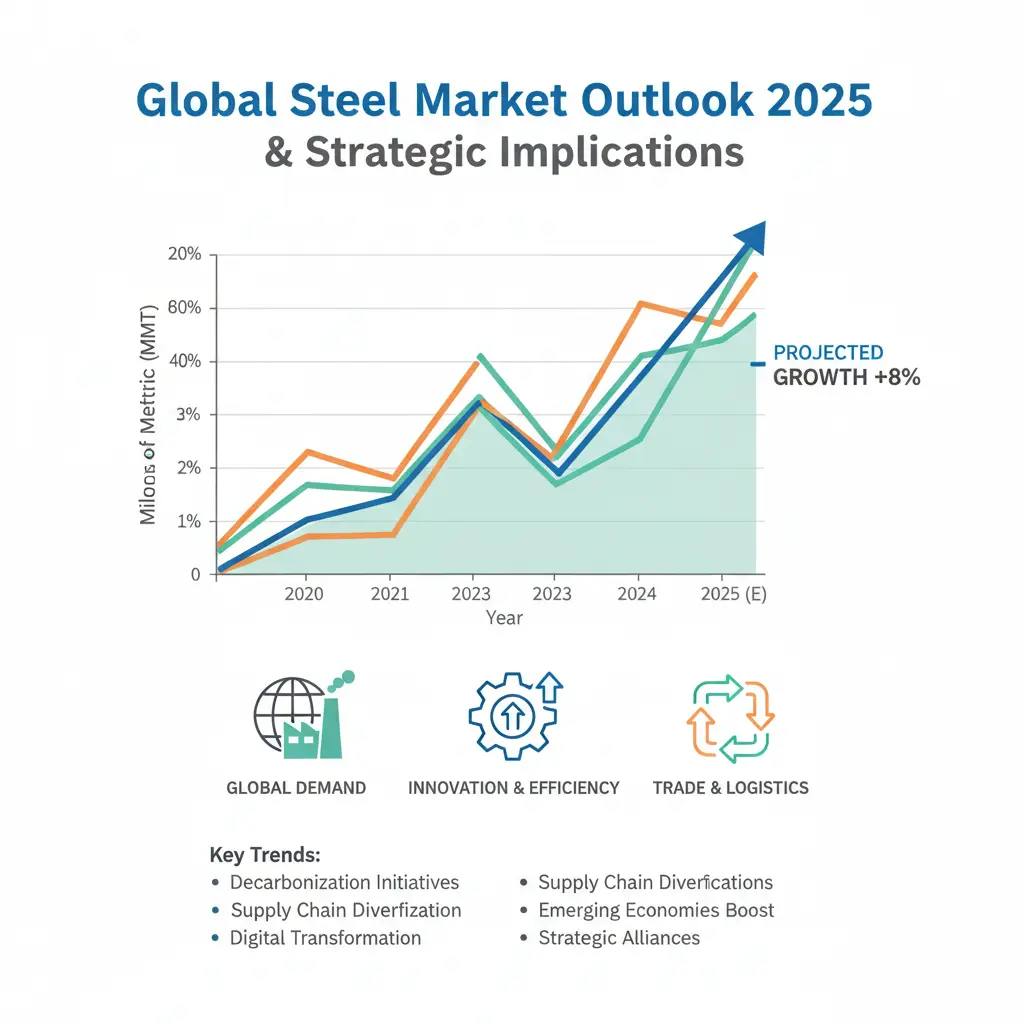
The Global Steel Market Outlook for 2025 anticipates a complex yet resilient landscape, shaped by evolving macroeconomic factors, technological shifts, and a heightened focus on sustainability. As the world navigates post-pandemic recovery and geopolitical dynamics, the steel industry is poised for moderate growth, driven by infrastructure development, renewable energy projects, and a rebound in manufacturing sectors. This trajectory, however, is not without its challenges, including fluctuating raw material costs, evolving trade regulations, and the imperative for decarbonization. This section projects the market’s trajectory, identifies key growth opportunities, and offers actionable strategic recommendations for industry stakeholders, from international bulk steel suppliers to end-users, ensuring readiness for the future of steel.
1. Technological Advancements in Steelmaking (Green Steel)
The steel industry is on the cusp of a transformative era, largely propelled by significant technological advancements, particularly in the realm of “Green Steel.” Traditional blast furnace routes, heavily reliant on coking coal, are gradually being phased out or significantly modified. Innovations such as hydrogen-based direct reduced iron (H-DRI) processes are gaining traction, promising a substantial reduction in CO2 emissions. Sweden’s HYBRIT project and Germany’s ThyssenKrupp are leading examples, demonstrating the feasibility of producing steel with near-zero carbon footprints. Electric Arc Furnaces (EAFs), which primarily use recycled scrap steel, will continue to play a crucial role, with advancements in efficiency and scrap pre-treatment further enhancing their environmental credentials. Beyond primary production, digital transformation through AI and IoT is optimizing operational efficiency, predictive maintenance, and supply chain management, leading to improved yield and reduced waste. These innovations are not merely environmental mandates but represent a competitive edge, attracting environmentally conscious buyers and potentially commanding premium pricing in a market increasingly prioritizing sustainability. Companies investing in these technologies early will be better positioned to meet future regulatory demands and capture emerging market segments.
2. Role of Decarbonization and Circular Economy
Decarbonization and the embrace of a circular economy are no longer optional but fundamental pillars of the 2025 Global Steel Market Outlook. Global climate targets and increasing pressure from investors, consumers, and governments are compelling steelmakers to drastically reduce their carbon footprint. This involves not only process innovation (as discussed above) but also a holistic approach to resource management. The circular economy model emphasizes waste reduction, material reuse, and recycling throughout the steel value chain. Enhancing scrap collection, sorting, and processing capabilities will be paramount, as high-quality scrap becomes an increasingly valuable commodity. Furthermore, carbon capture, utilization, and storage (CCUS) technologies are being explored as interim solutions for existing infrastructure. Policies such as carbon taxes and emissions trading schemes (ETS) will likely expand, directly impacting the steel price trends analysis for producers who fail to adapt. Companies that proactively integrate decarbonization strategies and circular economy principles into their core business models will not only mitigate risks but also unlock new avenues for growth, potentially through green finance and partnerships that leverage sustainable supply chains. This shift also influences metal commodity trade regulations, pushing for more transparent and sustainable sourcing practices.
3. Strategic Recommendations for Producers, Buyers, and Traders
- For Producers: Diversify production methods by investing in green steel technologies (H-DRI, EAF upgrades) to future-proof operations and meet growing sustainability demands. Focus on operational efficiency through digitalization and automation to manage fluctuating input costs. Explore strategic partnerships for raw material sourcing and technology development. Building strong relationships with international bulk steel suppliers and ensuring supply chain resilience will be crucial.
- For Buyers: Prioritize long-term contracts with suppliers demonstrating strong decarbonization commitments and transparent supply chains, reducing exposure to future carbon levies and reputational risks. Conduct thorough steel price trends analysis to anticipate market shifts and optimize procurement strategies. Consider diversifying sourcing from regions adopting green steel practices. Understand the implications of hot rolled coil import export dynamics and leverage free trade agreements where possible.
- For Traders: Develop expertise in emerging green steel products and their respective markets. Monitor global metal commodity trade regulations closely, especially those related to carbon tariffs and environmental compliance. Leverage advanced analytics to forecast market volatility and identify arbitrage opportunities in regional price differentials. Facilitate the trade of high-quality scrap and other circular economy inputs to support sustainable steel production. Building a robust network of reliable producers and buyers will be key to navigating a more complex, environmentally conscious trading environment. The emphasis should be on value-added services, including risk management and sustainability verification, to address the evolving needs of the market.
Partner with Vietnam’s Leading Suppliers
Looking for reliable suppliers in Vietnam? Contact VietnamSuppliers.com today to connect with verified manufacturers and exporters across all industries.
—————————————
References
– World Steel in Figures – worldsteel: https://www.worldsteel.org/steel-by-topic/statistics/world-steel-in-figures.html
– The World Steel Association’s Short Range Outlook: https://www.worldsteel.org/media-centre/press-releases/2023/world-steel-short-range-outlook-october-2023.html
– :
– Metal commodity trade regulations: https://www.wto.org/english/tratop_e/adp_e/adp_e.htm
– technological advancements: https://www.worldsteel.org/steel-by-topic/sustainability/technological-breakthroughs.html