
What Are WTO Export Subsidies?
Export subsidies represent a contentious area in international trade policy, designed by governments to provide domestic producers with an artificial advantage in global markets. While seemingly beneficial for national industries, these financial incentives fundamentally undermine the principles of fair competition and open trade, leading to significant distortions in the global economic landscape. The World Trade Organization (WTO) has, therefore, established a stringent framework to regulate and, in many cases, prohibit such practices, recognizing their potential to harm the trading interests of other member states and impede efficient resource allocation worldwide. Understanding the nature of these subsidies, their underlying motivations, and their trade-distorting effects is crucial to appreciating the WTO’s role in fostering a balanced and equitable international trading system.
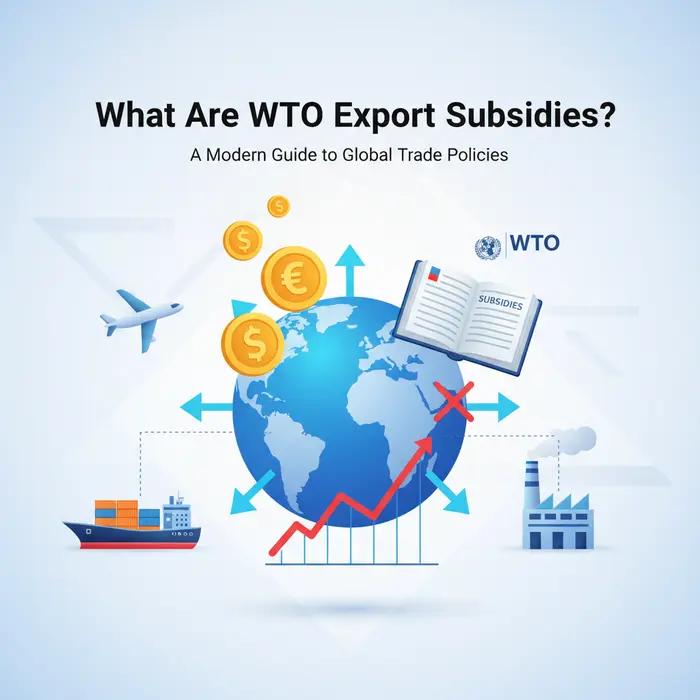
1. Export Subsidies Definition and Core Concepts
At its core, an export subsidy definition refers to a government payment or benefit conferred upon domestic companies conditional upon the export performance of their goods or services. These subsidies can take numerous forms, making them sometimes challenging to identify but consistently potent in their impact. They are broadly categorized into direct and indirect subsidies. Direct export subsidies often involve outright cash payments to exporters per unit of product sold abroad, or direct grants specifically tied to export activities. Indirect export subsidies are more varied and can include preferential tax treatment for export earnings, provision of goods or services (like transportation or credit) at below-market rates for exporters, government assumption of export-related risks, or even domestic support programs that allow companies to sell products cheaper in international markets than they would otherwise. The defining characteristic is the explicit link between the government support and the act of exporting. This direct or indirect financial assistance lowers the cost of production or the selling price for exporters, enabling them to offer their products more competitively in foreign markets than they could without such aid.
2. Why Governments Use Export Subsidies (and the WTO’s Concern)
Governments typically deploy export subsidies with several domestic policy objectives in mind. Primarily, they aim to boost national industries, helping them gain or maintain market share in highly competitive international environments. This can lead to increased domestic production, stimulate economic growth, and create employment opportunities within the subsidizing nation. For certain strategic industries or during economic downturns, subsidies might be seen as a tool to protect jobs and ensure the viability of key sectors. The various types of export subsidies are often tailored to specific industry needs, from agricultural products to high-tech manufacturing.
However, the WTO views these measures with significant concern due to their inherently distortive nature. While beneficial for the subsidizing country’s industries in the short term, such subsidies provide an unfair competitive advantage. They allow subsidized producers to undercut prices, even if they are less efficient than their foreign counterparts, thereby harming unsubsidized producers in other countries. This concern about the detrimental impact of export subsidies on trade forms the bedrock of WTO rules, which generally prohibit export subsidies for industrial products and place strict limits on them for agricultural goods. The WTO’s objective is to ensure a “level playing field” where trade competition is based on genuine comparative advantage and efficiency, not on government largesse.
3. The Principle of Trade Distortion
The core objection to export subsidies within the WTO framework revolves around the principle of trade distortion. By artificially lowering the export price of goods, these subsidies create an uneven playing field. Foreign producers, who do not receive similar government support, find it difficult to compete, even if they are more efficient or have a comparative advantage. This can lead to decreased sales, production cuts, and job losses in importing countries, harming their domestic industries. For example, if Country A heavily subsidizes its steel exports, steel producers in Country B, which operates purely on market principles, will struggle to sell their steel both domestically and internationally. This can force Country B’s producers out of business, leading to deindustrialization and economic instability.
Furthermore, export subsidies can lead to a misallocation of global resources. Instead of production occurring in the most efficient locations, it gravitates towards countries that can afford to subsidize their exports, regardless of their true cost-effectiveness. This inefficiency ultimately reduces overall global welfare. To counter these unfair practices, importing countries may impose countervailing duties export subsidies, which are tariffs designed to offset the amount of the subsidy, thereby restoring fair competition. The WTO Agreement on Subsidies and Countervailing Measures (ASCM) provides the legal basis for challenging illegal subsidies and imposing these duties, highlighting the international community’s commitment to mitigating the damaging effects of WTO Export Subsidies and maintaining a fair trading environment.
Types of Export Subsidies Under WTO Scrutiny
Export subsidies, in their essence, are government programs designed to encourage the export of goods and services by making them cheaper or more competitive in international markets. While seemingly beneficial for domestic industries, these subsidies distort fair global trade, giving an artificial advantage to subsidized products over those from countries that do not provide such aid. The World Trade Organization (WTO) meticulously scrutinizes various forms of WTO Export Subsidies, aiming to create a level playing field for all member nations. The WTO’s Agreement on Subsidies and Countervailing Measures (SCM Agreement) provides a framework for identifying, classifying, and disciplining these subsidies. Understanding the types of export subsidies is crucial for comprehending their impact of export subsidies on trade and the potential for retaliatory measures like countervailing duties export subsidies.
1. Direct Financial Contributions and Grants
Direct financial contributions and grants represent the most straightforward and often most egregious forms of export subsidies. This category encompasses any direct transfer of funds from the government to an exporter or a company contingent upon export performance. Examples include cash grants, direct payments, and loans at preferential rates specifically tied to export activities. For instance, a government might offer a direct cash payment to a textile manufacturer for every unit of fabric exported, effectively reducing the cost of production for export purposes. Another example could be a low-interest loan provided exclusively for expanding export-oriented production facilities, which would not be available for domestic market expansion. Under the SCM Agreement, direct subsidies contingent on export performance are generally categorized as ‘prohibited subsidies’ because they inherently distort international trade. The rationale is that these direct injections of capital give an unfair cost advantage, enabling the subsidized product to be sold at a lower price in foreign markets, thereby displacing non-subsidized competitors. Such subsidies are considered ‘per se’ illegal, meaning their existence alone is sufficient to establish a violation, without needing to prove adverse effects.
2. Tax Exemptions, Credits, and Duty Waivers
Moving beyond direct payments, governments frequently employ indirect financial benefits that achieve a similar outcome: lowering the cost of exporting. Tax exemptions, credits, and duty waivers are common examples. These measures reduce an exporter’s tax burden or the cost of inputs, thereby enhancing their competitiveness abroad. Examples include: exemption from income tax on profits derived from exports; tax credits for export-related expenses; special deductions or accelerated depreciation for assets used in export production; and waivers, reductions, or refunds of indirect taxes (like VAT or excise duties) on exported goods or inputs consumed in their production. A widely used mechanism is the duty drawback scheme, where duties paid on imported inputs are refunded if those inputs are incorporated into products that are subsequently exported. While some duty drawback schemes are permissible under WTO rules, they become problematic if the refund exceeds the duties originally paid, effectively becoming a subsidy. Similarly, tax incentives specifically for export production can be challenged under the SCM Agreement if they confer a benefit contingent on export performance. These indirect measures essentially allow exporters to operate at a lower effective cost than their non-subsidized international counterparts, making their goods more attractive in foreign markets.
3. Government-Provided Goods, Services, or Infrastructures
The third major category involves the provision of goods, services, or infrastructure by the government at rates that are less than adequate remuneration, again, contingent on export performance. This type of subsidy is often more subtle but equally effective in distorting trade. It includes a wide array of support mechanisms that reduce the operational costs for exporters. Examples are plentiful: government-funded export credit insurance at below-market rates, covering risks associated with international trade; preferential access to, or subsidized usage of, transportation infrastructure (e.g., port facilities, special freight rates); free or highly subsidized market research and promotion services tailored for exporters; and subsidized utilities (electricity, water) for export-oriented factories. The key element for these to be considered a prohibited subsidy under the WTO is that the provision of these goods, services, or infrastructure must be contingent on export performance, and the benefit conferred must be specific to certain enterprises or industries. The WTO examines whether the government provision confers a ‘benefit’ and if this benefit is ‘specific’ and ‘contingent on export performance’. If these criteria are met, even seemingly innocuous support can be challenged as an export subsidies definition, leading to disputes and potentially countervailing duties imposed by affected importing countries. The objective of the WTO’s scrutiny is to ensure that competition is based on genuine comparative advantage, not on government largesse.
The WTO Agreement on Subsidies and Countervailing Measures (ASCM)
The global trade landscape is profoundly shaped by the rules governing state support to industries. Central to these regulations is the WTO Agreement on Subsidies and Countervailing Measures (ASCM), a critical multilateral agreement that establishes disciplines on the provision of subsidies and procedures for remedies to address the adverse effects of subsidized trade. At its core, the ASCM aims to prevent unfair competition and trade distortion caused by government financial assistance, particularly concerning WTO Export Subsidies.
An export subsidies definition refers to financial contributions by a government or any public body that are contingent upon export performance. Essentially, these are incentives given to domestic companies to make their goods more competitive in international markets, often by lowering production costs or prices for export. While intended to boost national exports, the impact of export subsidies on trade can be profoundly negative, leading to depressed prices, reduced sales, and job losses in importing countries, thus creating an uneven playing field. The ASCM meticulously categorizes subsidies into distinct types, dictating the permissible actions member countries can take.

1. Prohibited Export Subsidies (Red Light Subsidies)
The most stringent category under the ASCM is the “red light” subsidies, which are explicitly prohibited by Article 3 of the Agreement. These subsidies are deemed inherently trade-distorting and illegal because their very existence is contingent upon export performance or the use of domestic over imported goods. The WTO views these as direct government interventions designed to give domestic producers an unfair advantage in global markets. Types of export subsidies falling into this category include:
- Direct subsidies contingent upon export performance (e.g., grants, tax breaks tied to export sales).
- Internal transport and freight charges on export shipments provided on terms more favorable than for domestic shipments.
- The provision by governments of products or services for use in the production of exported goods on terms more favorable than for domestic production.
- Currency retention schemes or any similar practice that involves a bonus on exports.
- Exemptions from direct taxes or social welfare charges related to exports.
- Export credit guarantees at premiums that are inadequate to cover the long-term operating costs and losses of the programs.
Should a WTO member prove that another member is providing such prohibited subsidies, it can initiate a dispute settlement procedure without needing to demonstrate adverse effects or injury. The offending subsidy must be withdrawn without delay, reflecting the WTO’s firm stance against these highly distortive practices.
2. Actionable Subsidies and Their Criteria
Unlike prohibited subsidies, “actionable” subsidies (sometimes referred to as “yellow light” subsidies) are not automatically illegal. Instead, they are permissible unless they cause adverse effects to the interests of another WTO member. The criteria for an actionable subsidy are two-fold: it must be a “specific” subsidy and it must confer a “benefit.” A subsidy is specific if it is available only to certain enterprises or industries, or to enterprises located within a designated geographical region. It confers a benefit if it improves the financial position of the recipient.
If an actionable subsidy causes adverse effects, the affected member can take countermeasures. These adverse effects typically fall into three categories:
- Injury to the domestic industry of another member: This is the most common ground for action, where subsidized imports cause material injury (e.g., loss of market share, reduced profits, job losses) to the competing industry in the importing country.
- Nullification or impairment of benefits: Occurs when the subsidy undermines tariff concessions or other benefits expected under WTO agreements.
- Serious prejudice: This can arise when the subsidy displaces or impedes the exports of a like product of another member into its own market or into a third-country market, or causes significant price undercutting or depression.
When adverse effects are proven, the primary remedy available is the imposition of countervailing duties export subsidies. A countervailing duty is a tariff imposed by an importing country to offset the benefits of a subsidy provided to producers or exporters in the exporting country, thus restoring fair competition. The investigation and imposition of these duties must strictly follow the procedures outlined in the ASCM.
3. Non-Actionable Subsidies (Green Light Subsidies)
Historically, the ASCM included a category for “non-actionable” or “green light” subsidies, which were deemed non-distorting and thus could not be challenged or subject to countervailing duties. This category was established on a temporary basis and expired at the end of 1999. It covered specific types of subsidies, such as those for certain research and development activities, assistance to disadvantaged regions, or adaptation of existing facilities to new environmental requirements.
The rationale was that these subsidies served legitimate policy objectives and were unlikely to distort trade significantly. However, after the expiration of this provision, most subsidies that would have fallen into the non-actionable category are now treated as actionable subsidies. This means that even if a subsidy promotes an ostensibly positive public good, it can still be challenged if it is specific and causes adverse effects to the interests of another WTO member. This shift underscores the WTO’s evolving commitment to limiting all forms of trade-distorting subsidies, ensuring that government support mechanisms align with the principles of open and fair global trade.
Impact of Export Subsidies on Global Trade and Economies
Export subsidies, by their very nature, are government interventions designed to encourage the export of specific goods by making them cheaper or more attractive to foreign buyers. An export subsidies definition encompasses direct financial payments, tax exemptions, preferential export financing, or even subsidized freight and insurance rates for goods destined for foreign markets. While seemingly beneficial for the subsidizing nation’s industries, the far-reaching impact of export subsidies on global trade and economies is predominantly negative, fostering an uneven playing field and leading to significant market distortions. The World Trade Organization (WTO) has long recognized the detrimental effects of these measures, categorizing most export subsidies as prohibited under the Agreement on Subsidies and Countervailing Measures (SCM Agreement), thereby aiming to curb their usage and promote fair international commerce.
There are various types of export subsidies, including direct payments from governments to exporters per unit of exported goods, tax breaks for income earned from exports, preferential interest rates on loans for export activities, or the provision of goods and services to exporters at below-market prices. These interventions, while intended to boost a nation’s competitive edge and domestic employment, often come at the expense of global market stability and the viability of industries in importing countries.
1. Distorting Fair Competition and Market Prices
One of the most immediate and significant impacts of export subsidies is the distortion of fair competition and global market prices. By artificially lowering the production costs or selling prices of exported goods, subsidies give an unfair advantage to subsidized foreign producers over unsubsidized domestic producers. This creates an unlevel playing field where price, rather than efficiency or quality, becomes the primary determinant of success. For instance, if Country A subsidizes its steel exports, its steel can be sold at a lower price in international markets than the steel from Country B, even if Country B is a more efficient producer. This artificial price advantage can drive down global market prices for the subsidized goods, making it difficult for non-subsidized producers to compete. The ultimate impact of export subsidies on trade is a race to the bottom, where countries might feel compelled to introduce their own subsidies to protect their industries, leading to a tit-for-tat dynamic that harms overall global economic efficiency.
2. Harm to Domestic Industries in Importing Nations
The influx of artificially cheap, subsidized imports can be devastating for domestic industries in importing nations. Local businesses, unable to compete with the subsidized prices of foreign goods, face reduced sales, declining profits, and often, business closures. This can lead to significant job losses, a decrease in domestic investment, and a decline in technological innovation within the affected sectors. For example, if a developed nation heavily subsidizes its agricultural exports, developing countries that rely on their own agricultural sectors can find their local farmers unable to sell their produce at a competitive price, undermining rural economies and food security. In response to such unfair trade practices, the WTO allows importing countries to impose countervailing duties export subsidies. These duties are tariffs levied on imported goods to offset the subsidies received by the producers or exporters in the exporting country, aiming to restore a fair competitive environment. However, the process of investigating and imposing countervailing duties can be complex and time-consuming, and their application itself can sometimes lead to trade disputes.
3. Shifts in Global Production and Market Shares
Export subsidies fundamentally distort the efficient allocation of resources globally. Instead of production being concentrated in countries where it is most efficient and cost-effective, subsidies can lead to production shifting to nations that provide the most generous government support. This means that global resources (labor, capital, raw materials) are not used in the most productive way, resulting in overall economic inefficiency and reduced global welfare. Over time, these subsidies can lead to significant shifts in global production patterns and market shares, often consolidating power in the hands of heavily subsidized industries. This can stunt the growth of nascent industries in developing economies that cannot afford to match the subsidies offered by wealthier nations, hindering their path to economic diversification and sustainable development. The long-term consequence is a less resilient and more volatile global economy, where trade is driven by governmental support rather than genuine comparative advantage.
Countervailing Duties: The WTO’s Remedy Against Export Subsidies
In the complex landscape of international trade, governments occasionally employ measures to boost their domestic industries, sometimes to the detriment of fair competition. One such measure is the provision of export subsidies, which can give a country’s exporters an unfair price advantage in global markets. These subsidies distort trade, harm foreign competitors, and undermine the principles of free and fair trade championed by the World Trade Organization (WTO). To counteract these detrimental practices, the WTO provides a legal framework for member countries to impose countervailing duties (CVDs). This powerful remedy allows importing nations to level the playing field by offsetting the competitive edge created by foreign government subsidies, all while adhering to the strict rules outlined in the WTO’s Agreement on Subsidies and Countervailing Measures (ASCM).

1. What Are Countervailing Duties (CVDs)?
At its core, a Countervailing Duty (CVD) is an import tariff levied by an importing country on goods that have received specific subsidies from their country of origin. The purpose of a CVD is not to punish the exporting country, but rather to neutralize the unfair competitive advantage created by the subsidy, thereby restoring fair trade conditions. For a subsidy to be actionable under WTO rules, it must be ‘specific,’ meaning it is granted to a select enterprise, industry, or group of enterprises or industries, rather than being a generally available measure. The export subsidies definition broadly encompasses financial contributions by a government or public body that confer a benefit, such as direct payments, tax exemptions, the provision of goods or services below market rates, or income/price support. The WTO’s ASCM clearly outlines the various types of export subsidies that can be subject to CVDs, prohibiting those directly linked to export performance.
2. The Investigation Process for Imposing CVDs
Imposing countervailing duties is not an arbitrary decision; it follows a stringent, quasi-judicial investigation process mandated by the WTO. The process typically begins when a domestic industry files a petition with the relevant national authority (e.g., the U.S. Department of Commerce and International Trade Commission, or the European Commission) alleging that imports are being unfairly subsidized and causing material injury. The investigating authority then initiates a thorough investigation, which involves several critical stages:
- Initiation and Notification: Upon receipt of a properly documented petition, the authority formally initiates the investigation and notifies all interested parties, including the exporting government and producers.
- Subsidy Determination: The first phase involves determining whether a specific, actionable subsidy exists and calculating the extent of that subsidy. This requires detailed information gathering from the foreign government and producers.
- Injury Determination: Concurrently, the authority assesses whether the subsidized imports are causing or threatening to cause material injury to the domestic industry. This involves analyzing factors like declining sales, market share, profits, employment, and capacity utilization of the domestic industry.
- Causal Link: A crucial step is establishing a causal link between the subsidized imports and the alleged injury. The injury must not be due to other factors.
- Preliminary and Final Determinations: Based on the evidence, the authority issues preliminary findings, which may lead to provisional duties. This is followed by a more comprehensive final determination. Throughout, due process is paramount, allowing all parties to present their cases and rebut arguments, consistent with the WTO’s Agreement on Subsidies and Countervailing Measures.
3. Calculating and Applying Countervailing Duties
Once both the existence of a subsidy and material injury have been affirmatively determined, the importing country can impose final CVDs. The calculation of these duties is precise and is directly related to the ‘subsidy margin’ – the estimated amount of the subsidy per unit of the imported product. This ensures that the duties do not exceed what is necessary to offset the subsidy. CVDs are typically applied to imports from the specific foreign producers or exporters found to be receiving the actionable subsidy, not necessarily to all imports from that country.
The duration of CVDs is generally limited to five years, though this can be extended through a ‘sunset review’ if it’s determined that the expiry of the duties would likely lead to a continuation or recurrence of both subsidization and injury. The ultimate goal of countervailing duties export subsidies is not to block trade but to ensure that competition is based on genuine comparative advantages rather than artificial government support. By providing a structured, rules-based mechanism to address the impact of export subsidies on trade, CVDs serve as a vital tool in maintaining the integrity and fairness of the multilateral trading system.
Partner with Vietnam’s Leading Suppliers
Looking for reliable suppliers in Vietnam? Contact VietnamSuppliers.com today to connect with verified manufacturers and exporters across all industries.
—————————————
References
– WTO Agreement on Subsidies and Countervailing Measures: https://www.wto.org/english/docs_e/legal_e/aid_e.htm#subscmc
– WTO Agreement on Subsidies and Countervailing Measures: https://www.wto.org/english/tratop_e/scm_e/scm_e.htm
– WTO Agreement on Subsidies and Countervailing Measures (ASCM): https://www.wto.org/english/docs_e/legal_e/14-scm.pdf
– :
– WTO Agreement on Subsidies and Countervailing Measures: https://www.wto.org/english/docs_e/legal_e/14-scm_e.htm

