
What is an Export Packing List?
The Export Packing List is a fundamental shipping document in international trade, serving as a detailed inventory of all items included in a particular shipment. It provides crucial information about the contents, dimensions, and weight of each package, indispensable for various stakeholders throughout the supply chain. Its primary function is to offer a clear, precise record of the goods, facilitating efficient handling, customs clearance, and verification processes from the point of origin to the final destination. An accurate packing list helps avoid delays and complications in international shipments.

1. Definition & Core Purpose
At its core, an Export Packing List is an itemized record prepared by the exporter, detailing the contents of each package or container within a shipment. Unlike a commercial invoice which focuses on the financial transaction, the packing list concentrates purely on the physical attributes and quantity of the goods. Its core purpose is multifaceted:
- Customs Clearance: It is a vital document required by customs authorities in both the exporting and importing countries. Customs officials use the packing list to verify the contents against declarations, identify prohibited or restricted goods, and help assess duties and taxes. An accurate list helps expedite the inspection process and avoid costly delays or penalties.
- Logistics & Handling: Freight forwarders, carriers, and warehouse staff rely on the packing list to efficiently manage the shipment. It informs them about the total number of packages, their weights, and dimensions, which are essential for calculating freight charges, optimizing container loading, and ensuring proper handling and storage.
- Inventory & Verification: Both the exporter and importer use the packing list for inventory management and to verify that the correct goods, in the specified quantities, have been shipped and received. It acts as a checklist, helping to identify any missing, damaged, or incorrect items upon arrival.
- Insurance Claims: In the unfortunate event of loss or damage during transit, the packing list serves as a critical piece of evidence for filing insurance claims, providing a clear record of the items that were supposed to be in the shipment.
2. Key Information Typically Included
While the specific layout of an Export Packing List can vary, a robust and compliant document typically includes the following essential details. Exporters often utilize an export packing list template to ensure all necessary fields are covered consistently.
- Shipper/Exporter Information: Full name, address, and contact details.
- Consignee/Importer Information: Full name, address, and contact details of the recipient.
- Notify Party (if different): Details of the party to be notified upon shipment arrival.
- Invoice Number & Date: Reference to the corresponding commercial invoice.
- Purchase Order Number: Buyer’s reference number for the order.
- Shipment Details: Origin/destination ports, transportation vehicle ID, container ID, and seal numbers (if applicable).
- Shipping Marks: Unique marks or numbers used to identify packages.
- Detailed Goods Description:
- Itemized List: Clear description of each product, often including its Harmonized System (HS) code.
- Quantity: Number of units per item.
- Net Weight: Weight of goods themselves, per item and total.
- Gross Weight: Total weight including packaging, per item and total.
- Dimensions: Length, width, and height of each package or carton.
- Cube/Volume: Total cubic measurement of the shipment.
- Package Count: Total number of packages, cartons, or pallets.
- Hazardous Materials Information (if applicable): Specific declarations for dangerous goods.
- Date of Issuance & Authorized Signature.
This comprehensive detail ensures that all parties involved have access to the physical attributes of the goods, which is vital for smooth operations and compliance with customs requirements packing list.
3. Packing List vs. Commercial Invoice: Understanding the Distinction
While both the Export Packing List and the Commercial Invoice are indispensable documents in international trade, they serve distinct purposes and contain different primary information. New exporters often confuse these two, but understanding their individual roles is key to seamless operations.
The fundamental difference lies in their focus:
- Commercial Invoice: This document is primarily financial. It serves as a bill of sale between the exporter and importer, detailing the price of the goods, payment terms, currency, any applicable charges, and the total amount due. It’s crucial for customs valuation, payment processing, and proving the sale. Customs authorities use the commercial invoice to assess duties and taxes based on the declared value of the goods.
- Export Packing List: This document is entirely logistical and descriptive. Its sole purpose is to provide a comprehensive inventory of the physical contents of the shipment, including weights, dimensions, and the quantity of each item per package. It does not include pricing information, a best practice for clarity and security.
Think of it this way: the commercial invoice tells customs what the goods are worth, while the packing list tells them what the goods physically are and how they are packaged. Both are often required for customs requirements packing list and must be consistent with each other in terms of product descriptions and quantities. Discrepancies between these two documents can lead to serious customs issues, including delays, inspections, fines, or even seizure of goods. For those looking to streamline their document preparation, a reliable downloadable packing list form or an export packing list template can be found on resources like Vietnam Suppliers, helping ensure all necessary details are captured correctly.
Why the Export Packing List is Crucial for Customs
In the complex world of international trade, where goods traverse oceans and borders, documentation is king. Among the most vital documents for ensuring a smooth journey and successful customs clearance is the Export Packing List. Often underestimated, this detailed inventory goes far beyond a simple manifest; it acts as a critical communication tool between exporters, carriers, and customs authorities, safeguarding compliance and preventing costly setbacks. Understanding its role is paramount for any business engaged in cross-border trade.
1. Facilitating Customs Clearance & Compliance
The primary function of the export packing list is to facilitate efficient customs clearance. Customs officers rely heavily on this document to verify the contents of a shipment against other declarations, such as the commercial invoice and bill of lading. It provides a granular breakdown of each package, detailing item descriptions, quantities, net and gross weights, dimensions, and cubic measurements. This level of detail allows customs to quickly identify and classify goods, perform risk assessments, and ensure that the shipment adheres to all customs requirements and import regulations of the destination country. Without an accurate and comprehensive packing list, officers would face significant challenges in processing shipments, leading to bottlenecks and delays at the border. It’s the blueprint that helps them confirm that what’s declared is exactly what’s being shipped, upholding trade security and preventing the entry of prohibited or restricted items.
2. Preventing Delays, Fines, and Penalties
One of the most immediate benefits of a meticulously prepared export packing list is the prevention of avoidable delays and financial penalties. Discrepancies between the physical cargo and the information provided on the packing list can trigger immediate red flags for customs officials. This can result in physical inspections, prolonged holding periods, demurrage charges, storage fees, and even fines or seizure of goods. For instance, if the declared weight or number of packages doesn’t match the actual shipment, it could lead to an investigation, causing significant disruptions to supply chains and damaging business reputation. An accurate packing list helps customs process shipments quickly, minimizing the chances of goods being held up. Furthermore, it plays a crucial role in fulfilling specific customs requirements packing list mandates, which vary by country, ensuring compliance and avoiding non-compliance penalties.
3. Security, Inventory Control, and Damage Claims
Beyond customs, the export packing list offers considerable value in other operational aspects. From a security standpoint, it aids in verifying the integrity of the shipment, allowing for checks to ensure no unauthorized items have been added or removed during transit. This is particularly important for high-value goods or sensitive materials. For effective inventory control, the packing list serves as a crucial reference throughout the shipping process, from warehouse loading to final delivery. It enables all parties – the exporter, carrier, forwarder, and importer – to track the movement and contents of each package, facilitating efficient logistics management. Should any goods be lost or damaged in transit, the export packing list becomes an indispensable document for filing insurance claims. It provides definitive proof of what was shipped, its condition (if noted), and its quantity, which is essential for substantiating the claim with the carrier or insurance provider. Without this detailed record, proving the extent of loss or damage can be extremely challenging, potentially leading to denied claims. Businesses often find that using a reliable export packing list template or a downloadable packing list form helps them capture all necessary details consistently.
While often confused with the commercial invoice, which focuses on the financial transaction, the export packing list provides physical details of the cargo. Both are indispensable, but serve distinct, complementary purposes. In conclusion, the export packing list is not merely administrative paperwork; it is a strategic tool that underpins the efficiency, compliance, and security of international trade, making it absolutely crucial for navigating the complexities of customs with confidence.
Packing List vs. Commercial Invoice: Understanding the Differences
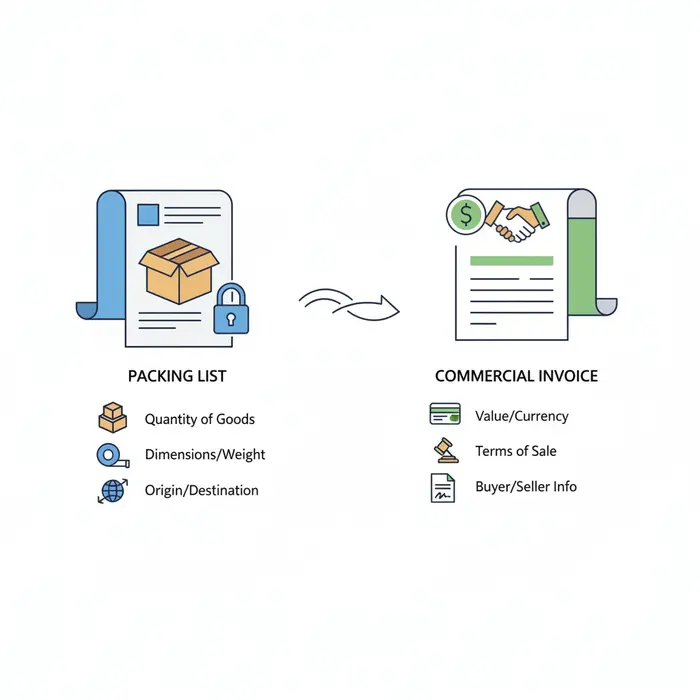
Navigating international trade efficiently hinges on precise documentation. Among the critical papers, the Export Packing List and the Commercial Invoice are frequently confused yet serve distinct, indispensable roles. While both accompany export shipments, understanding their individual purposes and content is vital for smooth logistics, accurate customs clearance, and timely payments. Mismanagement or omission of either can lead to significant delays, penalties, and even cargo holds, underscoring why mastering the “packing list vs commercial invoice” distinction is paramount for any exporter.
1. Key Distinctions in Content and Purpose
The core difference between an export packing list and a commercial invoice lies in their primary focus: one details the physical characteristics of the cargo, the other the financial transaction.
The Export Packing List: Physical Manifest of Goods
The Export Packing List (often sought as an “export packing list template” or “downloadable packing list form”) is a logistical document. Its main purpose is to inventory the physical goods within a shipment, detailing what’s inside each package. It typically includes:
- Shipper and consignee details.
- Invoice number (for reference).
- Date of export.
- General description of goods (e.g., “Men’s T-shirts”).
- Quantity of items per package.
- Type, dimensions, gross, and net weight of each package.
- Package marks and numbers.
- Total number of packages and total weight of the shipment.
This document is crucial for freight handling, cargo loading, and physical verification by customs. It contains no financial data.
The Commercial Invoice: Financial and Legal Proof of Sale
Conversely, the Commercial Invoice is a financial and legal document serving as the bill of sale. It is the primary document for customs valuation and duty calculation. A commercial invoice must contain:
- Seller and buyer details.
- Invoice number, date, and payment terms.
- Incoterms (e.g., FOB, CIF).
- Specific description of goods (e.g., “Men’s Cotton Crew Neck T-shirt, Style XYZ”).
- Unit price, total value per item type, and total invoice value.
- Currency of transaction and country of origin.
- Reason for export.
Essential for payment, accounting, and customs assessment of duties and taxes, the commercial invoice’s financial details highlight the critical “packing list vs commercial invoice” distinction.
2. When to Use Each Document
The distinct uses of each document clarify their importance across the export process.
The Export Packing List is utilized for operational and logistical steps:
- Exporter: For shipment preparation and providing to freight forwarders.
- Freight Forwarders & Carriers: For cargo booking, space allocation, creating transport documents, and physical handling during transit.
- Customs Officials: For physical inspections, verifying contents against manifests, and fulfilling “customs requirements packing list.”
- Importer: To cross-check received goods against the list, aiding unpacking and inventory.
The Commercial Invoice is critical for financial and regulatory compliance:
- Exporter: To request payment and for accounting.
- Importer: For payment processing, accounting, and clearing goods through their country’s customs.
- Customs Officials: The primary document for assessing import duties, taxes, and verifying trade regulation compliance.
- Banks: Essential for processing Letters of Credit and other trade finance instruments.
- Insurance Companies: To determine insurable value in case of loss or damage.
3. Complementary Roles in Export Documentation
While distinct, the Export Packing List and Commercial Invoice are mutually dependent and indispensable for seamless international trade. Neither can replace the other; they offer different, yet equally critical, views of the same shipment.
The packing list provides the physical details—what’s in each box, its dimensions, and weight—facilitating efficient handling, loading, and physical verification. It answers logistical questions like “Is this cargo stackable?”
The commercial invoice, on the other hand, conveys the financial specifics—the value of the goods and the terms of sale. It addresses crucial financial and regulatory queries such as “How much duty is owed?”
Together, these documents form a comprehensive package satisfying logistics providers, customs authorities, financial institutions, and both trading partners. Discrepancies between them can cause significant customs delays or penalties. Therefore, meticulous preparation and accurate synchronization of both the commercial invoice and the Export Packing List are paramount, ensuring a smooth journey for goods from origin to destination.
Creating an Effective Export Packing List
In the intricate world of international trade, accuracy and attention to detail are paramount. Among the many documents required, the Export Packing List stands out as a critical component, serving as a detailed inventory of all items within a shipment. While often confused with the commercial invoice, which focuses on the financial transaction, the packing list provides essential physical details of the cargo. A well-prepared packing list is indispensable for customs clearance, freight forwarding, and ensuring the consignee receives exactly what was ordered. It aids in efficient cargo handling, minimizes delays, and helps prevent costly errors or fines at every stage of the supply chain.
1. Essential Data Fields and Required Information
To be effective, your export packing list must contain specific, comprehensive information. Each field contributes to the clarity and legal compliance of your shipment:
- Shipper/Exporter Details: Full legal name, address, and contact information of the party sending the goods.
- Consignee Details: Full legal name, address, and contact information of the party receiving the goods.
- Notify Party (if different): Details of any third party who needs to be informed upon the shipment’s arrival.
- Reference Numbers: Include the shipper’s internal reference number, the buyer’s purchase order (PO) number, and the corresponding commercial invoice number.
- Date of Issuance: The date the packing list was prepared.
- Carrier Information: Name of the vessel/flight number, voyage number (for sea freight), and port of loading and port of discharge.
- Container & Seal Numbers: For full container load (FCL) shipments, list the container number(s) and their respective seal numbers.
- Marks & Numbers: Unique identification marks (e.g., specific codes, logos, or numbers) printed on each package, aiding in identification and sorting.
- Detailed Description of Goods: A clear, precise, and non-ambiguous description of each item. This should align perfectly with the commercial invoice.
- Quantity: The number of units per package, the number of packages (e.g., cartons, pallets), and the total quantity of goods.
- Dimensions: Length, width, and height of each package (carton, crate, pallet).
- Weight: Both net weight (weight of goods only) and gross weight (weight of goods plus packaging) for each package, and the total net and gross weight for the entire shipment.
- Volume/Cube: The cubic measurement of each package and the total cubic measurement for the entire shipment.
2. Best Practices for Accuracy and Clarity
Drafting an export packing list goes beyond merely filling in fields; it requires a commitment to accuracy and clarity to prevent costly complications:
- Consistency is Key: Ensure every piece of information on your packing list matches exactly with your commercial invoice, bill of lading/air waybill, and other export documents. Discrepancies, even minor ones, can lead to customs holds, fines, and significant delays. The difference between Export Packing List and packing list vs commercial invoice understanding is vital for this consistency.
- Detail-Oriented Descriptions: Provide sufficient detail for customs officials and freight handlers to identify the goods easily. Avoid vague terms; be specific about the type, material, and purpose of the items.
- Standardized Units: Always use internationally recognized units of measurement (e.g., kilograms for weight, cubic meters for volume).
- Legibility and Format: A well-formatted, easy-to-read document is less prone to misinterpretation. Utilizing an "Export packing list template" or a "downloadable packing list form" can help maintain a professional and consistent appearance.
- Thorough Review: Before finalizing and submitting, have at least two people review the packing list. A fresh pair of eyes can often catch errors that were overlooked.
- Digital and Hard Copies: While most processes are digitized, always have hard copies available, especially for the actual shipment, and ensure digital versions are easily accessible and shareable.
3. Tips for Complex and Multi-Item Shipments
When dealing with shipments that involve a wide variety of goods, multiple consignees, or unique packaging, specific strategies can enhance the effectiveness of your packing list:
- Granular Itemization: For mixed containers or shipments with numerous product SKUs, itemize each unique product separately. Include its specific quantity, weight, and dimensions, even if packaged within a larger unit. Consider grouping similar items under clear headings.
- Packaging Hierarchy: Clearly describe the packaging structure. For instance, "10 units per carton, 5 cartons per pallet, 20 pallets per container." This level of detail aids in precise cargo handling and inventory management.
- Consolidated Shipments: If your shipment combines orders for multiple buyers or goods from various suppliers, clearly delineate each sub-shipment within the main packing list. You might use distinct sections or attach supplementary packing lists for each component.
- Special Cargo Considerations: For hazardous materials, fragile goods, or oversized items, include special handling instructions, UN numbers (for dangerous goods), and any specific "customs requirements packing list" notations relevant to their classification. This ensures compliance and safe transit.
- Visual Aids: In exceptionally complex loading scenarios or for goods with unusual dimensions, consider attaching photos or diagrams that illustrate the packaging or loading plan. This visual aid can be invaluable for handlers and customs officials alike.
Download Your Export Packing List Template Today
Navigating the complexities of international shipping requires meticulous documentation. Among the most crucial documents is the export packing list, a detailed inventory of items within each package in a shipment. Far more than just a simple list, it serves as a vital tool for customs clearance, freight forwarding, and ensuring accurate delivery. Manual creation of these lists can be prone to errors and consume valuable time. This is where a standardized, downloadable export packing list template becomes indispensable, streamlining your documentation process and enhancing operational efficiency.

1. Benefits of Using an Export Packing List Template
Adopting a robust export packing list template offers a multitude of advantages, significantly simplifying your logistics and reducing potential headaches:
- Accuracy and Consistency: A template ensures all necessary information is captured uniformly across every shipment. This reduces the risk of omissions and errors, which can lead to costly delays or fines. It standardizes details like package dimensions, weight, contents, and marks.
- Enhanced Efficiency: Rather than starting from scratch for each shipment, a template allows for quick population of data. This saves considerable time and effort, enabling your team to focus on other critical aspects of the export process. It’s a key component in efficient supply chain management.
- Compliance with Customs Requirements: International trade is governed by strict regulations. A well-designed template helps ensure your customs requirements packing list includes all mandatory fields, facilitating smoother customs clearance. It acts as a checklist, helping you meet the specific data needs of importing countries and avoiding potential penalties for non-compliance.
- Improved Communication: The packing list serves as a primary communication tool for all parties involved: shippers, carriers, customs officials, and consignees. A clear, comprehensive list minimizes misunderstandings and ensures everyone has access to the precise details of the shipment’s contents.
- Distinction from Commercial Invoice: While often confused, it’s crucial to understand the difference between a packing list vs commercial invoice. The packing list details what’s in the boxes, while the commercial invoice details what’s being sold and its value. A good template highlights these distinct purposes, ensuring both documents are completed correctly without overlap or missing information.
2. How to Customize Your Template for Specific Shipments
While a generic export packing list template provides a solid foundation, successful international shipping often requires customization to suit the unique aspects of each consignment. Tailoring your template ensures it perfectly aligns with specific product types, packaging methods, and destination country requirements.
Begin by identifying the core data points your template needs, such as shipper and consignee information, shipment number, and total package count. From there, consider adding fields that are specific to your products. For instance, if you ship fragile goods, you might include fields for “fragile labeling” or “special handling instructions.” If your products have serial numbers, dedicate a column for these.
Furthermore, adapt the template to reflect different packaging types. For palletized goods, include pallet dimensions and gross weight. For individual cartons, detail carton dimensions and net/gross weights per box. Don’t forget to incorporate sections for any specific marks and numbers required by the consignee or carrier. Regular review and updates of your customized template will ensure it remains effective and compliant with evolving trade regulations and your business needs. This proactive approach to managing your export packing list documentation will save time and prevent issues down the line.
3. Where to Find Reliable Downloadable Packing List Forms
Finding a dependable downloadable packing list form is the first step towards optimizing your export documentation. While many resources claim to offer templates, it’s essential to choose one that is comprehensive, easy to use, and compliant with international shipping standards.
A great starting point is official trade and customs websites. For example, the U.S. Commercial Service’s guidance on logistics and documentation provides valuable resources on trade documentation, ensuring adherence to global best practices. Many freight forwarders and logistics providers also offer free templates as a service to their clients, often incorporating fields relevant to their specific operations.
Additionally, specialized online platforms and supplier portals like Vietnam Suppliers are excellent places to find practical tools for international trade. Searching for an “Export Packing List” on such sites can yield templates specifically designed to meet the needs of businesses engaged in global commerce, particularly for sourcing and supplying goods. Look for forms that are easily editable in common software like Microsoft Excel or Google Sheets, allowing for straightforward customization. By leveraging these reliable sources, you can quickly implement an effective export packing list system into your export operations, ensuring smooth sailing for your shipments. For more details on effective export practices, learn about common export packing list errors to avoid, or find a comprehensive guide to completing your export packing list documentation. Enhance your shipping process with an optimized export packing list template.
Partner with Vietnam’s Leading Suppliers
Looking for reliable suppliers in Vietnam? Contact VietnamSuppliers.com today to connect with verified manufacturers and exporters across all industries.
—————————————
References
– Documents Used in Export Transactions | International Trade Administration: https://www.trade.gov/documents-used-export-transactions
– customs clearance: https://www.cbp.gov/trade/basic-import-export/importing-sample
– International Chamber of Commerce (ICC) Incoterms: https://iccwbo.org/resources-for-business/incoterms-rules/
– U.S. Customs and Border Protection – Export Docs: https://www.cbp.gov/trade/basic-import-export/export-docs
– U.S. Commercial Service’s guidance on logistics and documentation: https://www.export.gov/Logistics-and-Documentation

