
Understanding CE Certification for EU Entry
For manufacturers and suppliers looking to penetrate the lucrative European Union market, understanding and obtaining CE Certification is not merely a formality but a fundamental requirement. This section will demystify what the CE mark signifies, highlight its critical importance for accessing the EU market, and delve into the legal obligations and implications it carries for businesses worldwide, including EU market entry strategy CE certification.
1. What is the CE Mark and Why it Matters
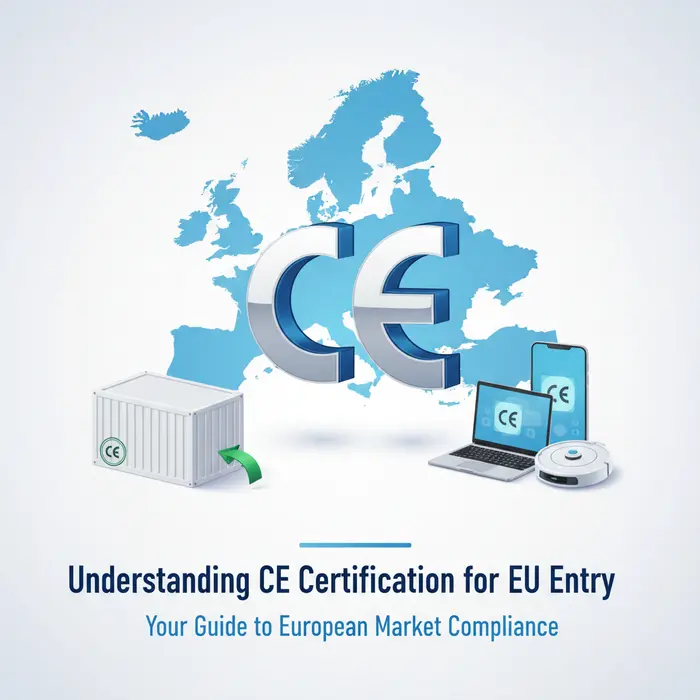
The CE mark, an acronym for ‘Conformité Européenne’ (European Conformity), is a mandatory certification mark for products sold within the European Economic Area (EEA). By affixing the CE mark to a product, a manufacturer declares that the product meets all the essential health, safety, and environmental protection requirements of the applicable European directives and regulations. It is not a quality mark, but rather a declaration by the manufacturer that the product complies with the relevant EU legislation.
For any product governed by one or more CE marking directives, the CE mark is your product’s passport to the EU market. Without it, your product cannot legally be placed on the market in any of the 27 EU member states, as well as Iceland, Liechtenstein, and Norway. This makes CE mark compliance requirements absolutely non-negotiable for manufacturers aiming for successful market penetration. It assures customs authorities and consumers alike that the product meets the stringent European Union market access regulations, fostering trust and enabling the free movement of goods within the single market.
2. The Legal Imperative for European Market Access
Beyond being a ‘passport’, CE certification represents a significant legal imperative. Manufacturers bear the full responsibility for ensuring their products comply with all relevant directives and for correctly affixing the CE mark. This responsibility extends to drawing up the necessary technical documentation, conducting the required conformity assessment procedures – which may involve self-declaration or engagement with a Notified Body for higher-risk products – and issuing a Declaration of Conformity (DoC).
Failure to comply with these requirements can lead to severe consequences. Products found non-compliant can be recalled from the market, confiscated, and significant fines can be levied against the manufacturer or importer. For B2B suppliers EU market, particularly those manufacturing in non-EU countries, understanding and meticulously following the EU product certification process is critical. Importers and distributors within the EU also share a degree of responsibility, ensuring that products they place on the market bear the CE mark and are accompanied by the correct documentation. This collective responsibility underscores the importance of a robust compliance strategy, making CE certification a cornerstone of any effective European Union market access regulations strategy.
3. The CE Certification Process: A Manufacturer’s Roadmap
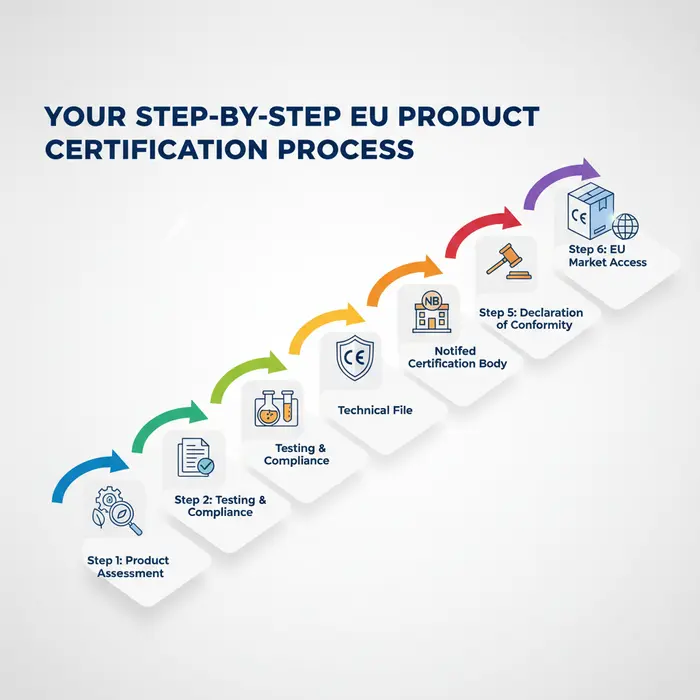
Navigating the CE certification process can appear complex, but it follows a structured roadmap designed to ensure product safety and compliance. The first step involves identifying the applicable EU directives and regulations that pertain to your product. There are over 25 directives, ranging from toys and machinery to medical devices and electronics, each outlining specific essential requirements. Once identified, manufacturers must determine the conformity assessment procedure. This can range from internal production control (Module A) for low-risk products to involving a Notified Body for type examination or full quality assurance systems for high-risk items.
Following the assessment, a comprehensive technical file must be compiled, containing all documentation proving conformity. This includes design specifications, manufacturing details, test reports, and risk assessments. Finally, the manufacturer must draw up the Declaration of Conformity (DoC), a legal document stating that the product complies with all relevant directives, and then affix the CE mark to the product. For B2B suppliers EU market, particularly those seeking a competitive edge, demonstrating a clear understanding and adherence to the EU product certification process not only ensures legal market entry but also builds trust with potential European partners and end-users. It signifies a commitment to quality and safety that resonates deeply within the European commercial landscape.
Deciphering CE Mark Compliance Requirements
For B2B suppliers aiming to penetrate the lucrative European single market, understanding the intricacies of EU market entry strategy CE certification is paramount. The CE mark isn’t just a label; it’s a declaration by the manufacturer that their product complies with all applicable European Union market access regulations. This section delves into the specific directives, harmonized standards, and essential requirements products must meet to legally bear the CE mark, thereby navigating the complex CE mark compliance requirements and ensuring a smooth EU product certification process.
1. Key EU Directives and Harmonized Standards
The foundation of CE marking lies in a set of EU Directives. These legislative acts define the essential health, safety, and environmental protection requirements that products must satisfy before being placed on the EU market. Each directive typically covers a broad category of products, such as machinery, electrical equipment, medical devices, or toys. Examples include the Low Voltage Directive (LVD) for electrical safety, the Electromagnetic Compatibility (EMC) Directive for limiting electromagnetic interference, and the Machinery Directive for ensuring the safety of machines.
To help manufacturers comply with these directives, the European Commission issues harmonized standards. These are detailed technical specifications developed by European standardization organizations (CEN, CENELEC, ETSI) and published in the Official Journal of the European Union. While their application is generally voluntary, using harmonized standards offers a significant advantage: it provides a “presumption of conformity” with the essential requirements of the relevant directives. This means that if a product is designed and manufactured according to the specifications of a relevant harmonized standard, it is presumed to meet the corresponding essential requirements of the directive, simplifying the EU product certification process considerably. Manufacturers can, however, choose other technical solutions, but in such cases, they must demonstrate independently that their product meets the essential requirements without the presumption of conformity.
2. Essential Health and Safety Requirements (EHSRs)
At the core of every EU directive are the Essential Health and Safety Requirements (EHSRs). These are the fundamental, non-negotiable principles designed to protect users, other persons, domestic animals, and property, as well as the environment, from risks posed by products. EHSRs are not overly prescriptive; instead, they state the general hazards that must be addressed and the safety objectives to be achieved. For instance, a directive might require that a machine be designed and constructed to prevent the risk of crushing, shearing, or impact, without specifying the exact technical means to achieve this.
Manufacturers are obligated to perform a thorough risk assessment to identify all potential hazards related to their product and determine how the EHSRs apply. Documenting this risk assessment and the measures taken to mitigate identified risks is a critical part of the technical documentation required for CE marking. Even if a harmonized standard is applied, manufacturers must still confirm that all relevant EHSRs are met. This step is crucial for ensuring comprehensive CE mark compliance requirements are addressed before a product can legally enter the EU market.
3. Conformity Assessment Modules and Notified Bodies
The process of demonstrating that a product meets all applicable CE mark compliance requirements is known as conformity assessment. The EU legislation offers various conformity assessment procedures, often referred to as ‘modules’ (ranging from A to H), which specify the steps a manufacturer must follow. The choice of module depends primarily on the product’s risk level and the specific directives that apply. For lower-risk products, manufacturers can often perform a self-declaration of conformity (Module A), meaning they take full responsibility for ensuring compliance and affixing the CE mark after conducting internal checks and assembling the technical file.
However, for higher-risk products, or when certain directives mandate it, the involvement of a third-party organization known as a Notified Body becomes mandatory. A Notified Body is an independent testing and certification organization that has been authorized by an EU member state to carry out conformity assessment tasks specified in the new approach directives. These bodies perform tasks such as type examination, quality assurance system assessment, or product verification. Their involvement adds an extra layer of scrutiny and assurance, particularly for B2B suppliers EU market products where safety and reliability are paramount. Manufacturers must carefully identify which directives apply to their product and, subsequently, which conformity assessment module and whether a Notified Body is required, to successfully navigate the European Union market access regulations.
Understanding these layers of requirements – from specific directives and harmonized standards to EHSRs and the role of Notified Bodies – is fundamental for any B2B supplier seeking to ensure their products are compliant and competitive within the EU market. This structured approach to CE mark compliance requirements is indispensable for a robust EU market entry strategy CE certification.
Your Step-by-Step EU Product Certification Process
Navigating the complex landscape of European Union market access regulations requires a meticulous approach, especially when it comes to product compliance. For any EU market entry strategy CE certification is not just a regulatory hurdle but a critical declaration of safety and quality. This section outlines the practical steps involved in achieving CE certification, guiding B2B suppliers through the process from initial risk assessment to the final declaration of conformity, ensuring your products meet the stringent CE mark compliance requirements.
1. Risk Assessment and Conformity Assessment Modules
The journey to CE certification begins with a thorough understanding of your product and its potential risks. A comprehensive risk assessment is paramount, involving the identification of all conceivable hazards associated with the product – from design flaws and material choices to intended use and foreseeable misuse. This systematic evaluation helps in determining the likelihood and severity of potential harm, allowing you to implement appropriate risk reduction measures. Once risks are identified and mitigated, the next crucial step is selecting the correct conformity assessment module. The CE marking directives offer various modules (e.g., Module A for internal production control, Module B for EU-type examination, Module C for conformity to type, Module H for full quality assurance, etc.), tailored to different product categories and risk levels. Products with higher inherent risks or those falling under specific directives (like machinery or medical devices) may necessitate the involvement of a Notified Body – an independent third-party organization authorized by EU member states to conduct conformity assessments. Choosing the right module is critical, as it dictates the level of third-party involvement and the scope of required documentation and testing for your specific EU product certification process.
2. Technical Documentation and Declaration of Conformity
Central to demonstrating CE mark compliance requirements is the creation of comprehensive Technical Documentation (also known as the Technical File or Construction File). This critical compilation serves as proof that your product adheres to all relevant EU directives and harmonized standards. The Technical Documentation must provide a detailed overview of the product’s design, manufacturing, and operation, typically including: product description, design and manufacturing drawings, a list of applied harmonized standards, risk assessment results, test reports, calculations, and instructions for use. It should be kept up-to-date and be available for inspection by national market surveillance authorities for typically 10 years after the last product has been placed on the market.
Following the completion of the technical documentation, the manufacturer must draw up the Declaration of Conformity (DoC). This is a formal, legally binding statement issued by the manufacturer or their authorized representative, affirming that the product meets all essential requirements of the applicable CE directives. The DoC must contain specific information, including the name and address of the manufacturer, identification of the product, a list of all relevant directives and harmonized standards applied, and the name and address of the Notified Body if involved. The DoC is the manufacturer’s ultimate declaration of responsibility and is a mandatory part of the overall EU product certification process, signalling that the product is ready for the European market.
3. Testing, Labeling, and Market Surveillance
With the risk assessment complete and technical documentation prepared, the next essential phase involves robust product testing. This ensures that your product truly conforms to the harmonized standards and essential safety requirements identified in the applicable EU directives. Testing can be conducted in-house if your facilities and expertise allow, or, more commonly, by accredited third-party laboratories. The test reports generated are a vital part of your technical documentation, providing objective evidence of compliance. Once testing is successfully completed and all requirements are met, the final step before market placement is the proper affixation of the CE mark. The CE logo must be visibly, legibly, and indelibly marked on the product itself, or on its data plate, packaging, or accompanying documentation if the product’s size or nature prevents direct marking. If a Notified Body was involved in the conformity assessment, their identification number must also accompany the CE mark.
However, achieving the CE mark is not a one-time event. B2B suppliers EU market must also be prepared for ongoing post-market surveillance. This involves maintaining the technical documentation, monitoring product performance in the market, handling any customer complaints related to safety, and cooperating with national market surveillance authorities. Products must continue to comply throughout their lifecycle. Adhering to these ongoing obligations is crucial for sustained European Union market access regulations and demonstrating due diligence, protecting both your brand and your customers within the EU.
Mastering European Union Market Access Regulations
Navigating the European Union’s vast and intricate market can seem daunting for manufacturers and B2B suppliers EU market. While CE marking is often seen as the primary gateway, it represents just one crucial component of a much broader regulatory landscape. A successful EU market entry strategy CE certification requires a deep understanding of the comprehensive framework that governs product safety, conformity, and post-market obligations. Beyond simply affixing the CE mark, companies must grasp market surveillance, the critical roles of authorized representatives and importers, and various other product-specific regulations that define European Union market access regulations.
1. The Role of Authorized Representatives and Importers
For manufacturers based outside the EU, the concept of an Authorized Representative (AR) or EC-REP is not merely an administrative hurdle but a cornerstone of compliance. An AR is a natural or legal person established within the EU, explicitly designated by the manufacturer to act on their behalf with regard to specific tasks related to the manufacturer’s obligations under relevant Union harmonisation legislation. Their responsibilities are extensive and include keeping the declaration of conformity and technical documentation available for national surveillance authorities, cooperating with these authorities, and forwarding requests for information or samples. Essentially, the AR serves as the manufacturer’s official contact point within the EU, bridging the geographical and legal gap between the non-EU manufacturer and EU regulatory bodies.
Equally critical is the role of the Importer. According to EU regulations, the importer is any natural or legal person established within the Union who places a product from a third country on the Union market. Importers bear significant responsibilities, ensuring that products they place on the market comply with applicable EU legislation. This includes verifying that the manufacturer has carried out the appropriate conformity assessment procedure, that the product bears the CE mark, and that the required documentation (like the Declaration of Conformity) is available. Importers must also ensure that their name, registered trade name or registered trade mark, and contact address are indicated on the product or its packaging. Both the AR and the Importer are vital links in the supply chain, ensuring accountability and adherence to CE mark compliance requirements before products reach end-users or distributors.
2. Market Surveillance and Post-Market Obligations
Achieving initial CE mark compliance is only the beginning. The EU places a strong emphasis on market surveillance to ensure products continue to meet safety and performance standards once they are on the market. Market surveillance authorities, operating at national and sometimes EU levels, proactively monitor product compliance. They can conduct inspections, test products, review documentation, and investigate complaints. Should a non-compliance be identified, these authorities have the power to demand corrective actions, impose sales bans, or even order product recalls. This continuous scrutiny underscores the importance of maintaining robust technical documentation and quality management systems long after a product has been launched.
Furthermore, manufacturers have significant post-market obligations. This includes monitoring products for safety-related incidents or malfunctions, maintaining records of complaints, and taking necessary corrective and preventive actions. In cases of serious risk, manufacturers must promptly inform the relevant national authorities and the European Commission, and take immediate steps to mitigate the risk, which could include withdrawing the product from the market or issuing a recall. This proactive approach to safety and quality is central to the EU product certification process and the overall goal of protecting consumers. Understanding and preparing for these ongoing responsibilities is crucial for any business engaged in European Union market access regulations.
3. Beyond CE: Product-Specific Regulations and Harmonized Standards
While the CE mark signifies compliance with applicable EU directives and regulations, it’s essential to recognize that not all products require CE marking, and many products fall under additional, sector-specific legislation. For instance, medical devices are governed by the stringent Medical Device Regulation (MDR), while electronics may be subject to the Restriction of Hazardous Substances (RoHS) Directive or the Waste Electrical and Electronic Equipment (WEEE) Directive. These product-specific regulations often entail additional conformity assessment procedures, specific documentation, and sometimes third-party certification by a Notified Body, going well beyond the general CE mark compliance requirements.
Harmonized standards play a pivotal role in demonstrating conformity to these diverse regulations. Developed by European standards organizations (CEN, CENELEC, ETSI) in response to mandates from the European Commission, these standards provide detailed technical specifications. Compliance with a harmonized standard, whose reference has been published in the Official Journal of the European Union, grants a presumption of conformity with the corresponding essential requirements of the applicable EU legislation. This means that if a manufacturer applies a relevant harmonized standard, their product is presumed to meet the safety and performance requirements outlined in the directive or regulation. However, using harmonized standards is generally voluntary; manufacturers can choose other technical solutions to demonstrate conformity, provided they can prove their solutions meet the essential requirements. Staying abreast of the latest versions of these standards and understanding their application is critical for a successful EU market entry strategy CE certification, ensuring products meet the full spectrum of European Union market access regulations. For a comprehensive overview of the EU’s regulatory approach, consult the Blue Guide on the implementation of EU product rules.
B2B Suppliers: Tailoring Your EU Market Entry Strategy
For B2B suppliers eyeing the vast and lucrative European Union market, a well-defined EU market entry strategy CE certification is paramount. Navigating the diverse regulatory landscape and ensuring product compliance, particularly with the CE mark, is not merely a formality but a fundamental prerequisite for success. This section delves into specific considerations and actionable strategies for B2B companies looking to not only enter but thrive within the EU market with their CE-compliant products. From rigorous due diligence in the supply chain to strategic marketing and distribution, understanding the nuances of CE mark compliance requirements and broader European Union market access regulations will be your compass.
1. Due Diligence for Supply Chain Partners
The integrity of your product’s CE compliance begins long before it reaches the EU border. For B2B suppliers, rigorous due diligence for all supply chain partners is not just good practice—it’s a legal imperative. Every entity involved, from raw material providers to logistics partners, can impact the final product’s adherence to CE marking directives. Prioritize manufacturing partners with proven quality management systems (e.g., ISO 9001, ISO 13485 for medical devices) and expertise in the EU product certification process relevant to your specific product category. For instance, if you are sourcing electronic components, ensure your supplier can provide declaration of conformity (DoC) and technical documentation demonstrating compliance with relevant directives like RoHS or EMC. In a B2B context, your customers—other businesses—will demand assurances of compliance, and any breakdown in your supply chain due to non-compliance can lead to significant financial penalties, reputational damage, and product recalls.
Crucially, identify who holds the ultimate responsibility for CE marking within your supply chain. For products manufactured outside the EU, the importer often bears significant responsibility, but the manufacturer always retains fundamental duties. If you are manufacturing goods for another EU business, ensure your contractual agreements clearly outline CE mark obligations, documentation provision, and liability. A thorough vetting process should include auditing potential partners’ documentation practices, quality control procedures, and their familiarity with EU market surveillance requirements. This proactive approach safeguards your business and provides confidence to your B2B clients who rely on your products for their own compliance obligations.
2. Marketing and Distribution of CE-Marked Products to Businesses
For B2B suppliers EU market, marketing CE-marked products extends beyond consumer appeal; it’s about conveying reliability, quality, and regulatory adherence. The CE mark itself is a powerful marketing tool in the B2B sphere, signaling to potential business clients that your product meets the EU’s stringent safety, health, and environmental protection requirements. Your marketing materials—technical specifications, data sheets, user manuals, and online presence—must clearly feature the CE mark and provide readily accessible information about the product’s conformity. This includes detailing which directives the product complies with (e.g., Low Voltage Directive, Machinery Directive, EMC Directive) and confirming the existence of a Declaration of Conformity and supporting technical documentation.
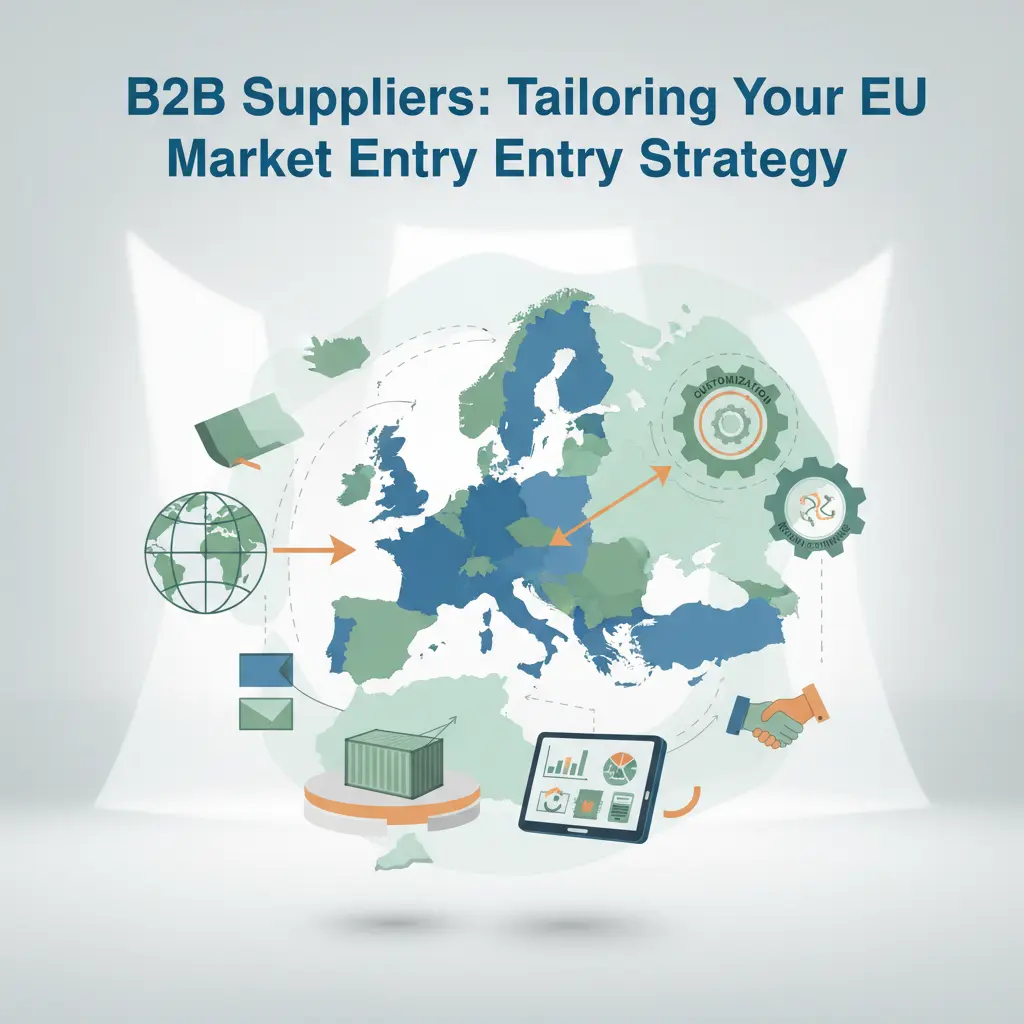
When it comes to distribution, B2B companies often deal with complex logistics and larger volumes. Establishing robust distribution channels requires understanding EU member states’ logistical infrastructure and complying with national regulations. This involves selecting suitable logistics partners, managing customs efficiently, and ensuring correct and durable product labeling (CE mark, manufacturer’s address, and unique identification). Consider the implications of Incoterms for your B2B sales, as these terms define the responsibilities for costs and risks associated with shipping and can impact who is considered the ‘importer’ and, consequently, who bears certain CE compliance obligations. Clear communication and contractual agreements with distributors are vital to ensure they uphold all aspects of your product’s CE compliance throughout the supply chain, including proper storage, handling, and onward traceability.
3. Navigating European Union Market Access Regulations and Post-Market Surveillance
Gaining initial access to the EU market through CE certification is a significant achievement, but it’s only the first step. B2B suppliers must understand that EU market entry strategy CE certification is an ongoing commitment. The European Union market access regulations include a strong emphasis on post-market surveillance. This means manufacturers and their authorized representatives have a continuous obligation to monitor products placed on the market, collect feedback on performance and potential safety issues, and take corrective actions if necessary. Establishing a robust post-market surveillance system is critical, especially for products with a long lifecycle or those used in critical B2B applications.
Appointing an Authorized Representative (AR) in the EU is often a legal requirement for non-EU manufacturers and a strategic advantage. The AR acts as a crucial liaison between the manufacturer and EU national authorities, handling documentation and ensuring products remain compliant post-market entry. Staying abreast of evolving EU legislation is paramount. Directives and regulations are periodically updated, requiring regular review of your product portfolio against the latest standards to maintain compliance and avoid costly disruptions. Proactive engagement with regulatory updates and investing in internal expertise or external consultancy ensures that your B2B operation in the EU remains robust, compliant, and prepared for future challenges, reinforcing your brand’s reputation as a reliable and responsible supplier.
Partner with Vietnam’s Leading Suppliers
Looking for reliable suppliers in Vietnam? Contact VietnamSuppliers.com today to connect with verified manufacturers and exporters across all industries.
—————————————
References
– CE mark compliance requirements: https://ec.europa.eu/growth/single-market/ce-marking_en
– CE marking – European Commission: https://ec.europa.eu/growth/single-market/ce-marking_en
– CE mark compliance requirements: https://ec.europa.eu/growth/single-market/ce-marking_en
– Blue Guide on the implementation of EU product rules: https://single-market-economy.ec.europa.eu/single-market/goods/new-legislative-framework/blue-guide_en
– CE Marking Information on Europa.eu: https://ec.europa.eu/growth/single-market/ce-marking_en

