Introduction to FCA Incoterms 2020 Explained
International trade, with its complex web of logistics, regulations, and financial instruments, relies heavily on clear communication and standardized rules. Central to this framework are Incoterms, a set of globally recognized trade terms published by the International Chamber of Commerce (ICC). Among these, Free Carrier (FCA) stands out as a highly versatile and increasingly preferred rule, particularly suited for modern multimodal transport. This section delves into the essence of FCA Incoterms 2020, explaining its definition, its critical role in facilitating international trade, and setting the stage for understanding its core principles. Mastering FCA is fundamental for efficient and secure global transactions, especially in a dynamic market like FCA Vietnam export trade.

What are Incoterms and why they matter?
Incoterms, an acronym for “International Commercial Terms,” are a globally recognized set of rules that define the responsibilities of sellers and buyers for the delivery of goods under sales contracts. Published by the International Chamber of Commerce (ICC) and updated periodically – with the latest version being Incoterms 2020 – these terms clarify who is responsible for paying and managing the shipment, insurance, documentation, and customs clearance. They are crucial because they prevent misunderstandings, disputes, and costly delays in international shipping by establishing clear points for the transfer of costs and risks. Understanding these fundamental FCA shipping terms explained is paramount for any business engaged in cross-border commerce, ensuring smooth operations from origin to destination. For more detailed insights into the official Incoterms rules, one can refer to the International Chamber of Commerce’s Incoterms page.
Defining Free Carrier (FCA) in 2020
Free Carrier (FCA) is one of the most flexible and widely used Incoterms, particularly suitable for containerized cargo and multimodal transport. Under FCA Incoterms 2020, the seller delivers the goods to the buyer’s nominated carrier at a named place, which can be the seller’s own premises or another agreed-upon location, such as a freight forwarder’s warehouse or a port terminal. The moment the goods are handed over to the carrier at this named point, the risk of loss or damage transfers from the seller to the buyer. This also marks the point where the seller’s responsibility for costs ends, with the buyer then assuming all subsequent costs, including the main carriage, insurance, and import customs formalities.
Understanding the FCA Incoterms responsibilities buyer seller is critical.
- Seller’s Responsibilities: The seller is responsible for packaging goods, export customs clearance (if applicable), and delivering them to the agreed-upon named place to the carrier nominated by the buyer. If delivery is at the seller’s premises, the seller loads the goods onto the buyer’s carrier.
- Buyer’s Responsibilities: The buyer must nominate the carrier, arrange and pay for the main carriage, pay for insurance (if desired), and handle all import customs formalities and costs at the destination.
FCA’s adaptability makes it an excellent choice for modern logistics chains, offering a balanced distribution of responsibilities. For comprehensive guidance on applying these terms in various contexts, including specific implications for Vietnamese trade, explore further information on FCA Incoterms 2020 details.
Key changes and updates from previous versions
The Incoterms 2020 rules introduced several refinements to FCA, enhancing its utility and addressing practical challenges in international trade. The most significant change for FCA relates to the provision for bills of lading with an on-board notation. Previously, under FCA, sellers faced a conflict when L/Cs required an “on-board” bill of lading, which the carrier might only issue later. Incoterms 2020 now allows parties to agree that the buyer can instruct its carrier to issue an on-board bill of lading to the seller after loading, enabling the seller to present it for payment. This resolves a long-standing practical issue, streamlining financial transactions, particularly for those relying on L/Cs.
Another update clarified that under FCA, both the buyer and seller can arrange for their own transport rather than solely relying on third-party carriers. The Incoterms 2020 also emphasized security-related requirements, mandating compliance with security-related information and costs up to their respective points of risk transfer.
When comparing FCA vs FOB Incoterms 2020, FCA is generally preferred for containerized cargo and multimodal transport because the point of delivery and risk transfer occurs earlier, typically at an inland terminal. FOB (Free On Board), conversely, is specific to sea and inland waterway transport, with risk transfer occurring when goods are loaded onto the vessel at the port of shipment. This distinction is particularly relevant for diverse global supply chains, including those involving FCA Vietnam export trade, where containerization is common.
FCA Incoterms Responsibilities: Buyer & Seller Obligations
Understanding FCA Incoterms 2020 is crucial for international trade, offering a flexible yet precise framework for Free Carrier agreements. This Incoterm is highly adaptable, allowing for multimodal transport and specifying that the seller delivers the goods to a carrier or another person nominated by the buyer at a named place. The clarity provided by FCA Incoterms regarding who is responsible for what, at each stage of the shipping process, prevents disputes and ensures smooth transactions, especially in complex supply chains like those involving FCA Vietnam export trade.
Unlike more restrictive Incoterms such as FOB, FCA can be used for any mode of transport, making it exceptionally versatile. It clearly delineates the specific duties, costs, and risks for both the buyer and seller, ensuring transparency from the point of origin to the final destination.
1. Seller’s core obligations: From packaging to delivery at the named place
Under FCA Incoterms 2020, the seller carries significant responsibilities up to the point of delivery. These duties are meticulously defined to ensure the goods are prepared and handed over correctly to the buyer’s nominated carrier or other party. Here’s a breakdown of the FCA Incoterms responsibilities buyer seller for the seller:
- Packaging and Marking: The seller is responsible for packaging the goods appropriately for the chosen mode of transport and marking them clearly. This includes ensuring the packaging is sufficient to protect the goods during their journey to the named place of delivery.
- Pre-carriage: The seller must arrange and pay for the transportation of the goods from their premises to the named place of delivery. This could be their own factory, a warehouse, a port terminal, or a freight forwarder’s facility as agreed upon.
- Export Customs Formalities: A critical responsibility of the seller is to handle all export customs clearance procedures. This includes obtaining any necessary export licenses, security clearance, and paying all duties and taxes related to the export of the goods.
- Delivery at Named Place: The seller fulfills their delivery obligation by handing over the goods to the buyer’s nominated carrier or another person nominated by the buyer at the named place of delivery. If this named place is the seller’s own premises, the seller is responsible for loading the goods onto the collecting vehicle. If the named place is elsewhere (e.g., a carrier’s terminal), the seller delivers the goods ready for unloading by the carrier.
- Costs up to Delivery: The seller bears all costs associated with the goods until they have been delivered to the buyer’s nominated party at the named place. This includes packaging, pre-carriage, and export formalities.
2. Buyer’s responsibilities: Loading, main carriage, and beyond
Once the seller has fulfilled their obligations under FCA shipping terms explained, the onus shifts entirely to the buyer. The buyer assumes responsibility for the majority of the transportation journey and related costs and risks. The buyer’s key responsibilities include:
- Nomination of Carrier/Party: The buyer must nominate the specific carrier or another person to whom the seller should deliver the goods at the named place. This nomination is crucial as it defines the exact point of delivery and risk transfer.
- Loading (if applicable): If the named place of delivery is not the seller’s premises (e.g., a carrier’s terminal, a port, or an airport), the buyer is responsible for unloading the goods from the seller’s transport and loading them onto the main carriage vehicle. However, if delivery occurs at the seller’s premises, the seller is responsible for loading, and the buyer assumes risk once goods are on the truck. This distinction is vital for understanding FCA Incoterms responsibilities buyer seller.
- Main Carriage: The buyer is responsible for arranging and paying for the main international transportation of the goods from the named place of delivery to the final destination. This includes freight charges, port or terminal handling fees at the origin (if applicable after delivery), and any associated costs.
- Insurance: While not mandatory under FCA, it is advisable for the buyer to obtain insurance coverage for the main carriage, as the risk transfers at the named place of delivery.
- Import Customs Formalities: The buyer is responsible for all import customs clearance procedures in the destination country. This involves obtaining import licenses, security clearance, and paying all import duties, taxes, and other official charges.
- Onward Transportation: After the goods arrive at the destination port or airport, the buyer is responsible for arranging and paying for the unloading, any onward transportation to their final warehouse or premises, and all associated costs.
3. Understanding the critical point of risk transfer
The precise moment of risk transfer is the most critical aspect of FCA Incoterms 2020. Under FCA, both risk and cost transfer from the seller to the buyer when the goods have been delivered to the buyer’s nominated carrier or another person at the named place of delivery. This means that once the goods are in the custody of the buyer’s chosen carrier, all subsequent risks of loss or damage, as well as all further costs, fall upon the buyer.
The flexibility of the “named place” is a distinguishing feature of FCA. This place can be the seller’s factory, a specific terminal, a port, or a freight forwarder’s warehouse. For instance, in FCA Vietnam export trade, a Vietnamese exporter (seller) might deliver goods to a freight forwarder’s warehouse in Ho Chi Minh City, and once the goods are received by the forwarder, the risk transfers to the international buyer. This makes FCA particularly useful for multimodal shipments where goods might be transferred between different modes of transport early in the journey.
It’s important to differentiate FCA vs FOB Incoterms 2020. While both involve delivery at origin, FOB (Free On Board) is strictly for sea and inland waterway transport, and risk transfers when goods are on board the vessel nominated by the buyer at the named port of shipment. FCA, however, is far more versatile, allowing for delivery at any specified point, regardless of the mode of transport, and risk transfers when goods are handed over to the carrier. This flexibility makes FCA a preferred choice for many modern international transactions, offering a clear framework for FCA Incoterms responsibilities buyer seller from the initial stages of shipment.
Practical Application of FCA Shipping Terms
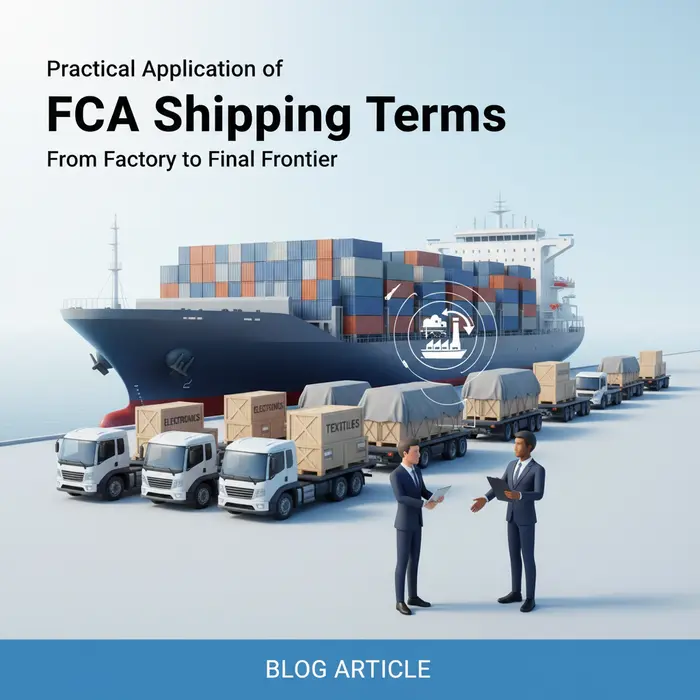
The Free Carrier (FCA Incoterms 2020) rule is among the most flexible and widely used Incoterms, particularly relevant in modern multi-modal transport and when goods are handed over to a carrier at an inland point rather than directly onto a vessel. Understanding its practical application is crucial for exporters and importers seeking efficient and compliant international transactions. Unlike terms like FOB, FCA emphasizes the transfer of risk and cost at a named place of delivery where the seller hands over the goods to the buyer’s nominated carrier. This section delves into real-world scenarios, common challenges, and best practices to ensure smooth international trade under FCA shipping terms.
1. Choosing the ‘named place of delivery’: Seller’s premises vs. other locations
The selection of the ‘named place of delivery’ is perhaps the most critical decision under FCA, dictating precisely when and where the risk and cost transfer from seller to buyer. This choice significantly impacts the responsibilities of both parties:
- Seller’s Premises: When the named place is the seller’s own factory, warehouse, or facility, the seller is responsible for loading the goods onto the transport provided by the buyer’s nominated carrier. The risk and cost transfer occurs at the moment the goods are successfully loaded. This is often preferred by sellers as they have control over the loading process and equipment, making it a clear point of transfer. For instance, an exporter in Vietnam selling electronics might arrange for the buyer’s designated truck to pick up goods directly from their factory in Ho Chi Minh City. Here, the seller ensures the goods are loaded safely onto the truck, and once loaded, the responsibility shifts to the buyer.
- Other Named Location (e.g., freight forwarder’s warehouse, port terminal, inland container depot): If the named place is any location other than the seller’s premises, the seller is responsible for delivering the goods to that location, ready for unloading from the seller’s transport. However, it is crucial to note that the seller is not responsible for unloading the goods at this alternative location. The buyer bears the risk and cost of unloading. This scenario is common for Less than Container Load (LCL) shipments, where goods are consolidated at a freight forwarder’s warehouse before being loaded into a container. For example, if a buyer designates a freight forwarder’s warehouse in Hanoi as the delivery point, the Vietnamese seller must transport the goods to that warehouse, and make them available for unloading. The responsibility for the actual unloading at the warehouse then falls on the buyer or their chosen forwarder. Clearly defining this point prevents potential disputes regarding handling charges and damages during unloading. Understanding these nuances is essential, especially when comparing FCA vs FOB Incoterms 2020, as FOB always specifies delivery onto a vessel, while FCA offers much greater flexibility in delivery point.
2. Loading and unloading considerations under FCA
As highlighted, the precise allocation of loading and unloading responsibilities is paramount under FCA shipping terms explained. Misunderstanding these can lead to delays, additional costs, or even cargo damage:
- Seller’s Premises: If the delivery point is the seller’s facility, the seller is responsible for safe loading onto the buyer’s collecting vehicle. This includes providing the necessary equipment (forklifts, cranes) and personnel. They should ensure the goods are properly secured for transit.
- Other Named Place: If the delivery point is not the seller’s premises, the seller is responsible for transporting the goods to that point and making them available on their arriving vehicle (e.g., truck) for unloading. The responsibility for the actual unloading operation rests with the buyer. It’s imperative that both parties communicate clearly about the type of transport, required equipment for unloading (e.g., a forklift at the warehouse), and scheduling. Discrepancies here can result in demurrage charges, re-handling fees, or delays if the buyer’s chosen carrier isn’t equipped or prepared for immediate unloading. For example, in FCA Vietnam export trade, if a seller delivers goods to a regional consolidation hub, they must ensure the goods are ready to be taken off their truck, but the buyer’s agent at the hub is responsible for the physical unloading.
3. Documentation requirements for smooth FCA transactions
Seamless FCA Incoterms responsibilities buyer seller rely heavily on accurate and timely documentation. The seller is primarily responsible for export documentation, while the buyer handles import-related documents and the main carriage contract.
- Seller’s Responsibilities:
- Commercial Invoice and Packing List: Essential for customs clearance, detailing goods, value, and packaging.
- Export License: If required by the exporting country (e.g., Vietnam), the seller must obtain this.
- Proof of Delivery: A document confirming the goods were handed over to the buyer’s nominated carrier at the named place. This could be a carrier’s receipt or a signed truck waybill. This document is crucial for the seller to prove fulfillment of their obligation and for the buyer to initiate the main carriage.
- Customs Export Declaration: The seller must complete all necessary export formalities and documentation for clearance in the country of origin.
- Buyer’s Responsibilities:
- Transport Document (Bill of Lading, Air Waybill, etc.): The buyer or their nominated carrier arranges and issues the main transport document covering the carriage from the named place to the destination.
- Import License: If required by the importing country, the buyer must obtain this.
- Customs Import Declaration: The buyer handles all import formalities and duties in the destination country.
- Certificate of Origin (if requested): While often prepared by the seller, the buyer usually requests this for preferential duty treatment.
Clear communication regarding documentation, especially proof of delivery and any specific customs requirements for FCA Vietnam export trade, is vital. Any missing or incorrect document can lead to significant delays and penalties at customs, underscoring the need for meticulous attention to detail from both parties.
FCA vs FOB Incoterms 2020: A Critical Comparison
The world of international trade relies heavily on Incoterms® rules to define the responsibilities of buyers and sellers for the delivery of goods. Among the eleven Incoterms 2020 rules, FCA (Free Carrier) and FOB (Free On Board) are two of the most frequently used, yet often misunderstood, terms. While both deal with the point at which goods are delivered from the seller to the buyer, their application, risk transfer, and cost allocation differ significantly. Understanding these distinctions is crucial for businesses, especially those involved in complex global supply chains or emerging markets like Vietnam, where efficient logistics are paramount. This comparison will provide a clear perspective on FCA vs FOB Incoterms 2020, highlighting their fundamental differences in terms of risk, cost, and suitability for various modes of transport.
1. Risk and cost transfer: The fundamental distinction
The core difference between FCA and FOB lies in the precise point at which the risk of loss or damage to the goods, as well as the costs associated with their transportation, transfer from the seller to the buyer.
Under FCA Incoterms 2020, the seller delivers the goods to the carrier or another person nominated by the buyer at the seller’s premises or another named place. The critical point here is delivery to the carrier. Once the goods are handed over to the buyer’s nominated carrier at the agreed location – be it the seller’s factory, a warehouse, or a transport hub – the risk of loss or damage transfers to the buyer. At this same point, the costs transfer. The seller is responsible for export packaging, loading onto the first carrier (if at their premises), and export customs clearance. All subsequent costs, including main carriage, import duties, and onward delivery, fall on the buyer. This makes FCA a highly versatile term, placing much of the responsibility for the main carriage and its associated risks squarely on the buyer. For a deeper dive into these responsibilities, exploring FCA Incoterms responsibilities buyer seller is essential.
In contrast, FOB (Free On Board) specifies that the seller delivers the goods on board the vessel nominated by the buyer at the named port of shipment. The risk of loss or damage to the goods transfers when the goods are physically on board the ship. Costs also transfer at this point. The seller is responsible for all costs up to and including loading the goods onto the vessel, including export clearance and any terminal handling charges prior to loading. The buyer then assumes responsibility for the main carriage, insurance (if desired), and all costs from the named port of shipment onwards. The distinction is clear: FCA places the transfer earlier, often at the origin country’s interior, while FOB places it later, at the port of departure, specifically on the ship.
2. Suitability for different modes of transport (multimodal vs. sea/inland waterway)
One of the most significant practical differences determining when to use FCA vs FOB Incoterms 2020 is their applicability to different modes of transport.
FCA Incoterms 2020 is designed for any mode or modes of transport. This means it can be used for air freight, road freight, rail freight, and critically, multimodal transport – where goods are transported using a combination of modes (e.g., road to port, then sea, then rail). Given the complexities of modern logistics, where goods are rarely moved by a single mode from door to door, FCA’s flexibility makes it a highly appropriate choice for containerized cargo, which almost always involves more than one mode of transport. The term “Free Carrier” inherently refers to the handover to a carrier, irrespective of the mode they operate.
Conversely, FOB (Free On Board) is strictly limited to sea and inland waterway transport. It is specifically designed for situations where goods are loaded onto a vessel at a port. This makes it suitable for traditional bulk cargo (e.g., grain, oil), break-bulk cargo (e.g., machinery parts not in containers), or commodities that are physically loaded onto a ship rather than into a container first. Using FOB for containerized cargo, which typically involves the goods being handed over to a carrier at an inland container yard or the seller’s factory before ever reaching the ship, is technically incorrect according to Incoterms 2020 rules and can lead to ambiguities in risk and cost transfer. The International Chamber of Commerce (ICC), the author of Incoterms rules, strongly advises against using FOB for containerized freight for this reason. For authoritative guidance, refer to official ICC publications on Incoterms rules.
3. When to choose FCA over FOB (and vice-versa)
The choice between FCA and FOB hinges on the specific circumstances of the trade, the nature of the goods, the mode of transport, and the desired allocation of responsibilities between buyer and seller.
Choose FCA over FOB when:
- Multimodal or containerized transport: This is the primary driver. If goods are transported in containers, or if the journey involves more than one mode (e.g., truck to port, then ship), FCA is the correct and recommended term.
- Seller wants less responsibility post-delivery at their premises: Under FCA, the seller’s responsibility ends once the goods are loaded onto the buyer’s nominated carrier at their factory or a nearby location. This can simplify export logistics for the seller.
- Buyer wants more control over the main carriage: With FCA, the buyer typically nominates the carrier for the main transport, giving them greater control over carrier selection, freight rates, and scheduling.
- For exporters in regions like Vietnam: Using FCA Vietnam export trade can be beneficial, especially when goods are consolidated or picked up from inland factories, streamlining the seller’s obligations within Vietnam.
Choose FOB over FCA when:
- Traditional bulk or break-bulk cargo: If the goods are not containerized and are directly loaded onto a vessel (e.g., commodities, heavy machinery), FOB remains a viable and appropriate choice.
- Sea or inland waterway transport only: The entire journey from the named port of shipment must be by sea or inland waterway.
- Seller prefers to handle export customs and port loading: Some sellers may have established relationships with freight forwarders at the port and prefer to manage the entire process up to the goods being on board the vessel.
- Buyer wants less involvement until goods are on board: The buyer’s responsibility truly begins when the goods are safely on the ship.
In conclusion, while both FCA and FOB define delivery points, FCA is the more modern and versatile term, highly suited for today’s multimodal and containerized shipping environment. FOB, though still widely used, has a more limited application to traditional sea freight. Choosing the correct Incoterm is vital for clarity, risk management, and avoiding costly disputes in international trade. Businesses should carefully consider their specific operational realities and logistical setup before making a selection.
Navigating FCA Incoterms in Global Export Trade: Focus on Vietnam
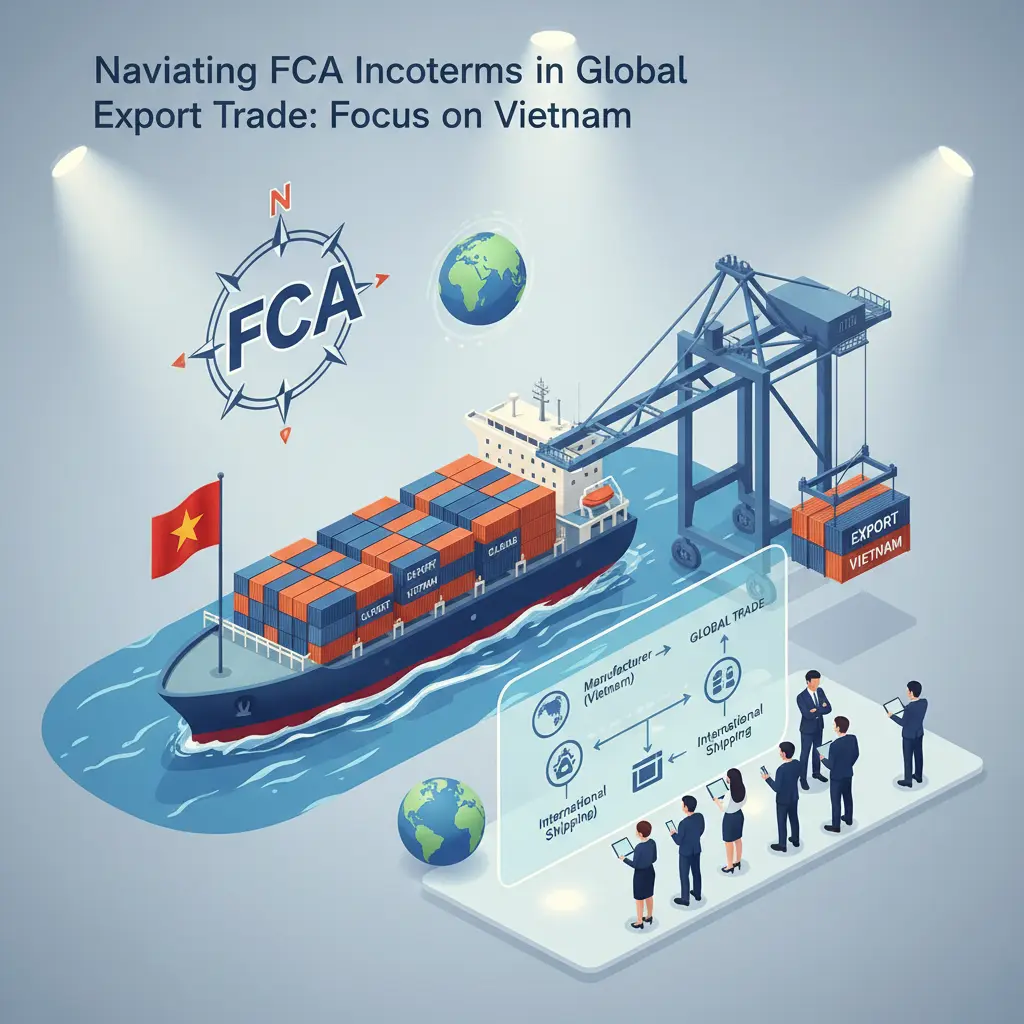
This section explores the specific implications and considerations of utilizing FCA Incoterms 2020 in global export scenarios, with a particular focus on how it applies to trade originating from countries like Vietnam. As global supply chains become increasingly intricate, understanding the nuances of shipping terms is crucial for both buyers and sellers. FCA (Free Carrier) is an Incoterm particularly well-suited for modern multimodal transport, offering distinct advantages and responsibilities that Vietnamese exporters and their international partners must grasp.
Under FCA shipping terms explained, the seller delivers the goods to the carrier or another person nominated by the buyer at the seller’s premises or another named place. The risk transfers from the seller to the buyer at this point of delivery. This flexibility, coupled with the seller’s responsibility for export customs clearance, makes FCA a popular choice, especially for manufacturers and suppliers in emerging export hubs like Vietnam who seek to optimize their domestic logistics while empowering buyers with control over international freight.
1. FCA and customs clearance processes in export countries
One of the defining characteristics of FCA Incoterms responsibilities buyer seller is the seller’s obligation to complete export customs clearance. For Vietnamese exporters, this means meticulously preparing all necessary documentation and adhering to local regulations before the goods are handed over to the buyer’s nominated carrier. This typically involves:
- Obtaining export licenses or permits, if required for specific goods.
- Preparing a commercial invoice, packing list, and certificate of origin (e.g., Form A, Form B, or C/O based on free trade agreements).
- Completing customs declarations with the Vietnam Customs authorities.
- Paying any applicable export duties or taxes, although Vietnam generally has low export taxes on manufactured goods.
By handling these steps, the Vietnamese seller ensures that the goods are legally clear for international transit, reducing potential delays or issues for the buyer down the line. The transfer of risk and cost (excluding main carriage) occurs once the goods are delivered and loaded onto the buyer’s carrier at the agreed-upon point in Vietnam, making the seller responsible for the initial domestic leg and all export formalities.
2. Challenges and opportunities for exporters using FCA Incoterms
Utilizing FCA Incoterms 2020 presents both challenges and opportunities for Vietnamese exporters:
Challenges:
- Domestic Logistics Coordination: The seller is responsible for transporting goods to the specified delivery point, which could be a port, airport, or a carrier’s depot. This requires efficient domestic logistics and reliable local transport partners.
- Carrier Coordination: Coordinating with the buyer’s nominated carrier can sometimes be tricky if the carrier is unfamiliar with local conditions or if communication is not seamless.
- Documentation Accuracy: Any errors in export documentation can lead to delays or penalties, underscoring the need for meticulous attention to detail.
Opportunities:
- Reduced Risk Exposure: Risk transfers to the buyer once goods are delivered to the nominated carrier. This significantly limits the Vietnamese exporter’s exposure to risks associated with international transit, such as damage, loss, or theft during the main carriage.
- Cost Control: Sellers have clear cost boundaries up to the delivery point, allowing for more precise pricing and profit margin calculation.
- Flexibility for Buyers: FCA allows buyers to choose their preferred international carrier, negotiate freight rates, and consolidate shipments, potentially making Vietnamese products more attractive.
- Compliance Management: By handling export clearance, sellers maintain control over compliance with Vietnamese regulations, potentially streamlining the process. This differs significantly from FOB (Free On Board) Incoterms, where the seller’s responsibility extends only to placing goods on board the vessel nominated by the buyer.
3. Case study: FCA Vietnam export trade logistics
Consider a Vietnamese textile manufacturer, ‘VietThreads Co.’, based in Ho Chi Minh City, exporting a shipment of garments to a buyer, ‘Global Fashion Inc.’, in the United States. Under an FCA Vietnam export trade agreement, specifically ‘FCA Ho Chi Minh City Port (Container Terminal)’, the responsibilities would unfold as follows:
- VietThreads Co. (Seller):
- Manufactures and securely packs the garments for international shipment.
- Arranges inland transport from its factory in Ho Chi Minh City to the designated container terminal at Cat Lai Port.
- Completes all Vietnamese export customs procedures, including filing declarations, obtaining necessary permits, and securing a Certificate of Origin.
- Loads the goods onto the container provided by Global Fashion Inc.’s nominated carrier at the Cat Lai Port container yard.
- Global Fashion Inc. (Buyer):
- Nominates the international carrier (e.g., a specific shipping line) and arranges for the main carriage from Ho Chi Minh City to the USA.
- Bears all costs and risks associated with the main carriage and subsequent import procedures in the USA.
In this scenario, VietThreads Co. leverages its local expertise to handle the initial logistics and navigate Vietnamese export regulations, ensuring a smooth hand-off. The risk and cost transfer occur precisely when the goods are loaded onto the buyer’s container at Cat Lai Port. This arrangement provides predictability for VietThreads Co. and gives Global Fashion Inc. autonomy over its international shipping, making it a mutually beneficial approach in FCA Incoterms 2020.
Partner with Vietnam’s Leading Suppliers
Looking for reliable suppliers in Vietnam? Contact VietnamSuppliers.com today to connect with verified manufacturers and exporters across all industries.
—————————————
References
– International Chamber of Commerce’s Incoterms page: https://iccwbo.org/resources-for-business/incoterms-rules/
– ICC Incoterms 2020 Rules – FCA: https://iccwbo.org/resources-for-business/incoterms-rules/incoterms-2020/#FCA
– ICC Incoterms 2020 Rules: https://iccwbo.org/resources-for-business/incoterms-rules/incoterms-2020-rules/
– Incoterms rules: https://iccwbo.org/resources-for-business/incoterms-rules/
– Incoterms® Rules by ICC: https://iccwbo.org/resources-for-business/incoterms-rules/