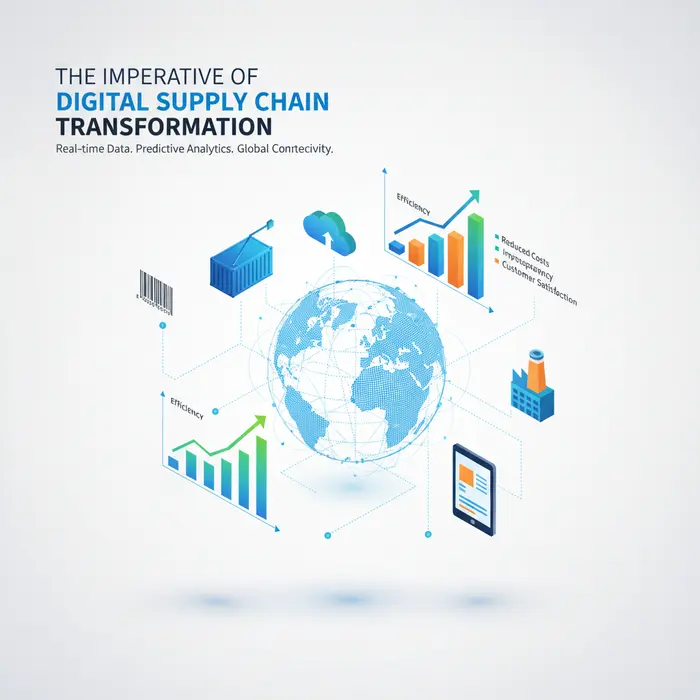
The Imperative of Digital Supply Chain Transformation
In an era defined by unprecedented change and relentless market volatility, the global supply chain has emerged as both a critical vulnerability and a powerful differentiator for businesses worldwide. From the far-reaching disruptions of the recent pandemic to the accelerating pace of technological innovation, organizations are facing a stark reality: clinging to outdated, manual processes is no longer sustainable. The call for Digital Supply Chain Transformation is not merely an evolutionary step but an existential imperative. Embracing this transformation now is crucial for navigating current complexities, unlocking future growth, and establishing a robust, responsive operational backbone. This section explores why businesses must urgently digitize their supply chains, highlighting the pressing challenges they face today and the immense opportunities that lie ahead in a rapidly evolving global landscape.
1. Navigating Post-Pandemic Supply Chain Complexities
The COVID-19 pandemic served as a brutal stress test for global supply chains, exposing deep-seated fragilities and a critical lack of visibility. Businesses grappled with sudden demand shifts, factory closures, port backlogs, and logistical bottlenecks, leading to widespread product shortages and significant financial losses. In this new normal, traditional linear supply chains are simply inadequate. Digital transformation offers the vital tools to build robust Supply Chain Resilience Strategies. Technologies like blockchain provide immutable records for enhanced traceability, while advanced analytics and machine learning predict potential disruptions before they escalate. Integrating AI in Global Logistics, for instance, allows for dynamic rerouting, optimized inventory placement, and predictive maintenance of assets, minimizing downtime and ensuring continuity of operations. By harnessing real-time data and interconnected platforms, companies can gain end-to-end visibility, respond proactively to unforeseen events, and transform vulnerabilities into strategic advantages.
2. Driving Efficiency and Cost Reduction through Digitization
Beyond resilience, digital transformation is a powerful catalyst for operational efficiency and significant cost reduction. Manual processes are prone to errors, time-consuming, and expensive. Digitization automates repetitive tasks, streamlines workflows, and eliminates unnecessary overheads. For example, the adoption of AI in Global Logistics can optimize routes, consolidate shipments, and reduce fuel consumption, leading to direct savings. Predictive analytics can forecast demand more accurately, minimizing overstocking and understocking, thus reducing warehousing costs and waste. Furthermore, integrating Sustainable Sourcing Technology not only enhances brand reputation but also often uncovers opportunities for resource efficiency, translating into lower operational expenditures. The digitization of documentation and communication reduces administrative burdens, while centralized data platforms enhance collaboration and decision-making across the entire supply network. These efficiencies collectively contribute to a healthier bottom line and a more agile organization.
3. Anticipating Future Market Demands and Consumer Expectations
The modern consumer is more informed, demanding, and ethically conscious than ever before. They expect speed, transparency, personalization, and increasingly, sustainability from the brands they choose. Digital supply chains are uniquely positioned to meet and even exceed these evolving expectations. Advanced data analytics and AI-driven insights can predict future market trends, allowing businesses to proactively adapt product offerings and production schedules. Technologies that enable Sustainable Sourcing Technology not only ensure ethical practices but also provide the transparency consumers crave, allowing them to trace product origins and environmental impact. Furthermore, the Trade Finance Digitization process, facilitated by blockchain and other digital platforms, can accelerate transactions, reduce fraud, and lower costs for global trade, indirectly benefiting consumers through faster delivery and more competitive pricing. By fostering agility and leveraging real-time feedback loops, digital supply chains enable businesses to stay ahead of the curve, delight customers, and secure a competitive edge in tomorrow’s marketplace.
The journey towards a fully digitized supply chain is complex, but its rewards are undeniable. It transforms an organization from reactive to proactive, from fragile to resilient, and from traditional to innovative. Businesses that embrace this imperative will not only survive the challenges of the present but will thrive, innovate, and lead in the digital future.
Building Robust Supply Chain Resilience Strategies
In an era defined by unprecedented volatility, from geopolitical shifts and natural disasters to global pandemics and economic uncertainties, the need for robust supply chain resilience strategies has never been more critical. Businesses can no longer afford to operate with fragile, linear supply chains vulnerable to single points of failure. Instead, the focus has shifted towards a proactive and adaptive approach, powered significantly by Digital Supply Chain Transformation. This comprehensive overhaul leverages digital tools and advanced frameworks to fortify supply chains against disruptions, ensuring not just business continuity but also enhanced adaptability and competitive advantage in a constantly evolving global marketplace.
The journey towards a resilient supply chain begins with a fundamental re-evaluation of traditional processes and a strategic adoption of technology. This transformation goes beyond mere digitization; it involves integrating sophisticated analytics, artificial intelligence (AI), machine learning (ML), and Internet of Things (IoT) to create a transparent, agile, and intelligent network. By embracing these advancements, companies can mitigate risks, optimize operations, and build a supply chain capable of withstanding future shocks, thereby safeguarding their long-term viability and growth.
1. Leveraging Real-time Data for Proactive Risk Mitigation
The cornerstone of modern supply chain resilience lies in the ability to collect, analyze, and act upon real-time data. Traditional supply chains often suffer from information silos and delayed insights, leaving them reactive to disruptions rather than proactive. Digital tools, however, bridge these gaps by deploying IoT sensors across warehouses, transportation fleets, and production lines. These sensors provide continuous streams of data on inventory levels, asset locations, environmental conditions, and production statuses. When combined with advanced analytics and AI in global logistics, this real-time information transforms into predictive insights.
AI algorithms can detect anomalies, forecast demand shifts, predict potential equipment failures, and even model the impact of geopolitical events on specific trade routes. For instance, by analyzing weather patterns, traffic congestion, and port congestion data, AI can dynamically re-route shipments to avoid delays. This capacity for proactive risk mitigation allows supply chain managers to anticipate challenges before they escalate, enabling swift, data-driven decisions that minimize disruption and maintain operational flow. The shift from historical reporting to predictive intelligence is a game-changer, fostering a supply chain that anticipates and adapts rather than merely reacting.
2. Diversifying Supplier Networks with Digital Platforms
Over-reliance on a limited number of suppliers, particularly those concentrated in single geographical regions, has proven to be a significant vulnerability. The modern approach to supply chain resilience advocates for robust supplier diversification, a strategy vastly simplified and enhanced by digital platforms. B2B marketplaces, supplier relationship management (SRM) systems, and blockchain-enabled platforms allow companies to identify, vet, and onboard a broader and more diverse range of suppliers globally. These platforms provide transparency into supplier capabilities, financial stability, and ethical practices, reducing the risks associated with unforeseen disruptions.
Furthermore, digital tools facilitate the integration of sustainable sourcing technology. Companies can leverage data analytics to assess suppliers’ environmental, social, and governance (ESG) performance, ensuring that diversification efforts align with corporate responsibility goals. By maintaining an active portfolio of alternative suppliers, businesses can quickly pivot their sourcing strategies in response to local disruptions, raw material shortages, or trade policy changes, thereby ensuring continuous access to critical components and materials.
3. Creating Agile and Adaptive Supply Chain Models
Beyond data insights and supplier diversification, true supply chain resilience hinges on creating inherent agility and adaptability. This involves designing supply chains that are flexible, modular, and capable of rapid reconfiguration. Digital twins – virtual models of physical supply chains – allow organizations to simulate various scenarios, test the impact of disruptions, and optimize responses without affecting real-world operations. Cloud-based supply chain management (SCM) systems provide the flexibility needed to scale operations up or down quickly and integrate seamlessly with partners across the globe.
Automation, from robotic process automation (RPA) in administrative tasks to automated guided vehicles (AGVs) in warehouses, further enhances agility by streamlining operations and reducing human error. Moreover, Trade Finance Digitization plays a crucial role in enabling faster, more secure, and transparent financial transactions across the supply chain. This accelerates payment cycles, reduces administrative burdens, and improves cash flow, allowing businesses to adapt quickly to changing market conditions and seize new opportunities. An agile supply chain is not just responsive; it is inherently designed to anticipate change and proactively reconfigure itself to maintain optimal performance.
In conclusion, building robust supply chain resilience strategies is no longer an optional endeavor but a strategic imperative. By fully embracing Digital Supply Chain Transformation, companies can move beyond reactive measures to establish proactive, intelligent, and highly adaptive supply networks. Leveraging real-time data, diversifying supplier networks through digital platforms, and fostering agile operational models are foundational pillars that ensure business continuity, drive efficiency, and secure a competitive edge in a perpetually unpredictable world.
The Transformative Role of AI in Global Logistics
The intricate web of global logistics, once driven by manual processes and historical data, is undergoing a profound metamorphosis thanks to Artificial Intelligence (AI). This seismic shift, often termed Digital Supply Chain Transformation, is not merely an incremental improvement but a fundamental reimagining of how goods move from origin to destination. AI in Global Logistics is revolutionizing every aspect, from the initial stages of intelligent forecasting and optimizing complex supply chains to the critical final leg of last-mile delivery. As businesses navigate an increasingly volatile global landscape, the integration of AI-powered solutions is proving indispensable for building robust Supply Chain Resilience Strategies, driving efficiency, and fostering sustainability. This digital evolution ensures not just faster and cheaper operations, but smarter, more adaptive, and environmentally conscious logistics networks.

1. Optimizing Route Planning and Fleet Management with AI
One of the most immediate and tangible impacts of AI in global logistics is its power to optimize route planning and fleet management. Traditional methods often rely on static maps and historical data, which quickly become obsolete in dynamic real-world conditions. AI-powered algorithms, however, can process vast quantities of real-time data – including live traffic conditions, weather patterns, road closures, delivery windows, and even driver availability and fatigue levels – to calculate the most efficient routes instantaneously. This leads to significant reductions in travel time, fuel consumption, and operational costs, aligning perfectly with Sustainable Sourcing Technology goals by minimizing carbon footprints.
Beyond route optimization, AI enhances fleet management through predictive maintenance. Sensors on vehicles constantly feed data to AI systems, which can identify potential mechanical failures before they occur. This proactive approach prevents costly breakdowns, reduces downtime, and extends the lifespan of vehicles, ensuring fleets operate at peak efficiency. Furthermore, AI can analyze driver behavior, offering insights for training to improve safety and fuel efficiency. The result is a highly efficient, responsive, and environmentally responsible fleet operation, a cornerstone of modern AI in Global Logistics.
2. Predictive Analytics for Enhanced Demand Forecasting
Accurate demand forecasting is the bedrock of an efficient supply chain, preventing both costly overstocking and damaging stockouts. AI-driven predictive analytics takes this to an unprecedented level of precision. Unlike conventional statistical models, AI and machine learning algorithms can analyze a multitude of complex and disparate data points simultaneously. This includes historical sales data, promotional calendars, seasonal trends, macroeconomic indicators, social media sentiment, news events, and even local weather forecasts.
By identifying subtle patterns and correlations that human analysts might miss, AI models can generate highly accurate forecasts, even for volatile products or new market entries. This enhanced foresight allows companies to optimize inventory levels, schedule production more effectively, and allocate resources precisely where they are needed. The result is a more agile and responsive supply chain, significantly bolstering Supply Chain Resilience Strategies against market fluctuations and unforeseen disruptions, and marking a critical step in overall Digital Supply Chain Transformation efforts.
3. Automating Warehouse Operations and Inventory Management
Warehouses, once labor-intensive hubs, are rapidly transforming into automated, intelligent facilities thanks to AI. Robotic process automation (RPA), coupled with AI, enables automated guided vehicles (AGVs) and autonomous mobile robots (AMRs) to handle tasks like picking, packing, and sorting with unparalleled speed and accuracy. Drones equipped with AI vision systems can conduct rapid inventory counts, identify misplaced items, and monitor warehouse conditions, drastically reducing the time and error rates associated with manual checks.
For inventory management, AI provides dynamic slotting capabilities, optimizing storage locations based on demand patterns, product dimensions, and picking frequency. It can predict optimal reorder points and quantities, reducing carrying costs and minimizing waste. Furthermore, AI-driven systems can monitor product freshness and expiry dates, crucial for industries like food and pharmaceuticals, minimizing spoilage. The integration of AI in these operations leads to higher throughput, reduced operational costs, and improved order fulfillment rates. This level of real-time inventory visibility and operational efficiency also contributes indirectly to smoother Trade Finance Digitization processes, as accurate and verifiable inventory data can streamline financing and collateral assessments.
In conclusion, AI is not just another technological tool; it is the catalyst for a paradigm shift in global logistics. From intelligent route planning and predictive maintenance to highly accurate demand forecasting and fully automated warehouses, AI is forging a future where supply chains are not only efficient and cost-effective but also remarkably resilient, sustainable, and responsive to an ever-changing world. Embracing this transformative technology is no longer an option but a strategic imperative for any business aiming to thrive in the modern global economy.
Empowering Sustainability with Sourcing Technology
The global supply chain landscape is undergoing a profound shift, driven by increasing consumer demand for ethical products, stricter regulatory frameworks, and a growing imperative to combat climate change. Sourcing technology is no longer a luxury but a necessity, acting as a powerful catalyst for empowering sustainability across the entire value chain. From raw material extraction to final product delivery, advanced digital tools are enabling unprecedented levels of transparency, accountability, and efficiency, paving the way for truly responsible and environmentally sound practices. This Digital Supply Chain Transformation is reshaping how businesses operate, offering robust solutions for complex challenges and fostering a new era of sustainable commerce.
1. Tracing Supply Chains for Ethical and Regulatory Compliance
The journey of a product from its origin to the consumer is often complex and opaque, making it challenging to ensure ethical labor practices, responsible material sourcing, and regulatory adherence. Sustainable Sourcing Technology, leveraging innovations like blockchain, Internet of Things (IoT) sensors, and advanced data analytics, is revolutionizing this opacity. Blockchain provides an immutable, distributed ledger, creating a verifiable and tamper-proof history of goods. IoT devices track conditions, offering real-time insights. This granular data empowers businesses to meticulously trace components, verify material origins – crucial for avoiding conflict minerals or illegal timber – and monitor labor conditions. Enhanced visibility significantly bolsters Supply Chain Resilience Strategies by identifying risks and non-compliance early. Companies can swiftly respond to regulatory changes, demonstrate due diligence, and build consumer trust. This technological capability is vital for meeting stringent global standards, ensuring robust ethical and regulatory compliance. For instance, according to the UN Global Compact report on supply chain sustainability, integrating sustainability into supply chain management is crucial for business continuity and societal impact.
2. Reducing Carbon Footprint through Smart Logistics and Data
Logistics and transportation are significant contributors to global carbon emissions. However, smart logistics, powered by data analytics and artificial intelligence, offers a powerful pathway to significantly reduce the environmental impact of supply chains. AI in Global Logistics can optimize transportation routes, consolidate shipments, and predict demand with greater accuracy, thereby minimizing empty runs and reducing fuel consumption. Predictive analytics allows for proactive inventory management, preventing overstocking and carbon-intensive expedited shipping. Real-time data from vehicle telematics and warehouse sensors enables continuous monitoring of energy consumption, identifying efficiency improvements. Green warehousing initiatives, supported by smart technology, can optimize lighting, heating, and cooling, cutting down energy usage. Companies can also utilize platforms to calculate and track their Scope 3 emissions, identifying hotspots for targeted interventions. By embracing these technological advancements, businesses achieve substantial reductions in their carbon footprint, contributing directly to global climate action goals while often realizing significant operational cost savings.
3. Implementing Circular Economy Principles with Technology
The traditional linear ‘take-make-dispose’ economic model is unsustainable. Technology is pivotal in facilitating the transition to a circular economy, where resources are kept in use for as long as possible, extracting maximum value, then recovering and regenerating materials. Advanced Product Lifecycle Management (PLM) systems, integrated with IoT, allow manufacturers to design products for durability, repairability, and recyclability from the outset. Digital twins can simulate product performance and material composition, enabling optimal resource utilization and waste minimization during production. Furthermore, technology supports reverse logistics platforms, making it easier to collect used products for repair, remanufacturing, or recycling. Blockchain can create ‘material passports,’ detailing material composition, making recycling processes more efficient. AI-powered sorting improves recovery rates from waste streams. These technological innovations not only reduce waste and conserve natural resources but also open new revenue streams through material recovery and reuse, fostering genuine economic and environmental sustainability.
The integration of cutting-edge sourcing technology is undeniably the cornerstone of modern sustainable business practices. From ensuring ethical compliance and bolstering Supply Chain Resilience Strategies to drastically cutting carbon emissions and fostering a circular economy, technology provides the tools necessary for a profound transformation. As businesses increasingly recognize the interconnectedness of environmental, social, and economic performance, investing in Sustainable Sourcing Technology and pursuing a comprehensive Digital Supply Chain Transformation will be paramount for long-term success, brand reputation, and contributing to a healthier planet. The future of supply chains is not just digital; it is inherently sustainable.
The Future of Trade Finance Digitization
The landscape of global trade is undergoing a profound evolution, driven by the imperative for greater efficiency, security, and transparency. At the heart of this transformation lies the Digital Supply Chain Transformation, a seismic shift towards integrated digital solutions in trade finance. This pivotal movement is not merely about digitizing existing paper-based processes; it’s about fundamentally reimagining how trade transactions are conducted, unlocking unprecedented speed, reducing inherent risks, and enhancing accessibility for businesses worldwide. As companies navigate increasingly complex global markets, the adoption of advanced digital tools becomes paramount for fostering Supply Chain Resilience Strategies and optimizing every facet of international commerce.

1. Streamlining Cross-Border Payments with Blockchain and DLT
One of the most significant advancements in Trade Finance Digitization is the application of Blockchain and Distributed Ledger Technology (DLT) to cross-border payments. These technologies promise to revolutionize the speed, security, and transparency of international transactions. By providing an immutable and verifiable record, blockchain eliminates numerous intermediaries, reducing transaction costs and processing times from days to hours. Smart contracts further automate payment triggers based on predefined conditions, minimizing human error and disputes. This traceability and automation are crucial for modern supply chains, enabling businesses to manage cash flow more effectively and fostering greater trust among trading partners. The enhanced transparency offered by DLT also aids in regulatory compliance and reduces the scope for illicit financial activities, setting a new standard for efficient global trade.
2. Improving Access to Capital for SMEs through Digital Platforms
Small and Medium-sized Enterprises (SMEs) often face significant hurdles in accessing traditional trade finance due to perceived high risks, lack of collateral, and complex, paper-intensive processes. Digital platforms are now leveling the playing field, offering innovative solutions that democratize access to capital. These platforms leverage advanced analytics, artificial intelligence, and digital identities to assess creditworthiness more efficiently, often utilizing alternative data points. Solutions such as digital invoice financing, peer-to-peer lending, and tokenized assets provide SMEs with faster, more flexible, and more affordable funding options. By simplifying applications and expediting approvals, these digital ecosystems empower SMEs to participate more robustly in international trade, driving economic growth and fostering innovation. The World Bank Group consistently highlights the importance of bolstering access to finance for SMEs as a key driver for development, a goal significantly advanced by the shift towards digital financial solutions.
3. Reducing Fraud and Operational Costs in Trade Finance
The traditional trade finance landscape is notoriously susceptible to fraud and burdened by high operational costs stemming from manual processes, extensive documentation, and multiple checks. Digital solutions in trade finance are powerfully addressing these challenges. Through the integration of AI, machine learning, and DLT, financial institutions can implement robust systems for real-time document verification, anomaly detection, and identity authentication. AI algorithms swiftly analyze vast datasets to identify suspicious patterns, while DLT provides an immutable audit trail, making it extremely difficult to tamper with transaction records. Furthermore, the automation of processes – from letter of credit issuance to settlement – significantly reduces reliance on manual data entry and paper handling, slashing administrative overheads and minimizing human error. This not only enhances the security and integrity of trade transactions but also leads to substantial cost savings, ultimately making global trade more efficient and secure for all participants. The ongoing digital transformation of supply chains is therefore not just about speed, but also about building a more resilient and trustworthy financial ecosystem.
In conclusion, the future of trade finance digitization is bright, promising a more interconnected, efficient, and secure global trading environment. By embracing blockchain, AI, and digital platforms, the industry is poised to overcome long-standing challenges, enhancing Supply Chain Resilience Strategies and fostering sustainable growth. This paradigm shift will not only streamline existing processes but also open new avenues for inclusive economic participation, redefining the very nature of international commerce.
Partner with Vietnam’s Leading Suppliers
Looking for reliable suppliers in Vietnam? Contact VietnamSuppliers.com today to connect with verified manufacturers and exporters across all industries.
—————————————
References
– Building resilient supply chains | McKinsey: https://www.mckinsey.com/capabilities/operations/our-insights/supply-chain-strategy-digital-and-analytics/building-resilient-supply-chains
– Building supply chain resilience: What it takes | McKinsey & Company: https://www.mckinsey.com/capabilities/operations/our-insights/building-supply-chain-resilience-what-it-takes
– AI in supply chain management: Transforming operations and value: https://www.mckinsey.com/industries/industrials-and-electronics/our-insights/ai-in-supply-chain-management-transforming-operations-and-value
– UN Global Compact report on supply chain sustainability: https://www.unglobalcompact.org/library/2261
– World Bank Group: Small and Medium Enterprises (SMEs) Finance: https://www.worldbank.org/en/topic/financialsector/brief/sme-finance