What is a Tariff-Rate Quota (TRQ)?
In the complex world of international trade, countries often employ various mechanisms to regulate the flow of goods across their borders. Among these, the Tariff-Rate Quota (TRQ) stands out as a sophisticated instrument designed to balance market liberalization with domestic industry protection. Understanding Tariff-Rate Quota Explained is crucial for businesses engaged in importing or exporting, as it directly impacts market access, competition, and ultimately, the profitability of trade ventures. This section will delve into the definition, structure, and economic rationale behind TRQs, explaining their fundamental purpose in international trade agreements and policy.
1. Defining Tariff-Rate Quotas (TRQs)
A Tariff-Rate Quota (TRQ) is a two-tiered system for applying tariffs to imported goods. Unlike a simple quota, which sets an absolute limit on the quantity of goods that can be imported, or a straightforward tariff, which applies a single duty rate to all imports, a TRQ combines elements of both. It allows a specific quantity of a particular imported product to enter a country at a reduced, or "in-quota," tariff rate. Once this quota volume is filled, any additional imports of that same product during the specified period are subject to a significantly higher, "out-of-quota," tariff rate. This mechanism distinguishes TRQs from basic quotas by not prohibiting imports beyond a certain volume, but rather by making them considerably more expensive. The strategic use of TRQs helps governments manage market access, control supply, and protect domestic producers without imposing outright bans. The differences between a simple tariff quota vs TRQ lie in this dynamic dual-tariff structure.

2. The Two-Tiered Duty System Explained
The core of a TRQ lies in its innovative two-tiered duty structure. The first tier, known as the in-quota tariff rate, applies to imports that fall within the specified quota volume. This rate is typically low, often zero, or substantially lower than the general most-favored-nation (MFN) tariff rate. This favorable rate encourages a certain volume of imports, fostering trade and potentially offering consumers lower prices or greater product variety. Businesses actively managing tariff rate quota compliance often prioritize securing access to this lower tariff window to maintain competitive pricing.
However, once the allocated quota volume is reached – whether on an annual, quarterly, or other defined basis – the second tier comes into effect. This is the out-of-quota tariff rate. This rate is substantially higher, designed to discourage further imports once the domestic market’s desired level of foreign competition has been met. The out-of-quota rate often makes additional imports economically unviable for many businesses. The TRQ mechanism and administration typically involve careful monitoring by customs authorities to track the volume of imports and ensure the correct duty rate is applied as the quota is filled. This dual-rate system allows a country to maintain a degree of market openness while simultaneously providing a safety net for its domestic industries against an overwhelming surge of imports, thus impacting import duties significantly based on volume.
3. Purpose and Economic Rationale Behind TRQs
The implementation of Tariff-Rate Quotas serves multiple strategic purposes in international trade policy. Primarily, TRQs are designed to provide a predictable level of market access for specific imported goods while offering a measure of protection for domestic industries. By allowing a limited quantity of imports at a lower tariff, a country can signal its commitment to trade liberalization and fulfill obligations under international agreements, such as those governed by the WTO agreements. This mechanism helps to prevent the complete closure of markets, which could lead to retaliatory measures from trading partners.
Economically, TRQs aim to strike a delicate balance. They can help stabilize domestic prices by ensuring a steady, though controlled, supply of foreign goods. The low in-quota tariff stimulates competition and provides consumers with choices, while the high out-of-quota tariff acts as a barrier, preventing excessive foreign competition from undermining local producers. This dual function allows governments to manage the TRQ impact on import duties effectively, using them as a tool to support agricultural sectors, emerging industries, or sectors deemed strategically important. Furthermore, TRQs are often negotiated during bilateral or multilateral trade talks as a compromise, allowing countries to partially open sensitive markets without fully exposing them to global competition. Effective managing tariff rate quota compliance is key for both importing countries to control their markets and for exporters to access them profitably.
TRQ Mechanism and Administration
Tariff-Rate Quotas (TRQs) are sophisticated instruments in international trade, designed to balance market access with protection for domestic industries. Unlike simple quotas, which cap import volumes, TRQs introduce a two-tiered tariff system. Understanding the operational aspects of the Tariff-Rate Quota Explained mechanism and its administration is crucial for importers, exporters, and policymakers alike. This section delves into how these quotas are implemented, allocated, and meticulously managed by governmental and international trade organizations, highlighting their significant impact on import duties and the complexities of managing tariff rate quota compliance.
1. How TRQs Function: In-Quota vs. Out-of-Quota Rates
At its core, a Tariff-Rate Quota (TRQ) operates through a dual tariff structure. It allows a specific quantity of an imported product to enter a country at a lower (in-quota) tariff rate. Once this predetermined quantity, or quota volume, is met, any subsequent imports of that same product during the specified period are subject to a significantly higher (out-of-quota) tariff rate. This structure provides a predictable level of market access up to the quota limit while simultaneously offering a protective barrier for domestic producers against excessive imports once that limit is surpassed.
The in-quota rate is typically much lower, sometimes even zero, making imports within this limit highly competitive. This encourages trade and ensures a certain level of supply from international markets. For instance, a country might allow 50,000 tons of a specific agricultural product to be imported at a 5% duty. As soon as the 50,000-ton threshold is reached, the out-of-quota rate automatically applies. This higher rate, which could be 50% or more, makes further imports less economically viable, effectively slowing down or halting additional foreign competition and shielding local industries from potential oversupply. The difference between these rates dictates the actual TRQ impact on import duties, creating a dynamic environment where the cost of goods can change dramatically based on market saturation relative to the quota.
2. Methods of Quota Allocation (e.g., first-come, first-served, historical shares)
The effectiveness and fairness of a TRQ mechanism largely depend on how access to the lower in-quota tariff is allocated among importers. Governments employ various methods, each with its own advantages and challenges, influencing market dynamics and competition. These allocation strategies are central to differentiating a tariff quota vs TRQ differences in practical application, as the method dictates who benefits from the lower rates.
- First-Come, First-Served (FCFS): This is perhaps the simplest method, where importers gain access to the in-quota tariff until the quota is exhausted. While seemingly fair, it often leads to a “race to the port,” favoring larger importers with more efficient logistics and immediate access to funds. It requires robust real-time tracking by customs authorities.
- Historical Shares: Under this system, quota allocations are based on an importer’s past import performance over a specific reference period. This method offers predictability and stability for established players but can be criticized for entrenching existing market structures and making it difficult for new entrants to gain a foothold.
- Licensing: Governments may issue import licenses or permits to specific entities, often based on predefined criteria such as domestic processing capacity, commitment to certain quality standards, or participation in domestic purchasing programs. This method allows for greater governmental control and can be tailored to specific policy objectives but may introduce bureaucratic hurdles.
- Auctioning: Some countries auction off quota shares to the highest bidders. This method is seen as economically efficient, as it theoretically allocates the quota to those who value it most and generates revenue for the government. However, it can disadvantage smaller importers who may not have the capital to compete with larger firms.
3. Role of Customs and Trade Agencies in TRQ Administration
Effective TRQ administration requires sophisticated coordination and rigorous enforcement by governmental bodies. Customs authorities and national trade agencies play pivotal roles in ensuring the smooth operation and integrity of TRQ systems, thereby managing tariff rate quota compliance.
- Monitoring and Enforcement: Customs agencies are on the front line, responsible for meticulously tracking import volumes against quota limits in real time. They apply the correct in-quota or out-of-quota tariff rates and prevent circumvention tactics, such as misclassification of goods or illegal transshipment. Their robust systems ensure that importers adhere to the specific rules and quantities set forth.
- Allocation and Transparency: Trade ministries or designated regulatory bodies typically manage the allocation process, whether it involves issuing licenses, overseeing auctions, or maintaining records for historical shares. These agencies are also responsible for publicizing the available quota amounts, the remaining quota balances, and the rules of access, ensuring transparency and providing clarity for all market participants.
- Data Collection and Reporting: Accurate data on import volumes, tariff collections, and quota utilization is critical. Agencies collect this data for domestic policy analysis and for fulfilling international reporting obligations, particularly to organizations like the World Trade Organization (WTO), which monitors members’ adherence to their TRQ commitments under various trade agreements.
- Dispute Resolution and Compliance: These agencies also act as arbitrators in disputes related to quota access or tariff application. They educate importers on compliance requirements and impose penalties for non-compliance, maintaining the fairness and integrity of the trade system.
Tariff Quota vs. TRQ: Understanding the Differences
In the complex world of international trade, precise terminology is crucial. Two terms often used interchangeably, yet possessing critical distinctions, are “tariff quota” and “tariff-rate quota” (TRQ). While both involve quantitative limits on imports, their fundamental mechanics and implications for businesses and market dynamics vary significantly. Clarifying these nuances is essential for importers, exporters, and policymakers to make informed decisions and navigate global supply chains effectively. This section aims to unravel these distinctions, providing a clear understanding of the Tariff-Rate Quota Explained and its lesser-known counterpart.
1. Key Distinctions in Duty Application and Trade Impact
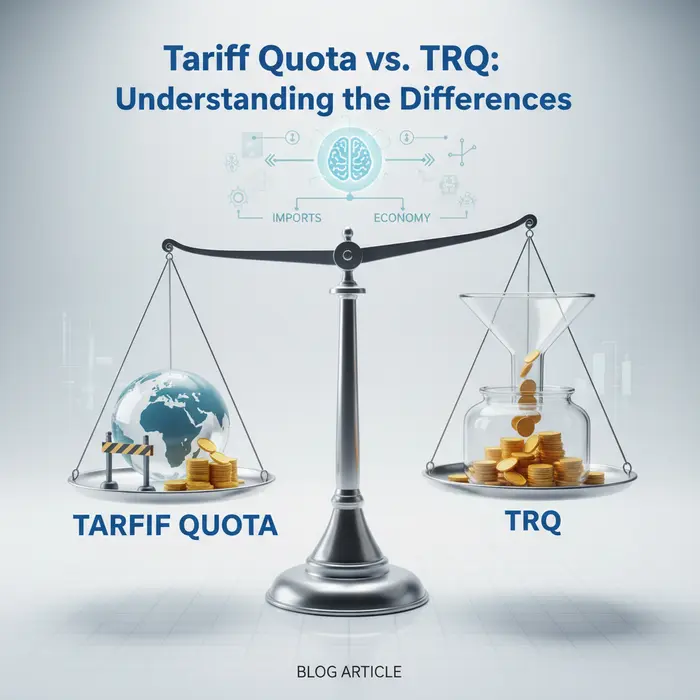
The primary divergence between a simple tariff quota and a TRQ lies in how import duties are applied once a specified import volume is reached. Understanding this difference is central to grasping the tariff quota vs TRQ differences.
- Tariff Quota: This imposes a quantitative restriction on goods imported at a preferential or regular duty. Once this quantity is met, further imports are either completely prohibited for the period or face such a high, prohibitive duty that trade effectively ceases. There’s typically no provision for continued imports at a higher, yet still viable, rate. The impact is often a hard stop, potentially leading to supply shortages and making market access highly competitive for early entrants.
- Tariff-Rate Quota (TRQ): A TRQ operates on a two-tiered duty system. It allows a specific quantity of a product to be imported at a lower “in-quota” duty rate. Crucially, once this “in-quota” volume is exceeded, additional imports are still permitted, but they are subject to a significantly higher “out-of-quota” duty rate. This mechanism ensures continued market access, albeit at a higher cost. The TRQ impact on import duties is thus more flexible, allowing markets to adjust to supply and demand with the out-of-quota duty protecting domestic industries rather than acting as an absolute barrier.
2. Scenarios Where Each Quota Type is Utilized
The choice between a tariff quota and a TRQ depends largely on the specific trade policy objectives of the importing country, product nature, and industry.
- Tariff Quota Utilization: Simple tariff quotas are often used when a government seeks strict control over import volumes. This might be to protect a particularly sensitive domestic industry, manage supply levels for strategic goods, or ensure domestic producers maintain dominant market share. They are simpler to administer but can cause abrupt market disruptions, as they often aim to entirely block imports beyond a certain point, for instance, to safeguard food security or agricultural sectors.
- TRQ Utilization: TRQs are far more prevalent in modern international trade agreements, including WTO frameworks and Free Trade Agreements (FTAs). They represent a compromise: providing preferential market access for a specified quantity while still protecting domestic producers for volumes exceeding that threshold. This flexibility allows countries to liberalize trade progressively without fully exposing sensitive sectors. The TRQ mechanism and administration enables managed competition, allowing foreign suppliers to compete up to a point, and beyond that, requiring them to factor in higher costs, often still competitive if products are unique or domestic supply is insufficient.
3. Implications for Importers and Exporters
The operational distinctions between these two quota types have profound implications for businesses involved in international trade.
-
For Importers:
- Tariff Quota: Importers face high risk and uncertainty. Missing the quota window can mean complete inability to import, leading to supply chain disruptions. Success often depends on swift action and precise timing to secure a portion of the limited quota.
- TRQ: Offers greater predictability. Importers can strategically plan purchases, knowing they can access goods at the lower in-quota rate or budget for the higher out-of-quota rate. This requires careful financial modeling and proactive monitoring of quota fill rates for optimizing costs. Managing tariff rate quota compliance is critical for logistics and financial planning.
-
For Exporters:
- Tariff Quota: Exporters need extreme agility and often established relationships to secure allocations. Market opportunity can be volatile and short-lived.
- TRQ: Provides a more stable, tiered market access structure. Exporters can factor in different duty rates when pricing products, remaining competitive even when selling beyond the in-quota volume. This encourages long-term planning and investment in markets with TRQ systems, as there’s always a pathway for goods to enter, albeit at a higher cost. Understanding TRQ rules and allocation methods is vital for securing market share.
In essence, while both tariff quotas and TRQs regulate import volumes, the TRQ offers a more flexible and economically nuanced approach with its two-tiered duty structure. This flexibility is critical for international trade, allowing managed market access and ensuring trade continues even after preferential volumes are met, albeit at a higher cost. Recognizing these fundamental differences is paramount for navigating global trade policies and optimizing business strategies.
Impact of TRQs on Import Duties and Trade
A Tariff-Rate Quota (TRQ) system is a sophisticated instrument in international trade, designed to balance market liberalization with domestic industry protection. Unlike a simple quota or a uniform tariff, a TRQ employs a two-tiered tariff structure that significantly influences import costs, market access for foreign goods, and the broader global trade landscape, affecting both producers and consumers alike. Understanding the nuances of a Tariff-Rate Quota Explained is crucial for businesses navigating global markets, as its administration and compliance directly impact profitability and competitive positioning.
The core of the “TRQ mechanism and administration” involves setting a specific quantity of a product that can be imported at a lower, “in-quota” tariff rate. Once this quota is filled, any additional imports during the specified period are subject to a higher, “out-of-quota” tariff rate. This approach, often differentiated from a simple tariff quota by its dual tariff structure, creates dynamic market conditions that demand careful “managing tariff rate quota compliance” from importers.
1. Calculating Duties Under a TRQ System
The primary and most direct impact of a TRQ system is on import duty calculation. For businesses importing goods subject to a TRQ, the cost structure depends on whether their shipments fall within the in-quota volume or exceed it.
- In-Quota Tariffs: These are typically low or even zero, designed to encourage a certain level of imports. Securing in-quota access means lower landed costs for importers, enhancing profit margins and market competitiveness. The administrative process for allocating these volumes can vary (e.g., first-come, first-served, licensing), requiring meticulous “managing tariff rate quota compliance.”
- Out-of-Quota Tariffs: Once the specified quota is met, subsequent imports face significantly higher duties. These “out-of-quota” tariffs are often prohibitive, strongly discouraging further imports beyond the quota. This sharp increase in duty costs directly translates to higher import prices, making it less attractive for businesses. This differentiation highlights the core “TRQ impact on import duties,” creating a stark cost difference that dictates import strategies. Importers must accurately track quota utilization to avoid unexpected and costly duty increases.
2. Effects on Market Access and Competitiveness
TRQs profoundly reshape market access and the competitive landscape for both foreign exporters and domestic producers.
- For Foreign Exporters: TRQs offer defined, albeit limited, preferential market access. Exporters securing in-quota access gain a significant competitive advantage due to lower tariff burdens. The competition to secure this limited quota can be intense, influencing pricing and supply chain commitments. Those unable to obtain in-quota access face a substantial disadvantage, often priced out of the market by higher out-of-quota tariffs. This tiered access mechanism can also lead to trade diversion.
- For Domestic Producers: TRQs provide a measure of protection against overwhelming foreign competition. The in-quota volume ensures some market exposure to imports, fostering competition and potentially driving domestic efficiency. Crucially, the higher out-of-quota tariff acts as a safeguard, preventing a flood of cheaper imports that could undermine domestic industries. This dual approach allows governments to manage import levels strategically, supporting domestic sectors while adhering to international trade rules established by bodies like the World Trade Organization. The “TRQ mechanism and administration” is vital for maintaining this balance.
3. Influence on Consumer Prices and Supply Chain Dynamics
Beyond duties and market access, TRQs have a ripple effect on consumer prices and the intricate dynamics of global supply chains.
- Consumer Prices: In-quota tariffs can lead to lower import costs, potentially translating into more competitive retail prices for consumers. This offers wider choice and lower prices for a portion of the market supply. However, once the quota is exhausted and out-of-quota tariffs apply, the cost of additional imports skyrockets, which can lead to higher consumer prices if domestic supply is insufficient or higher-cost imports are necessary. The overall impact depends on the quota size relative to demand and market elasticity.
- Supply Chain Dynamics: TRQs introduce complexity to supply chain management. Importers must become adept at “managing tariff rate quota compliance,” accurately forecasting demand, and timing imports strategically to fall within the in-quota period. Miscalculation can lead to significant cost increases. The potential for quotas to be filled rapidly creates uncertainty, forcing businesses to consider alternative sourcing or face supply disruptions. This can lead to stockpiling or reliance on domestic alternatives, impacting global sourcing patterns and increasing the need for agile logistics. The “TRQ impact on import duties” directly influences these strategic decisions, pushing businesses to optimize their supply chain within the TRQ framework.
In conclusion, Tariff-Rate Quotas are a powerful tool shaping economic realities. Their intricate structure dictates duty calculations, molds market access, and ultimately influences consumer prices and supply chain resilience. Navigating this landscape successfully demands a thorough understanding of the “TRQ mechanism and administration” and a proactive approach to compliance.
Managing Tariff-Rate Quota Compliance
Navigating the intricate landscape of international trade demands a thorough understanding of various regulations, with Tariff-Rate Quotas (TRQs) being particularly complex. A Tariff-Rate Quota Explained outlines a two-tiered tariff system where a specific quantity of imported goods is allowed into a country at a lower, in-quota tariff rate, while any imports exceeding that quantity are subject to a significantly higher, out-of-quota tariff rate. For businesses engaged in cross-border trade, particularly those dealing with products under TRQ regimes, ensuring meticulous compliance is not merely good practice—it’s essential for profitability and avoiding severe financial penalties. This section provides practical guidance and actionable strategies for businesses to effectively manage TRQ compliance, safeguarding their operations against potential pitfalls.

1. Key Compliance Requirements for Importers
Understanding the fundamental compliance requirements is the first step toward successful TRQ management. Importers must be intimately familiar with the specific rules governing each TRQ, which can vary significantly by product, country of origin, and importing nation. This involves staying abreast of the latest information regarding the TRQ mechanism and administration, including quota opening and closing dates, allocation methods (e.g., first-come, first-served, historical usage, license-based), and product-specific classifications. A clear distinction between a standard tariff quota vs TRQ differences is also crucial; while both limit quantities, TRQs impose different tariff rates inside and outside the quota, directly impacting import costs. Businesses must meticulously track their import volumes against the available quota and understand the specific customs procedures required to claim the in-quota tariff rate. Early engagement with customs brokers or trade consultants specializing in TRQs can provide invaluable insights and ensure accurate declarations.
2. Documentation and Record-Keeping Best Practices
Robust documentation and impeccable record-keeping are the backbone of effective TRQ compliance. Importers must maintain comprehensive records for every shipment, including commercial invoices, packing lists, bills of lading, certificates of origin, and any specific permits or licenses required under the TRQ. Crucially, these documents must accurately reflect the goods’ description, quantity, value, and country of origin, all of which determine eligibility for the in-quota rate. Maintaining an organized, easily accessible digital and physical archive of all customs declarations, tariff classifications, and communications with customs authorities is paramount. This diligence not only facilitates smooth customs clearance but also serves as critical evidence in the event of an audit or dispute. Proactive reconciliation of import data against official quota usage reports is a best practice, allowing businesses to identify discrepancies and address them promptly. For detailed guidance on specific TRQ rules and administration, refer to official government trade resources, such as those provided by the Office of the United States Trade Representative (USTR).
3. Strategies for Avoiding Penalties and Fines
The financial implications of non-compliance with TRQ regulations can be substantial, ranging from increased import duties to hefty fines and potential disruptions to supply chains. Therefore, proactive strategies are vital for managing tariff rate quota compliance and mitigating risks. One primary strategy is to implement robust internal controls and training programs for all personnel involved in import operations, ensuring they understand the nuances of TRQ rules and their potential impact. Regular audits of internal processes can help identify weaknesses before they lead to violations. Diversifying sourcing strategies can also reduce reliance on single-origin products that are heavily restricted by TRQs, offering flexibility when quotas are exhausted. Furthermore, establishing clear communication channels with suppliers to obtain accurate and timely information regarding product origin and availability within quota limits is critical. Businesses should closely monitor global trade news and official government announcements regarding TRQ updates, as changes can occur frequently. Understanding the full TRQ impact on import duties means planning for the possibility of exceeding quotas, perhaps by factoring the higher out-of-quota tariff into cost analyses or exploring alternative supply routes or product specifications. A proactive and informed approach is the most effective defense against TRQ-related penalties, safeguarding both financial stability and reputation.
Partner with Vietnam’s Leading Suppliers
Looking for reliable suppliers in Vietnam? Contact VietnamSuppliers.com today to connect with verified manufacturers and exporters across all industries.
—————————————
References
– :
– WTO Agreement on Agriculture – Market Access: https://www.wto.org/english/thewto_e/whatis_e/tif_e/agrm3_e.htm
– WTO Glossary: Tariff Quota: https://www.wto.org/english/tratop_e/agric_e/agric_glossary_e.htm#tariff_quota
– World Trade Organization – Topics: https://www.wto.org/english/tratop_e/tratop_e.htm
– Office of the United States Trade Representative (USTR): https://ustr.gov/issue-areas/trade-mechanisms/tariff-rate-quotas