
Introduction to CIP Incoterms
In the intricate world of global trade, clarity and precision are paramount. Every international transaction involves a complex dance of responsibilities, costs, and risks between buyers and sellers spanning different continents. This is where Incoterms, a set of universally recognized trade terms, step in to provide much-needed standardization. Among them, CIP Incoterms 2020 stands out as a versatile rule, particularly favored for multimodal transport. Understanding CIP – ‘Carriage and Insurance Paid To’ – is crucial for businesses aiming to navigate international shipping with confidence and minimize potential disputes. This introduction lays the groundwork for comprehending CIP, its significance in modern commerce, and the critical updates introduced in the latest 2020 revision.
1. What are Incoterms and Why Do They Matter?
Incoterms, an acronym for International Commercial Terms, are a series of eleven pre-defined trade terms published by the International Chamber of Commerce (ICC). They serve as essential guidelines for international sales contracts, clearly delineating the responsibilities of buyers and sellers for the delivery of goods. Essentially, Incoterms rules address three critical aspects of international trade: who pays for what, when risk transfers from seller to buyer, and who is responsible for logistics and customs formalities. By providing a common language, Incoterms prevent misunderstandings and legal disputes, streamline global trade operations, and ensure that both parties are clear on their obligations and liabilities from the outset of a transaction.
2. Defining CIP: Carriage and Insurance Paid To
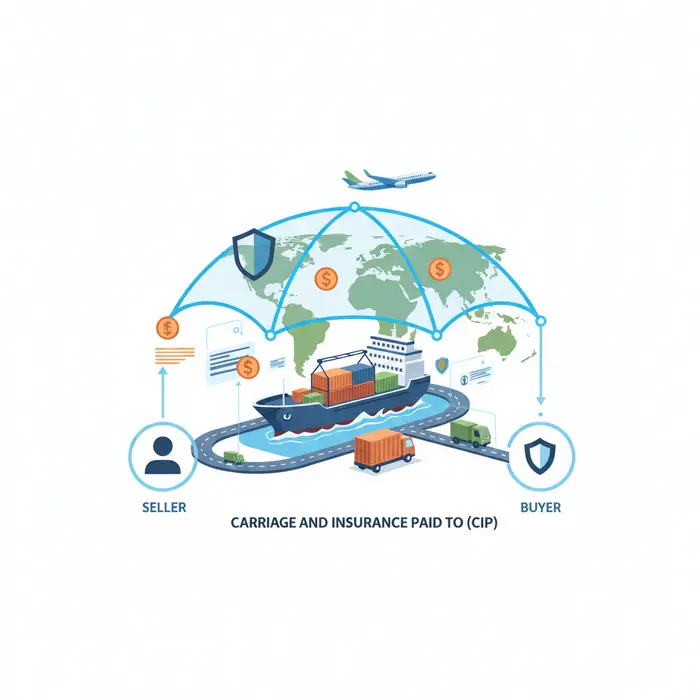
The term CIP, short for ‘Carriage and Insurance Paid To,’ signifies that the seller is responsible for paying the freight costs and insurance premiums to bring the goods to a named place of destination. This Incoterm is highly adaptable, making it suitable for any mode of transport, including multimodal shipments involving road, rail, air, and sea. Under CIP Incoterms explained, the seller's primary obligations include contracting and paying for the main carriage to the agreed destination, as well as obtaining cargo insurance coverage against the buyer’s risk of loss or damage to the goods during transit.
A distinctive feature of CIP, and a crucial aspect of CIP shipping responsibilities, is the separation of risk and cost transfer points. While the seller pays for the carriage and insurance to the named destination, the risk of loss or damage to the goods actually transfers from the seller to the buyer much earlier — once the goods have been delivered to the first carrier at the place of shipment. This means that even though the seller covers the cost of transport and insurance to the destination, the buyer bears the risk for the majority of the journey. Consequently, buyers must be aware of this distinction and understand the extent of their cargo insurance coverage. For sellers, accurate CIP freight cost estimation is vital, as they are responsible for all transport costs up to the agreed destination.
3. Key Changes from Incoterms 2010 to 2020 (and future implications)
The transition from Incoterms 2010 to CIP Incoterms 2020 brought about several refinements, with the most significant change for CIP revolving around the required level of cargo insurance. Under Incoterms 2010, CIP only mandated the seller to obtain minimal insurance coverage, specifically Institute Cargo Clauses (C). These clauses offer basic coverage for major risks like fire, explosion, grounding, or collision. However, recognizing the increased complexities and risks in modern global supply chains, Incoterms 2020 raised the bar.
The updated rules now require sellers under CIP to provide a higher level of CIP cargo insurance coverage, aligning with Institute Cargo Clauses (A). This "all risks" coverage offers a much broader scope of protection, safeguarding against virtually all risks of loss or damage, subject to specific exclusions. This enhancement significantly benefits the buyer, providing greater peace of mind regarding their cargo. Other minor adjustments in Incoterms 2020 include clearer provisions for security-related requirements during transport and updated obligations for sellers regarding proof of delivery. For businesses, these changes imply a need for updated contracts, revised cost calculations (as higher insurance premiums might be involved), and a deeper understanding of their enhanced responsibilities, ensuring compliance and robust risk management in an evolving global trade landscape.
Understanding CIP Shipping Responsibilities
When engaging in international trade, understanding the nuances of various Incoterms® rules is paramount for both sellers and buyers. Among these, CIP Incoterms 2020 (Carriage and Insurance Paid To) stands out as a versatile rule that places significant responsibilities on the seller while ensuring cargo insurance coverage during transit. This rule is particularly suitable for multimodal transport and offers a balanced approach, where the seller handles the bulk of the initial logistics and costs, but risk transfers much earlier than the final destination. Grasping specific CIP shipping responsibilities is crucial for efficient logistics, accurate cost estimation, and mitigating potential disputes.
Seller’s Obligations: Delivery, Risk, and Initial Costs
Under CIP Incoterms, the seller assumes extensive duties up to the named place of destination. Firstly, the seller is responsible for delivering the goods to the *first carrier* at the agreed place. This marks the point of delivery, and crucially, the point where risk transfers to the buyer. Despite this early risk transfer, the seller bears the obligation to contract and pay for the carriage of goods to the named place of destination. This encompasses pre-carriage costs (from the seller’s premises to the first carrier), main carriage costs (ocean freight, air freight, or land transport), and any associated loading charges.
A distinguishing feature of CIP is the seller’s obligation to obtain cargo insurance. This insurance must cover the goods at least to the named place of destination, providing minimum coverage (Clause C of the LMA/IUA Institute Cargo Clauses or similar clauses). While this ensures a basic level of CIP cargo insurance coverage, buyers should note it might not cover all risks and may consider purchasing additional insurance to higher levels (e.g., Clause A) if desired. Furthermore, the seller must handle all export customs formalities, including licenses, security clearances, and duties, providing the buyer with the necessary transport documents, such as a bill of lading or air waybill, to enable them to take delivery at the destination.
Buyer’s Responsibilities: Taking Delivery and Beyond
While the seller has significant upfront responsibilities, the buyer also has critical duties under CIP terms. The primary responsibility of the buyer is to take delivery of the goods from the carrier at the named place of destination. Once the goods are handed over to the first carrier, the risk of loss or damage to the goods passes to the buyer. This means that if any damage or loss occurs during the main carriage, it is the buyer who bears the risk, even though the seller arranged and paid for the transport and basic insurance.
Financially, the buyer is responsible for all costs not covered by the seller, particularly those arising after the goods’ arrival at the named destination. This includes costs associated with unloading the goods at the destination terminal, import customs formalities, duties, taxes, and any further onward carriage from the named destination to their final warehouse or premises. Buyers should meticulously calculate these potential expenses for accurate CIP freight cost estimation. It is also the buyer’s responsibility to arrange for any additional insurance coverage beyond the minimum provided by the seller, if deemed necessary to fully protect their interests.
The Crucial Point of Risk Transfer in CIP
Understanding the point of risk transfer is paramount when Incoterms rules like CIP are employed. Unlike D-group Incoterms (DAP, DPU, DDP) where both risk and cost transfer at the destination, CIP operates on a ‘free carrier’ basis for risk. The risk of loss or damage to the goods transfers from the seller to the buyer when the seller delivers the goods to the *first carrier* at the agreed point. This point is often in the seller’s country, such as a port, airport, or freight forwarder’s warehouse.
This early risk transfer, despite the seller paying for the main carriage and providing basic insurance, is a defining characteristic that sets CIP apart. It is essential for both parties to clearly define this delivery point to avoid ambiguity. The insurance obtained by the seller primarily protects the buyer during transit, as the buyer is the party at risk from the moment of delivery to the first carrier. Therefore, while the seller ensures that the goods are ‘Carriage and Insurance Paid To’ the destination, the buyer must be acutely aware that they assume the risk of loss or damage much earlier in the shipping process. This aspect is vital when considering the full scope of CIP Incoterms explained.
CIP Freight Cost Estimation and Allocation
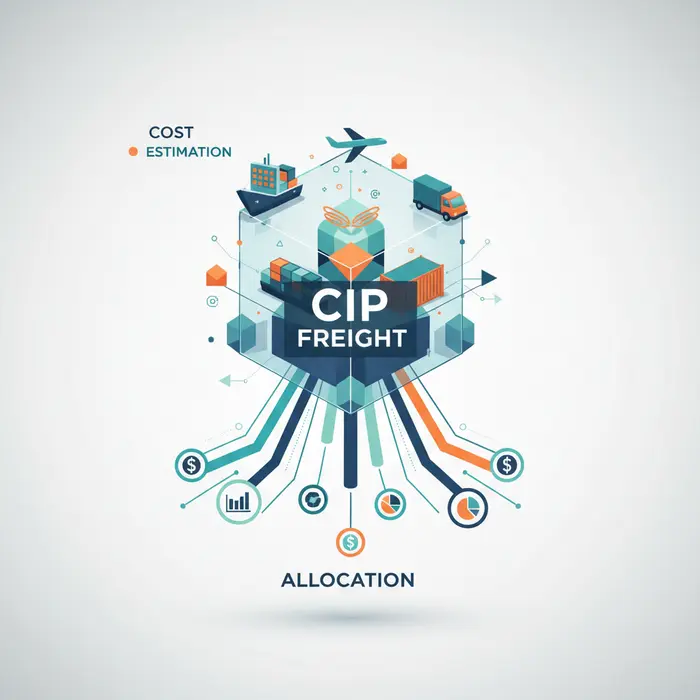
Accurately estimating costs under Carriage and Insurance Paid To (CIP) Incoterms is crucial for both parties to avoid financial surprises. CIP Incoterms 2020 obligates the seller to arrange and pay for carriage and insurance to a named destination. This guide clarifies the division of freight, terminal, and onward transport expenses, offering a detailed look at CIP shipping responsibilities and effective CIP freight cost estimation.
1. Identifying Seller-Paid Freight Components
Under CIP Incoterms, the seller’s primary obligation is to pay for the carriage of goods to the named place of destination and provide minimum insurance coverage. The risk transfers from seller to buyer when the goods are handed over to the first carrier. Key seller-paid costs include:
- Export Formalities: All expenses for export clearance, licenses, and security checks in the origin country.
- Origin Handling: Terminal handling charges (THC) at the port or airport of loading.
- Main Carriage Freight: The cost of transporting goods from origin to the named place of destination by the chosen mode (sea, air, road, rail). This forms the core of CIP freight cost estimation.
- Minimum Cargo Insurance: The seller must obtain and pay for cargo insurance, at least Institute Cargo Clauses (C), covering the goods from the point of risk transfer (first carrier) to the named destination. This is a crucial aspect of CIP Incoterms explained and CIP cargo insurance coverage.
Sellers must obtain detailed, itemized quotes from carriers to accurately account for these expenses.
2. Buyer’s Contribution to Transport Costs
Once the goods arrive at the named place of destination, the buyer’s financial responsibilities commence. Understanding these aspects of CIP shipping responsibilities is vital for budgeting. Buyer-paid costs typically include:
- Unloading Charges: Costs for unloading goods at the named destination, unless specifically included in the seller’s main carriage contract.
- Destination Handling: Terminal handling charges (THC) at the discharge port or airport.
- Import Formalities: All expenses related to import customs clearance, including documentation and agency fees.
- Duties and Taxes: Payment of customs duties, VAT, and any other government levies in the importing country.
- Onward Transportation: The cost of moving goods from the named destination to the buyer’s final facility, including inland freight and local delivery.
- Additional Insurance: If the buyer desires broader coverage (e.g., Institute Cargo Clauses A) or insurance for the onward journey beyond the named destination, these costs are borne by the buyer.
Buyers should meticulously plan for these post-arrival expenses, as they significantly influence the total landed cost. Accurate CIP freight cost estimation requires forecasting these charges.
3. Hidden Costs and Surcharges to Anticipate
Despite careful planning, international shipping under CIP Incoterms can incur unexpected charges. Both parties should be aware of potential “hidden” costs and surcharges:
- Fuel and Currency Surcharges: Fluctuating fuel prices (BAF) and exchange rates (CAF) can lead to additional carrier charges.
- Congestion and Peak Season Surcharges: Fees imposed during high demand periods or when ports experience delays.
- Demurrage and Detention: Significant daily charges for delayed return of carrier equipment (containers) or storage at the terminal beyond free time.
- Customs Inspection Fees: Costs arising if customs authorities require physical inspection of the cargo.
- Special Handling Fees: For oversized, overweight, or hazardous cargo.
To mitigate these, maintain open communication, ensure clear contractual terms, and request itemized breakdowns from logistics partners. Including a contingency budget for unforeseen circumstances is prudent when performing CIP freight cost estimation. A thorough understanding of CIP Incoterms explained empowers parties to anticipate and manage these potential additional costs.
CIP Cargo Insurance Coverage Explained
When engaging in international trade under CIP Incoterms 2020 (Carriage and Insurance Paid To), understanding the nuances of cargo insurance is paramount. Unlike some other Incoterms where insurance is optional or the buyer’s sole responsibility, CIP places a specific obligation on the seller to procure insurance. This section provides a deep dive into these mandatory insurance requirements, detailing the minimum coverage and considerations for additional protection, which is crucial for both parties involved in CIP Incoterms explained transactions.
1. Mandatory Insurance under CIP: ICC A/B/C
Under CIP Incoterms, the seller is obliged to obtain cargo insurance against the buyer’s risk of loss or damage to the goods during carriage. The rules specify a minimum level of coverage required, which aligns with Institute Cargo Clauses (ICC) (C). However, it’s important for parties to understand the different levels of protection offered by the various Institute Cargo Clauses, as buyers often prefer more comprehensive coverage.
- Institute Cargo Clauses (C): This is the bare minimum coverage required by CIP. ICC (C) provides cover for a very limited range of perils, including fire, explosion, stranding, grounding, capsizing or sinking of vessel or craft, collision or contact of vessel with any external object other than water, discharge of cargo at a port of distress, jettison, or general average sacrifice. While it meets the basic CIP requirement, it excludes many common risks associated with international shipping, making it less suitable for high-value or sensitive cargo.
- Institute Cargo Clauses (B): Offering a broader scope than ICC (C), ICC (B) extends coverage to include perils such as earthquake, volcanic eruption, lightning, washing overboard, entry of sea, lake, or river water into vessel, craft, hold, container, or liftvan, and total loss of any package lost overboard or dropped during loading or unloading. This offers a more robust protection level than ICC (C) but still has significant exclusions.
- Institute Cargo Clauses (A): Often referred to as "All Risks" coverage, ICC (A) provides the most comprehensive protection. It covers all risks of loss or damage to the cargo unless specifically excluded by the policy. While not mandatory under CIP, many buyers insist on or negotiate for ICC (A) due to its extensive coverage, particularly for valuable goods or fragile shipments. It’s crucial for sellers to clarify with buyers the desired level of insurance beyond the minimum ICC (C) to ensure adequate protection and avoid disputes related to CIP shipping responsibilities.
2. Who Arranges and Pays for Insurance?
Under CIP Incoterms 2020 rules, the seller bears the responsibility for both arranging and paying for the cargo insurance. This is a critical distinction, as while the seller pays for the insurance, the policy is taken out for the benefit of the buyer. The insurance must cover the goods from the point of delivery—which occurs when the goods are handed over to the first carrier at the place of shipment—up to the named place of destination. The seller must also provide the buyer with the insurance policy or other evidence of coverage, such as a certificate of insurance, which enables the buyer to make a direct claim against the insurer should loss or damage occur during transit. This obligation ensures that the buyer is protected, despite the risk of loss or damage transferring from the seller to the buyer upon delivery to the first carrier. When estimating CIP freight cost estimation, sellers must factor in this insurance expense.
3. Understanding Policy Limits and Exclusions
Beyond determining the appropriate ICC clauses, both buyers and sellers must meticulously review the specific terms of the insurance policy, including its limits and exclusions. According to CIP Incoterms, the minimum insurance coverage must be for at least 110% of the CIF (Cost, Insurance, and Freight) value of the goods. This 10% uplift is intended to cover potential costs the buyer might incur beyond the goods’ value, such as additional freight, duties, or anticipated profit.
Even with comprehensive ICC (A) "All Risks" coverage, policies always contain exclusions. Common exclusions include loss, damage, or expense attributable to:
- Willful misconduct of the assured.
- Ordinary leakage, ordinary loss in weight or volume, or ordinary wear and tear of the subject-matter insured.
- Insufficiency or unsuitability of packing or preparation of the goods.
- Inherent vice or nature of the subject-matter insured.
- Delay, even if caused by a covered peril.
- War, civil commotions, strikes, riots, or terrorist acts (these often require separate ‘War and Strikes Clauses’ to be added).
- Unseaworthiness of the vessel or craft, or unfitness of the container or conveyance for the safe carriage of the subject-matter insured, where the assured or their servants are privy to such unseaworthiness or unfitness.
It is imperative for the buyer to carefully examine the insurance policy provided by the seller to understand what is and isn’t covered under the CIP cargo insurance coverage. If specific risks are not covered but are deemed crucial by the buyer, additional or supplementary insurance may need to be procured, potentially at the buyer’s expense. Clear communication and due diligence in reviewing policy details can prevent significant financial losses and disputes in international trade.
Best Practices for Navigating CIP Incoterms
Navigating international trade can be complex, and understanding Incoterms is crucial for smooth transactions. Among the eleven rules, Carriage and Insurance Paid To (CIP) stands out as a versatile option, particularly for multimodal transport. CIP places significant responsibilities on the seller, who is accountable for arranging and paying for carriage to a named place of destination, and for obtaining cargo insurance against the buyer’s risk of loss or damage to the goods during carriage. For both buyers and sellers, mastering CIP Incoterms 2020 involves a blend of meticulous planning, clear communication, and strategic decision-making to minimize disputes and ensure efficient international logistics.

1. Clear Communication and Documentation
Effective communication is the bedrock of successful CIP transactions. Both parties must thoroughly understand the specific terms agreed upon, especially the ‘named place of destination’ and the scope of insurance coverage. Sellers, for instance, must clearly inform buyers about the transfer of risk once goods are delivered to the first carrier. While the seller pays for carriage and insurance, the risk transfers at the point of delivery to the carrier, not at the final destination. Buyers must acknowledge this distinction to avoid misunderstandings regarding liability for goods in transit. Detailed contracts should specify the type of goods, quantity, agreed price, delivery schedule, and most importantly, the exact point of delivery where risk transfers and the precise scope of the seller-provided insurance.
Documentation is equally vital. Sellers must provide all necessary shipping documents, including the bill of lading or air waybill, commercial invoice, packing list, and proof of insurance, promptly. These documents are essential for the buyer to claim the goods and, if necessary, make an insurance claim. Any discrepancies or delays in documentation can lead to customs hold-ups, demurrage charges, and significant logistical headaches. Establishing a clear communication channel and a standardized documentation checklist can significantly streamline the process and prevent disputes related to CIP shipping responsibilities.
2. Choosing Reliable Carriers and Insurers
Under CIP, the seller is responsible for contracting for carriage and obtaining insurance. This places a significant onus on the seller to select reputable and reliable partners. Choosing an experienced carrier with a proven track record for the specific trade lane can prevent delays, damage, or loss of goods. Factors such as transit time, route efficiency, handling capabilities, and their network at the destination should be carefully considered. Similarly, the choice of insurer is paramount. While CIP only mandates minimum insurance coverage (Clause C of the Institute Cargo Clauses), sellers should consider negotiating for broader coverage (Clause A or B) to offer better protection, especially for high-value or fragile goods. This extra precaution can be a selling point and provide peace of mind for both parties. When calculating CIP freight cost estimation, sellers should factor in the cost of comprehensive insurance, not just the bare minimum. Buyers should also verify the insurance policy provided by the seller to ensure it meets their expectations and provides adequate CIP cargo insurance coverage, especially given that they bear the risk after handover to the first carrier.
3. When is CIP the Right Choice? (Pros and Cons)
Understanding when to use CIP is key to leveraging its advantages. CIP is particularly well-suited for multimodal transportation, where goods move via several modes (e.g., truck, rail, ship, air) to reach their destination. It provides flexibility as the seller manages the entire journey up to the named destination, including obtaining insurance. This can be advantageous for buyers who prefer less involvement in the logistics chain and for sellers looking to offer a more comprehensive service. For sellers, it allows them to control the choice of carrier and potentially negotiate better rates due to higher volume with specific freight forwarders.
However, there are also cons. The primary drawback for buyers is the early transfer of risk (when goods are handed to the first carrier) while the seller remains responsible for carriage and insurance costs to the destination. This means the buyer technically owns the risk for the majority of the transit, even though the seller pays for the insurance. While the seller provides insurance, buyers might prefer to arrange their own, more comprehensive coverage, or one that aligns better with their specific claims process. For sellers, taking on the responsibility for both carriage and insurance can be complex, especially when dealing with unfamiliar territories or unreliable logistics infrastructure. Therefore, a thorough understanding of the specific trade route, cargo type, and the capabilities of both parties is essential before opting for CIP. The International Chamber of Commerce (ICC) provides detailed guidance on Incoterms rules, which can further clarify the nuances of CIP Incoterms explained and other trade terms.
Partner with Vietnam’s Leading Suppliers
Looking for reliable suppliers in Vietnam? Contact VietnamSuppliers.com today to connect with verified manufacturers and exporters across all industries.
—————————————
References
– :
– Incoterms rules: https://iccwbo.org/resources-for-business/incoterms-rules/
– ICC Incoterms Rules: https://iccwbo.org/resources-for-business/incoterms-rules/
– Incoterms 2020 rules: https://iccwbo.org/resources-for-business/incoterms-rules/incoterms-2020/
– CIP Incoterms explained: https://iccwbo.org/resources-for-business/incoterms-rules/