The Dawn of Adaptive Manufacturing
As businesses navigate an increasingly volatile and unpredictable global landscape, the traditional paradigms of manufacturing are no longer sufficient. The relentless pace of technological innovation, coupled with ever-evolving customer demands and persistent supply chain vulnerabilities, has created an urgent imperative for operational agility. Looking ahead to 2025, the ability to rapidly respond to market shifts, personalize products at scale, and optimize resource utilization will differentiate industry leaders from those left behind. This transformative shift marks the dawn of Adaptive Manufacturing Solutions – a revolutionary approach that goes far beyond mere automation to redefine how products are designed, produced, and delivered.

1. Defining Adaptive Manufacturing: Beyond Automation
At its core, adaptive manufacturing represents a dynamic and intelligent system capable of adjusting its processes, designs, and outputs in real-time based on internal and external stimuli. Unlike traditional automation, which automates fixed processes, adaptive manufacturing thrives on flexibility and responsiveness. It leverages advanced technologies such as Artificial Intelligence (AI), Machine Learning (ML), the Internet of Things (IoT), and advanced robotics to create production environments that are inherently self-optimizing and resilient. This includes robust flexible production capabilities that allow manufacturers to switch between product lines or variations with minimal downtime, thereby maximizing efficiency and reducing waste. Furthermore, it enables sophisticated custom manufacturing design adaptation, where product specifications can be altered on-the-fly to meet specific customer requirements or emerging market trends without retooling an entire assembly line. This paradigm shift means factories are no longer static production sites but living, evolving entities continuously learning and improving.
2. Historical Context: From Mass Production to Customization
The journey of modern manufacturing began with Henry Ford’s assembly line, which revolutionized production through standardization and mass production, making goods affordable and widely accessible. The mid-20th century saw the rise of lean manufacturing principles, focusing on waste reduction and efficiency. While these approaches delivered significant gains, they were largely predicated on stable demand and predictable markets. However, the late 20th and early 21st centuries witnessed a dramatic acceleration in consumer expectations for personalization and speed. The rise of e-commerce, global supply chains, and rapid technological cycles dismantled the predictability that once underpinned mass production. Today, consumers expect unique products delivered almost instantaneously. This demand for hyper-customization and rapid delivery necessitates expedited product development services and a fundamental reimagining of manufacturing systems – moving from a push-based, forecast-driven model to a pull-based, demand-driven one. Adaptive manufacturing is the natural evolution, designed to bridge this gap between mass production efficiency and bespoke market demands.
3. Why 2025 is the Tipping Point for Agility
The year 2025 is poised to be a critical inflection point for the widespread adoption of adaptive manufacturing, driven by a confluence of interconnected factors. Firstly, persistent global supply chain disruptions, exacerbated by geopolitical tensions and environmental events, have highlighted the urgent need for resilient and localized production capabilities. Businesses can no longer afford rigid, geographically stretched supply chains; they need the flexibility to pivot rapidly. Secondly, the maturation and increased affordability of key enabling technologies – particularly AI, advanced sensors, and collaborative robotics – make adaptive systems more accessible than ever. These technologies power insights into real-time operational performance and market demand, allowing for proactive adjustments. Thirdly, escalating customer demands for personalized products, coupled with a growing emphasis on sustainability and ethical sourcing, compel manufacturers to adopt more responsive and resource-efficient methods. Finally, intense global competition means that operational agility is no longer a competitive advantage but a fundamental requirement for survival. Companies that master adaptive strategies, including robust supplier collaboration design changes, will be better equipped to innovate faster, reduce time-to-market, minimize waste, and secure their position in the future economy. Embracing smart factories and digital transformation is no longer optional; it’s an imperative for sustained growth and resilience.
Unlocking Flexible Production Capabilities
In today’s rapidly evolving global marketplace, the ability to adapt and respond swiftly to fluctuating demand, technological advancements, and unforeseen disruptions is no longer a luxury but a fundamental necessity for manufacturers. Traditional, rigid production lines, designed for mass production of a single product, struggle to keep pace with personalized consumer expectations and volatile market conditions. This paradigm shift mandates a proactive approach to manufacturing, embracing what we call Adaptive Manufacturing Solutions. These solutions represent the core aspect of flexibility, enabling dynamic production lines and facilitating quick adjustments to demand, thereby future-proofing operations and fostering sustainable growth. By integrating advanced technologies and strategic methodologies, businesses can transform their operational models, ensuring agility and resilience in an increasingly competitive landscape.
1. Modular Production Lines and Reconfigurable Systems
The foundation of truly flexible manufacturing lies in the adoption of modular production lines and reconfigurable systems. Unlike static assembly lines, modular systems are built from standardized, interchangeable units that can be easily rearranged, added, or removed. This inherent design allows for unprecedented flexible production capabilities, enabling manufacturers to scale operations up or down, or even completely retool for different products, with minimal downtime and capital expenditure. For instance, a manufacturer might utilize a universal base module that can be fitted with various specialized tooling or robotic arms depending on the product being assembled, drastically reducing setup times and increasing responsiveness to market shifts. This approach extends to custom manufacturing design adaptation, where unique product specifications can be accommodated by simply swapping out specific modules rather than redesigning an entire line. Such systems empower companies to swiftly pivot production, offering bespoke products without sacrificing efficiency or incurring prohibitive costs, making mass customization a viable and profitable reality.
2. Leveraging AI and Machine Learning for Dynamic Scheduling
Beyond physical infrastructure, intelligence forms a critical component of adaptive manufacturing. Artificial Intelligence (AI) and Machine Learning (ML) algorithms are revolutionizing production planning and execution through dynamic scheduling. These sophisticated systems can analyze vast amounts of data in real-time – including demand forecasts, inventory levels, machine performance, and supplier lead times – to generate optimized production schedules. When unexpected events occur, such as a sudden surge in orders or a machine breakdown, AI-driven systems can instantly re-evaluate and adjust the entire production plan, minimizing bottlenecks and maximizing throughput. This capability is vital for expedited product development services, as AI can simulate different production scenarios for new designs, identify optimal manufacturing processes, and accelerate the transition from prototype to full-scale production. Furthermore, AI facilitates enhanced supplier collaboration design changes by integrating supplier data into the scheduling matrix, predicting potential supply chain disruptions, and automatically proposing alternative sourcing or production adjustments, ensuring a seamless and responsive supply chain.
3. Case Study: Rapid Pivot in Manufacturing Operations
A compelling real-world illustration of Adaptive Manufacturing Solutions in action is the numerous instances where manufacturers rapidly reconfigured their operations during the onset of the COVID-19 pandemic. Consider a prominent automotive parts supplier, traditionally focused on producing components for internal combustion engines. Facing a drastic decline in vehicle production and a simultaneous surge in demand for medical equipment, the company leveraged its existing infrastructure and manufacturing expertise. By implementing modular tooling and reconfigurable robotic cells, previously used for diverse auto parts, they swiftly adapted their production lines. Within weeks, their facilities were repurposed to manufacture essential medical devices like ventilator components and protective gear. This rapid pivot was not merely a logistical feat but a testament to pre-existing investments in flexible machinery and, crucially, the integration of data analytics and dynamic scheduling software. This allowed them to quickly re-engineer production processes, retrain staff, and integrate new supply chains for specialized materials, demonstrating the transformative power of adaptable systems to not only weather crises but to identify and capitalize on new market opportunities.
Custom Manufacturing Design Adaptation for Market Needs
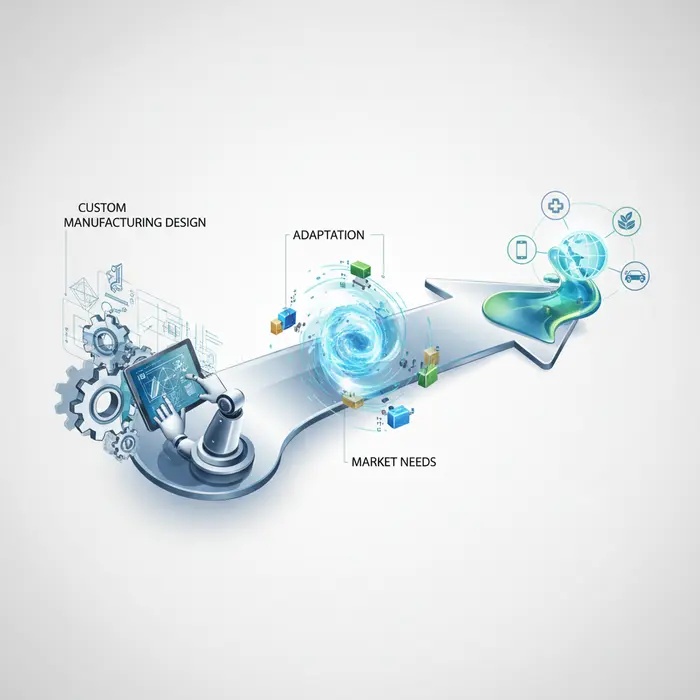
In today’s fiercely competitive and rapidly evolving global marketplace, the ability to swiftly adapt product designs to meet specific market demands and individual client needs is no longer a luxury but a fundamental necessity. This dynamism fuels the demand for Adaptive Manufacturing Solutions, which pivot on an iterative design process, ensuring products remain relevant, desirable, and competitive. Custom manufacturing thrives on this agility, transforming ideas into tangible goods with unprecedented speed and precision. The journey from concept to final product is a continuous loop of design, prototype, test, and refine, driven by real-time feedback and emerging trends. This commitment to Custom manufacturing design adaptation is what differentiates leading manufacturers, allowing them to capture niche markets and build strong client relationships through highly tailored offerings. It’s a proactive approach to production, embracing change rather than resisting it, thereby ensuring flexible production capabilities that can scale and reconfigure as demand dictates.
Parametric Design and Generative AI for Rapid Iteration
The cornerstone of modern design adaptation lies in advanced digital tools, primarily Parametric Design and Generative AI. Parametric design empowers engineers to define product geometries not by fixed dimensions, but by parameters and relationships. A single change to a parameter can automatically update the entire model, along with related parts and assemblies, drastically accelerating modifications. This inherent flexibility makes it possible to produce countless variations from a base design with minimal manual effort.
Complementing this, Generative AI explores a vast design space, autonomously generating a multitude of potential solutions based on predefined performance criteria, material constraints, and manufacturing processes. Engineers input parameters like desired strength, weight, or cost targets, and the AI presents optimal designs. This technology not only slashes design time but also fosters innovation by uncovering novel and highly efficient geometries. Together, parametric design and Generative AI are indispensable for expedited product development services, allowing manufacturers to quickly iterate through design concepts, simulate performance, and refine specifications long before physical prototyping. According to a report by Accenture, companies leveraging AI in design and engineering can achieve a 30% reduction in time-to-market. This synergy of AI and design software is revolutionizing the speed and scope of custom product development.
3D Printing and Additive Manufacturing for Agile Prototyping
Once digital designs are refined through parametric modeling and Generative AI, the next critical step in Custom manufacturing design adaptation is agile prototyping. Here, 3D printing and Additive Manufacturing play a transformative role. These technologies enable the rapid physical realization of complex designs directly from digital files, eliminating the need for expensive and time-consuming traditional tooling. Manufacturers can produce functional prototypes or even end-use parts layer by layer, allowing for immediate physical validation of design concepts.
The ability to quickly print multiple iterations of a component allows design teams to conduct rigorous testing, evaluate ergonomics, and gather tangible feedback in a fraction of the time compared to conventional methods. If a design flaw is identified, or a user suggests an improvement, the digital model can be adjusted parametrically, and a new prototype printed within hours or days. This rapid feedback loop is crucial for mitigating risks and ensuring that the final product precisely meets the desired specifications. Furthermore, additive manufacturing supports flexible production capabilities by allowing for on-demand manufacturing of low-volume, highly customized parts without significant setup costs. This agility is vital for businesses offering expedited product development services, as it bridges the gap between digital design and physical reality efficiently, driving innovation and accelerating market entry.
User-Centric Design: Adapting Products for Niche Markets
Ultimately, the goal of design adaptation is to create products that resonate deeply with their intended audience. This is where User-Centric Design principles come to the forefront, guiding the process of adapting products for niche markets and individual client needs. User-centric design places the end-user at the heart of every design decision, involving them in the feedback loop from early conceptualization through to final product testing. This approach emphasizes understanding specific pain points, preferences, and operational contexts of distinct user groups or individual clients.
For niche markets, this means conducting targeted market research and user interviews to uncover unique requirements that mass-produced items cannot address. For individual clients, it translates into close collaboration, ensuring their specific vision and functional demands are meticulously integrated into the design. Supplier collaboration design changes become paramount in this phase. Manufacturers work hand-in-hand with suppliers, designers, and clients to translate user insights into practical design modifications. This might involve altering material choices, adjusting ergonomics, or incorporating unique aesthetic elements. The iterative process of design adaptation, powered by user feedback, ensures that the final product is not just functional but also exceptionally user-friendly and perfectly tailored, solidifying market position through superior client satisfaction and bespoke solutions. This meticulous approach to customization is a hallmark of truly Adaptive Manufacturing Solutions.
Expedited Product Development Services: Speed to Market
In today’s hyper-competitive global marketplace, the ability to rapidly transform innovative concepts into market-ready products is not just an advantage—it’s a necessity. Businesses that can shorten their product development cycles gain a significant edge, capturing market share, achieving premium pricing, and solidifying their brand leadership. Our Adaptive Manufacturing Solutions are engineered precisely for this purpose, providing an unparalleled pathway from ideation to commercialization with remarkable speed and efficiency. We specialize in collapsing traditional timelines, leveraging advanced strategies and services to ensure your products reach consumers precisely when demand is highest and market windows are wide open. This approach encompasses everything from initial design refinement to full-scale production, all streamlined to deliver speed without compromising quality or innovation.
Our comprehensive approach to expedited product development services integrates cutting-edge methodologies and technologies, ensuring that every stage of the journey is optimized for velocity. By fostering flexible production capabilities and facilitating custom manufacturing design adaptation, we empower businesses to respond dynamically to market shifts and consumer demands. This agility is crucial, allowing for quick pivots and refinements that keep development on track and aligned with evolving objectives. The synergy between advanced techniques and strategic supplier collaboration ensures a seamless transition, making swift transformation not just possible, but predictable.
Agile Development Methodologies in Manufacturing
Traditional, linear product development processes often involve lengthy, sequential stages that can become bottlenecks, delaying crucial feedback and adaptation. Our implementation of Agile development methodologies fundamentally transforms this approach, introducing an iterative and incremental framework specifically tailored for manufacturing. This methodology breaks down the product development lifecycle into smaller, manageable sprints, each culminating in a functional increment or prototype. The core benefit lies in continuous feedback loops, allowing for early detection of issues, rapid course corrections, and immediate integration of design changes. For example, rather than waiting for a complete design to be finalized before tooling begins, Agile allows parallel development of different components, with frequent reviews. This fosters exceptional flexible production capabilities, enabling production lines to adapt quickly to evolving specifications and market feedback. Furthermore, it significantly enhances custom manufacturing design adaptation, ensuring that products can be tailored and refined even late in the development cycle without incurring massive delays or costs. This iterative flexibility is a cornerstone of our ability to deliver products faster and more efficiently, aligning perfectly with market demands.
Rapid Prototyping and Testing Cycles
At the heart of expedited product development lies the power of rapid prototyping and intensive, iterative testing cycles. We utilize advanced technologies such as 3D printing, CNC machining, and additive manufacturing to quickly transform digital designs into physical prototypes. This dramatically reduces the time it takes to move from concept to tangible product, allowing stakeholders to physically interact with and evaluate designs within days, not months. These rapid prototypes are not just for visual inspection; they are rigorously tested against performance specifications, user experience criteria, and manufacturing feasibility. This continuous cycle of prototype creation, testing, feedback, and refinement is critical. By quickly identifying and rectifying design flaws or performance issues early in the process, we prevent costly rework and delays further down the line. Our approach to expedited product development services ensures that testing is integrated at every mini-iteration, guaranteeing that each subsequent prototype is closer to the final, market-ready version. This commitment to swift, thorough validation dramatically de-risks the development process and accelerates the path to mass production.
Minimizing Time-to-Market for Competitive Advantage
The ultimate goal of our expedited product development services is to significantly reduce your time-to-market, thereby securing a decisive competitive advantage. In industries where innovation cycles are shrinking, being first, or at least early, to market can dictate success. It allows you to capture initial market share, establish brand loyalty, command premium pricing, and build a strong competitive moat before rivals can react. Our integrated approach, combining agile methodologies with rapid prototyping, ensures that your product is not only developed quickly but is also robust and market-ready. Crucially, this speed is amplified by proactive supplier collaboration design changes. By integrating suppliers early into the design process, we anticipate and resolve potential manufacturing challenges, ensuring that material sourcing and production scaling are seamless and fast. This holistic strategy mitigates common delays, streamlines logistics, and optimizes the entire value chain for speed. The result is a consistent flow of innovative products to market, giving your business an unparalleled edge and positioning you as a leader in your sector. According to a report by McKinsey & Company, embracing advanced manufacturing techniques and agile operations is fundamental for companies seeking to optimize efficiency and accelerate product delivery in the evolving industrial landscape.
Driving Supplier Collaboration Design Changes
In today’s dynamic global marketplace, the ability to rapidly adapt to market shifts and customer demands is paramount for manufacturing success. This necessitates a fundamental re-evaluation of traditional manufacturing paradigms, moving towards Adaptive Manufacturing Solutions. A cornerstone of this adaptability lies not just within a company’s internal capabilities but, critically, within its extended ecosystem – particularly its suppliers and partners. Driving supplier collaboration design changes is no longer a luxury but an imperative for fostering efficiency, accelerating innovation, and maintaining a competitive edge. By deeply integrating suppliers into the design and adaptation process, manufacturers can unlock unprecedented levels of flexibility, leverage diverse expertise, and significantly expedite product development cycles.

1. Integrated Supply Chains and Digital Twin Technology
The foundation of effective supplier collaboration in design rests upon an integrated supply chain. Modern manufacturing demands real-time visibility and predictive capabilities across the entire value chain. This is where advanced technologies like Digital Twin technology become transformative. A digital twin, a virtual replica of a physical product, process, or system, when extended to the supply chain, allows manufacturers and their suppliers to simulate design changes, test new materials, and predict performance before physical production even begins. This collaborative virtual environment facilitates flexible production capabilities by allowing rapid iterations and optimization. Suppliers can actively contribute to design optimization, material selection, and manufacturability assessments in a risk-free digital space. This integration ensures that design adaptations are not only innovative but also practical, cost-effective, and aligned with the supplier’s production capabilities. According to McKinsey & Company, digital twins are poised to revolutionize manufacturing operations, offering significant improvements in efficiency and responsiveness, thereby enabling seamless custom manufacturing design adaptation and improved overall efficiency.
2. Real-time Data Sharing and Feedback Loops with Partners
Beyond technological integration, the practical implementation of adaptive manufacturing hinges on robust mechanisms for real-time data sharing and continuous feedback loops with partners. This isn’t merely about exchanging CAD files; it’s about establishing transparent channels for performance data, quality metrics, demand forecasts, and design modification requests. When suppliers have immediate access to how their components perform in a larger system or how market demands are shifting, they can proactively suggest improvements or adapt their production processes. This bidirectional flow of information drastically reduces lead times for expedited product development services. For instance, if a design modification requires new tooling, real-time data allows the supplier to begin planning and prototyping simultaneously with the manufacturer’s internal design iterations. Such agile communication ensures that all parties are aligned, enabling quicker decision-making and preventing costly rework or delays in the design adaptation process. It transforms a sequential process into a concurrent, collaborative endeavor, accelerating time-to-market for innovative products.
3. Building Trust and Long-Term Partnerships for Innovation
Ultimately, the success of driving supplier collaboration design changes is underpinned by the strength of relationships. Trust is the invisible yet most potent ingredient. Long-term partnerships, built on mutual respect, shared goals, and transparent communication, encourage suppliers to invest in specialized capabilities, share proprietary knowledge, and truly co-innovate. When suppliers feel like genuine partners rather than mere vendors, they are more willing to contribute their expertise early in the design phase, offering insights that can prevent costly errors or unlock novel solutions. This collaborative spirit fosters a culture where risk-sharing is acceptable, and continuous improvement is a shared responsibility. These deep, symbiotic relationships are crucial for developing truly Adaptive Manufacturing Solutions, as they allow for fluid design iterations and the rapid deployment of new products and features, ensuring that the entire value chain can pivot with agility in response to market demands and competitive pressures.
Partner with Vietnam’s Leading Suppliers
Looking for reliable suppliers in Vietnam? Contact VietnamSuppliers.com today to connect with verified manufacturers and exporters across all industries.
—————————————
References
– Smart factories: An imperative for digital transformation: https://www.mckinsey.com/capabilities/operations/our-insights/smart-factories-an-imperative-for-digital-transformation
– Future of Manufacturing: Industry 4.0: https://www.weforum.org/agenda/2021/01/future-manufacturing-industry-4-0-digital-transformation/
– How Generative AI Is Redefining Product Design – Accenture: https://www.accenture.com/us-en/insights/automation/generative-ai-product-design
– McKinsey & Company: The future of the factory and the impact on the workforce: https://www.mckinsey.com/capabilities/operations/our-insights/the-future-of-the-factory-and-the-impact-on-the-workforce
– McKinsey & Company on Digital Twins in Manufacturing: https://www.mckinsey.com/capabilities/operations/our-insights/digital-twins-the-technology-set-to-transform-manufacturing