What is a Container Yard (CY)? A Core Definition
A Container Yard (CY) is a pivotal facility in the intricate web of international trade and logistics, serving as a dedicated hub for the temporary storage, organization, and movement of full container load (FCL) containers. It represents a critical interface where sea, rail, and road transportation converge, making it indispensable for the efficient flow of goods across global supply chains. Understanding the Container Yard (CY) definition international trade is fundamental to grasping the mechanics of modern global commerce, as these yards are designed to manage the immense volume of standard shipping containers that traverse the globe.
1. Defining the Container Yard (CY) in Shipping
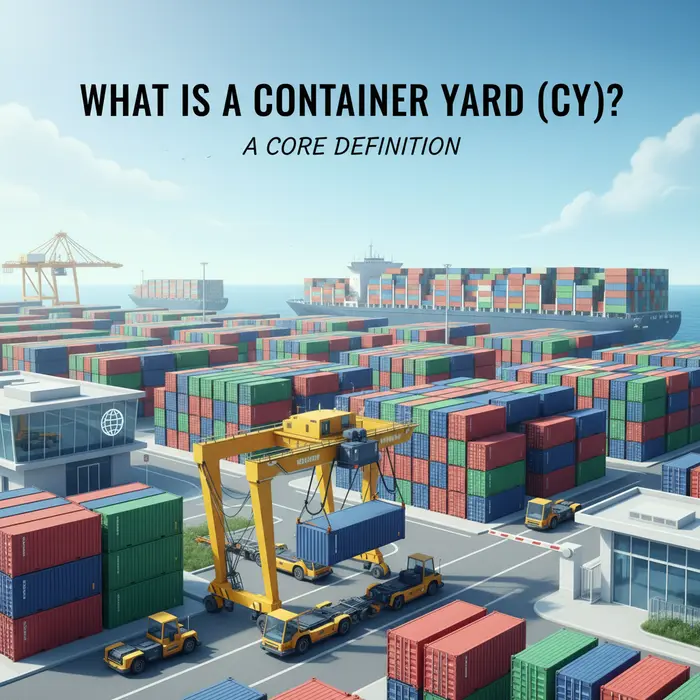
At its core, a Container Yard refers to a large, open-air space, typically adjacent to a port, rail terminal, or inland depot, specifically designed to handle the immense volume of standard shipping containers. Its primary purpose is to act as an intermediary point where containers are staged before being loaded onto vessels, trains, or trucks, or after being discharged from them, awaiting onward transport or pickup. The distinction between a CY and a Container Freight Station (CFS) is crucial for understanding their respective roles in container shipping. Unlike a CFS, where less than container load (LCL) cargo from multiple shippers is consolidated or deconsolidated, a CY exclusively deals with full containers, making the differentiation “CY vs CFS container shipping” a key concept in logistics. A CY provides the necessary space and infrastructure to efficiently manage the flow of these large units, ensuring smooth transitions between different modes of transport.
When considering “Container Yard Incoterms explained,” terms like FOB (Free On Board) or CIF (Cost, Insurance, and Freight) often implicitly involve the CY as the point where the seller delivers the goods, transferring risk and cost to the buyer. For example, under FOB, the seller is responsible for bringing the container to the CY at the port of shipment, where the cost and risk then transfer to the buyer once the goods are loaded onto the designated vessel.
2. Role of CY in Global Supply Chains
The strategic importance of a Container Yard within the global supply chain cannot be overstated. It functions as a critical node, facilitating the seamless flow of goods from manufacturers to consumers across continents. By providing a centralized location for container management, CYs significantly enhance the efficiency and speed of intermodal transportation. They enable carriers and logistics providers to optimize their schedules, minimize delays, and reduce operational costs associated with container handling. The ability to store a vast number of containers allows for flexibility in shipping schedules, absorbing fluctuations in cargo volume and ensuring that containers are readily available for vessels or inland transport. Moreover, CYs are instrumental in supporting “Container Yard FCL services,” ensuring that full containers are received, stored securely, and then dispatched to their final destinations without the need for additional cargo handling or consolidation processes. This direct flow is vital for businesses relying on efficient bulk shipments and maintaining supply chain integrity for large consignments.
3. Key Functions and Operations within a CY
The daily operations within a Container Yard are complex and highly coordinated, involving specialized equipment and skilled personnel to manage thousands of containers. Key functions include:
- Receiving and Stacking: Containers arriving from trucks, trains, or vessels are received, logged into a sophisticated management system, and then stacked using specialized equipment such as reach stackers, straddle carriers, or rubber-tired gantry (RTG) cranes. The stacking strategy is meticulously planned to optimize space and facilitate quick retrieval.
- Storage: The primary function, providing secure temporary storage for containers awaiting their next leg of the journey.
- Gate Operations: Highly automated gates manage the entry and exit of trucks, verifying documentation, container numbers, and driver details, often integrated with OCR (Optical Character Recognition) technology.
- Inspection and Maintenance: Containers may undergo inspections for damage or compliance, and minor repairs can be performed on-site.
- Tracking and Security: Advanced tracking systems ensure precise location knowledge of every container, while robust security measures, including surveillance and access control, protect valuable cargo.
- Customs Clearance Facilitation: CYs often work closely with customs authorities to streamline the clearance process for incoming and outgoing containers.
- Intermodal Transfer: Facilitating the transfer of containers between different modes of transport—ship-to-rail, rail-to-truck, or vice versa.
Managing the various “Container Yard charges export” is also a crucial operational aspect. These charges can include storage fees (demurrage for late pickup/return, detention for exceeding free time off-terminal), handling fees (lift-on/lift-off), gate fees, and potentially fees for special services like reefer container plugging or inspections. Understanding these costs is essential for exporters to accurately calculate their total logistics expenses. For a more comprehensive understanding of global trade logistics, readers can refer to resources like the World Trade Organization (WTO), which outlines the frameworks governing international trade and customs procedures, inherently linked to the efficient operation of CYs.
CY vs. CFS: Understanding Key Differences in Container Shipping
Differentiating between a Container Yard (CY) and a Container Freight Station (CFS) is crucial for anyone involved in international trade and container shipping. These facilities play distinct, yet complementary, roles in the logistics chain. Understanding their operations, typical use cases, and implications for your cargo can significantly impact shipping efficiency, costs, and overall supply chain management. This section clarifies their distinct roles and when each facility is utilized, providing a clear understanding of when to opt for one over the other.
1. Container Yard (CY) Characteristics and Use Cases
A Container Yard (CY) is a designated area, typically within or adjacent to a seaport, rail terminal, or inland depot, for the temporary storage, organization, and transfer of full container loads (FCLs). Its primary function is to serve as an interchange point where laden (full) or empty shipping containers are dropped off by truckers for export, or picked up for import. When discussing a “Container Yard (CY) definition international trade,” it refers to this critical hub for container movement, focusing solely on the container unit itself.
CY facilities feature extensive space, heavy-duty paving, and sophisticated equipment like reach stackers and gantry cranes to handle and stack containers efficiently. Shippers utilizing Container Yard FCL services typically have enough cargo to fill an entire container. This means the container arrives at the CY sealed by the shipper and departs sealed for the consignee, minimizing intermediate cargo handling.
For export, once cargo is loaded and sealed at the shipper’s premises, it’s transported to the CY, awaiting vessel loading. Understanding Container Yard Incoterms explained is vital, as Incoterms like FOB or CIF often dictate responsibilities for transportation and charges up to the CY. For instance, under FOB, the seller is responsible for bringing goods to the CY and loading them. Container Yard charges export typically include handling fees (lift-on/lift-off), storage if exceeding free-time, and potential demurrage. The CY’s role is purely managing the container unit, not the loose cargo within.
2. Container Freight Station (CFS) for LCL Shipments
In contrast to a Container Yard, a Container Freight Station (CFS) serves a very different purpose, primarily catering to Less than Container Load (LCL) shipments. A CFS is a warehouse facility where goods from multiple shippers are consolidated into full containers for export, or where imported full containers are deconsolidated and their contents sorted for individual consignees. This is where the core difference in CY vs CFS container shipping becomes apparent: CFS deals with individual pieces of cargo, while CY manages sealed containers.
For export, shippers with smaller cargo volumes deliver their goods to a CFS. Here, cargo is received, inspected, and then consolidated (“stuffed”) with other compatible LCL shipments heading to the same destination port. This process ensures optimal container space utilization, making international shipping economically viable for smaller businesses. Conversely, for imports, a full container arriving at a port moves to a CFS, where it is “devanned” (unloaded), and individual shipments are sorted for pickup by their respective consignees.
CFS operations require extensive warehousing, skilled labor for cargo handling, and robust inventory management. They provide value-added services like palletizing, labeling, and basic quality checks. Using a CFS allows businesses to pay only for the space their cargo occupies within a container, rather than the entire container, making it a cost-effective solution for small to medium-sized shipments. An Investopedia article explains the role of a Container Freight Station (CFS) in logistics by highlighting its function in consolidating and deconsolidating cargo.
3. Strategic Choice: When to Opt for CY vs. CFS
The decision of whether to use a Container Yard (CY) or a Container Freight Station (CFS) is strategic, primarily dictated by your shipment’s volume, nature, and urgency, as well as your operational capabilities. Understanding the distinct functions of CY vs CFS container shipping is paramount for optimizing your supply chain.
The fundamental differentiating factor is the cargo load type. If your shipment is large enough to fill an entire container – an FCL shipment – then a CY is your primary interface with the shipping line. You would arrange for the container to be delivered to your premises for loading, or load it at an inland depot, and then transport the sealed container directly to the CY at the port. This approach often results in faster transit times and reduced handling risks, as the container remains sealed from origin to destination. The clarity of Container Yard Incoterms explained ensures responsibilities are well-defined for these direct FCL movements.
Conversely, if your cargo volume is insufficient to fill a container – an LCL shipment – a CFS is the appropriate choice. While it involves additional handling and potentially slightly longer transit times due to consolidation, it offers a highly cost-effective solution for smaller consignments. Freight forwarders often manage LCL logistics, including movement to and from the CFS, leveraging their expertise. This minimizes your Container Yard charges export for the actual container, as you are only paying for the space your cargo occupies within a shared container.
Ultimately, the choice hinges on balancing cost, time, and risk. FCL via CY offers directness and security for large volumes. LCL via CFS offers flexibility and affordability for smaller consignments. Shippers must evaluate their specific needs and collaborate with logistics partners for informed decisions, ensuring smooth and efficient international movement of goods.
Container Yard Incoterms Explained: Responsibilities & Risk
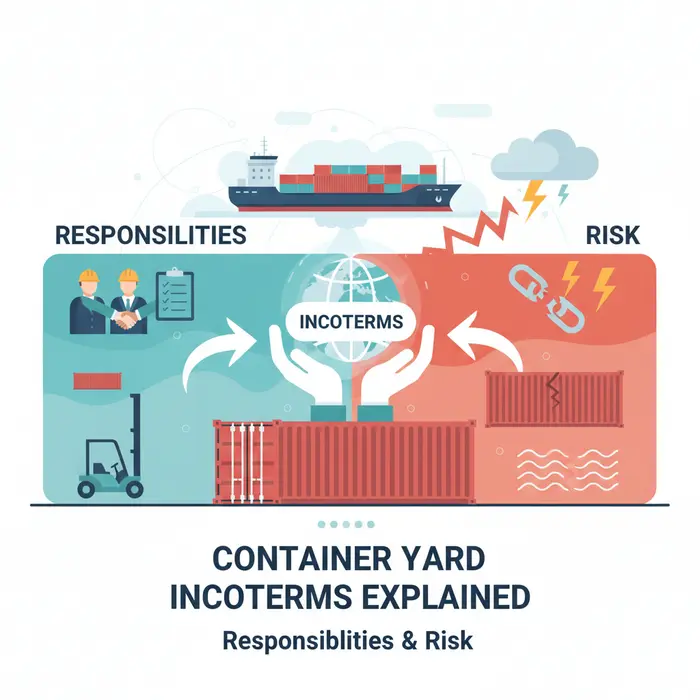
In the complex world of global trade, precise interpretation of Incoterms® is crucial. The Container Yard (CY) definition international trade is a vital logistical hub where Full Container Loads (FCL) are gathered, stored, and prepared for shipment, or received and distributed. Its role defines the transfer of responsibility and risk between buyers and sellers. This exploration will detail how various Incoterms interact with the Container Yard, explaining the shifts in obligations and liabilities upon arrival or departure from this facility. We will also distinguish the CY’s FCL focus from a Container Freight Station (CFS), which handles Less than Container Load (LCL) cargo, highlighting the CY vs CFS container shipping distinction.
Incoterms Designating CY as Delivery Point (e.g., FOB, CFR)
Incoterms®, published by the International Chamber of Commerce (ICC), define responsibilities for goods delivery. For containerized FCL cargo, the Container Yard often marks a critical delivery or staging point. Incoterms like FOB (Free On Board) and CFR (Cost and Freight) are prime examples.
Under FOB, the seller delivers when goods are loaded on board the vessel nominated by the buyer at the named port of shipment. This includes bringing goods, securely containerized, to the origin CY, completing export formalities, and ensuring readiness for loading. Risk transfers once goods are physically on board. Any incident at the CY before loading is the seller’s responsibility.
For CFR, the seller pays costs and freight to the named port of destination, but risk transfers to the buyer once goods are loaded on board the vessel at the port of shipment. The seller’s duties extend to transporting goods to the origin CY, undertaking export customs clearance, and securing their loading. The Container Yard (CY) definition international trade for these terms is where the seller consolidates pre-shipment responsibilities. This differs from a CFS, which handles LCL cargo, underscoring the CY vs CFS container shipping difference crucial for Container Yard FCL services.
Buyer & Seller Obligations at the Container Yard Under Incoterms
The chosen Incoterm dictates the division of tasks and financial liabilities at the Container Yard.
- Seller’s Responsibilities (to CY): For Incoterms like FOB, CFR, or FCA (named place: CY), the seller typically handles:
- Packing and stuffing containers.
- Inland transport to the origin Container Yard.
- Export customs clearance and associated duties/taxes.
- All costs and risks until the container is delivered to the carrier at the CY (FCA) or loaded onto the vessel (FOB/CFR), including origin terminal handling charges (THC).
- Buyer’s Responsibilities (from CY onwards): Once goods are delivered and risk transfers per the Incoterm (e.g., on board for FOB/CFR, or at CY for FCA), the buyer assumes control:
- Arranging and paying for main international carriage (ocean freight).
- Marine insurance (advisable).
- Import customs clearance, duties, and taxes at destination.
- Inland transport from destination port to final point.
- All risks of loss or damage from the transfer point onwards.
For EXW (Ex Works), the seller’s obligation ends at their premises; the buyer handles everything from there, including transport to the CY. Conversely, DAP (Delivered At Place) obligates the seller to deliver to a named destination, well beyond the destination CY. Understanding these nuances for Container Yard Incoterms explained prevents disputes.
- Seller’s Responsibilities (to CY): For Incoterms like FOB, CFR, or FCA (named place: CY), the seller typically handles:
Impact of CY on Cost & Risk Allocation in International Shipments
The Container Yard critically impacts both cost and risk. Various Container Yard charges export and import, like terminal handling charges (THC), storage fees (demurrage/detention), and lift-on/lift-off fees, add to total shipping costs. The responsible party up to the risk transfer point incorporates these into their budgeting.
The CY’s primary impact is on risk allocation. The exact moment goods are delivered to the CY, handed to a carrier, or loaded onto a vessel (depending on Incoterm) is when responsibility for loss or damage shifts. For example, damage within the origin CY before loading under FOB makes the seller liable. After loading, the buyer typically bears the risk.
A precise understanding of the chosen Incoterm’s relation to the CY is thus invaluable. Misinterpretations cause disputes, unexpected costs, and delays. Clear communication among buyer, seller, and logistics providers regarding Incoterms and their implications at Container Yard FCL services ensures a smoother, predictable international shipping process, safeguarding both parties.
FCL Services at the Container Yard: Optimizing Shipments
In the complex world of global logistics, efficient handling of Full Container Load (FCL) shipments is paramount. The Container Yard (CY) definition international trade is a crucial concept, referring to a designated area within or adjacent to a port where full containers are received, stored, and prepared for shipping or onward delivery. Unlike a CFS (Container Freight Station), which handles Less than Container Load (LCL) shipments requiring consolidation or de-consolidation, the CY is dedicated to the streamlined flow of sealed, full containers. Optimizing FCL operations at the Container Yard is critical for minimizing transit times, reducing costs, and ensuring the integrity of goods from origin to destination.
The Container Yard serves as a pivotal hub where FCL shipments undergo various stages, from initial gate-in to final gate-out, connecting inland transportation with ocean voyages. Understanding the specific services and processes offered at these facilities is vital for any business engaged in international trade seeking to enhance its supply chain efficiency.
1. Handling and Storage of FCL Shipments at CY
Upon arrival, FCL shipments entering a Container Yard undergo a meticulous process to ensure proper handling and storage. Typically, an FCL container, transported by truck or rail, first passes through a gate-in inspection, where its condition, seal integrity, and documentation are thoroughly checked against the booking manifest. Once cleared, sophisticated terminal operating systems (TOS) guide its placement within the yard. Containers are strategically stacked, often using specialized equipment like reach stackers or gantry cranes, maximizing space utilization while ensuring accessibility for future movements. This temporary storage phase is critical, as containers await vessel loading for export or customs clearance and pickup for import. The secure environment of a CY, often equipped with advanced surveillance and access control, safeguards the cargo, ensuring its integrity until the next stage of its journey. Efficient stacking and retrieval, supported by real-time tracking, differentiate a well-managed CY operation, directly impacting overall logistics timelines and costs for FCL cargo.
2. Common FCL-Specific Services Offered by Container Yards
Container Yards provide a range of specialized Container Yard FCL services designed to support the unique needs of full container loads. A primary service is comprehensive container tracking and monitoring, allowing shippers and consignees to know the exact location and status of their FCL units within the yard. For temperature-sensitive FCL cargo, CYs offer reefer container plug-in and monitoring services, ensuring perishable goods maintain their required climate control throughout their dwell time. Minor container repair and maintenance services are also frequently available, addressing any damages sustained during transit or handling before the container is loaded onto a vessel or released for pickup. Furthermore, CYs often facilitate customs inspections and provide pre-trip inspections (PTIs) for reefer containers to verify operational readiness before departure. The various Container Yard charges export, such as terminal handling charges (THC), storage fees, and lift-on/lift-off fees, reflect these essential services, directly contributing to the smooth flow of international trade.
3. Best Practices for Streamlining FCL Logistics via CY Operations
To truly optimize FCL logistics, businesses must adopt best practices that leverage the capabilities of Container Yards. Firstly, precise documentation and advanced booking are paramount to avoid delays during gate-in and customs clearance. Utilizing digital platforms, such as Port Community Systems (PCS) and Electronic Data Interchange (EDI), can significantly streamline communication and data exchange between all stakeholders—shippers, carriers, customs, and the CY operator. Collaboration is key; maintaining strong relationships with shipping lines, truckers, and the CY management can lead to more flexible scheduling and quicker turnaround times. Understanding Container Yard Incoterms explained (e.g., FOB, CIF, EXW) is also crucial, as Incoterms clearly define the point at which responsibility and costs transfer from seller to buyer, often involving the CY as a critical transfer point. Implementing pre-stacking strategies and ensuring timely pickup or delivery further minimizes container dwell times, thereby reducing potential demurrage and detention charges. By proactively managing these aspects, companies can significantly enhance the efficiency and cost-effectiveness of their FCL shipments through optimized CY operations.
Navigating Container Yard Charges for Export Shipments
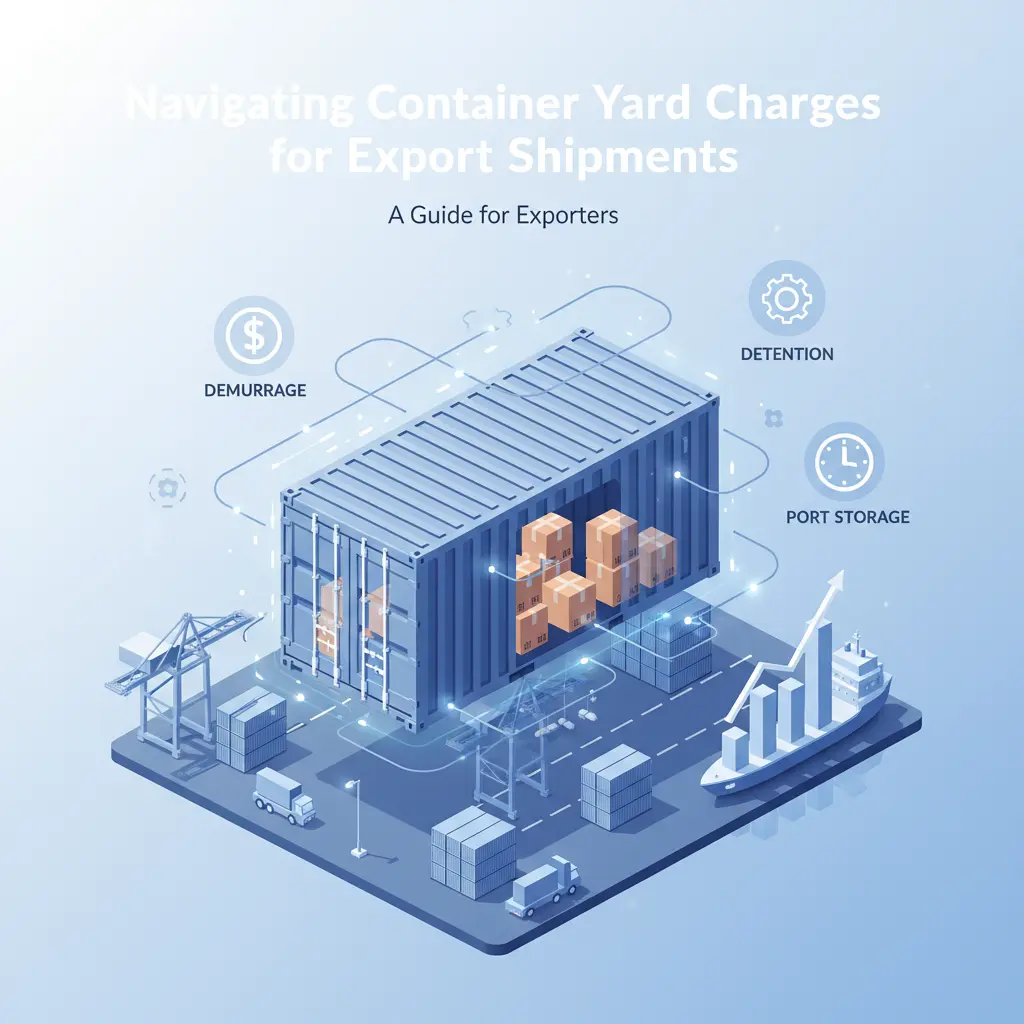
For businesses engaged in international trade, understanding and managing logistical costs are paramount to profitability. Among the various stages of the export process, the Container Yard (CY) plays a pivotal role, serving as a crucial interchange point where export containers are received, stored, and prepared for loading onto vessels. Navigating the myriad of charges associated with Container Yard operations can be complex, but an essential guide to these fees can help exporters effectively manage or minimize their costs. This section will delve into the standard fees, potential surcharges, and strategic approaches to keep your export expenses in check.
1. Typical Export-Related Charges at a Container Yard
At a Container Yard, exporters will encounter several common charges designed to cover the handling, storage, and administrative aspects of preparing a container for shipment. These are often distinct from ocean freight costs and can significantly impact the overall export budget, especially when dealing with Container Yard FCL services (Full Container Load). Key charges include:
- Terminal Handling Charges (THC): This is perhaps the most fundamental charge. THC covers the cost of handling the container at the port terminal, including lifting it from the truck chassis, stacking it in the yard, and eventually moving it to the vessel. The exact cost can vary by port and shipping line.
- Storage Charges: Once a container arrives at the CY, it is typically granted a certain number of free days for storage. Beyond this free period, storage charges are levied daily. These charges escalate over time, making timely movement of goods critical.
- Gate-In/Gate-Out Fees: These administrative fees cover the processing of containers as they enter and exit the terminal gates, including documentation checks and security procedures.
- Chassis Usage Fees: If the container needs a chassis (the frame on which containers are transported over land) while at the yard or for drayage to or from the yard, a daily rental fee may apply.
- Lift-On/Lift-Off Charges: Similar to THC, these charges specifically refer to the action of lifting a container on or off a truck chassis or rail car within the yard.
- Documentation Fees: Although not strictly a CY charge, various documentation fees are associated with export shipments, such as B/L (Bill of Lading) fees or manifest amendment fees, which are often processed in conjunction with CY operations.
Understanding the distinction between these charges and, for instance, those incurred at a Container Freight Station (CFS), where Less than Container Load (LCL) shipments are consolidated, is crucial for accurate cost estimation.
2. Understanding Demurrage and Detention in CY Context
Two of the most frequently misunderstood and potentially costly charges are demurrage and detention. While often used interchangeably, they refer to different aspects of container and equipment usage within the Container Yard (CY) definition international trade context and beyond:
- Demurrage: This charge is levied by the shipping line for the extended use of the container *inside* the port terminal or Container Yard beyond the agreed-upon free days. It compensates the shipping line for the loss of potential earnings from that container due to its prolonged stay at the terminal. Demurrage begins once the container has been discharged from the vessel (for imports) or gated into the terminal (for exports) and continues until it is picked up by the consignee or loaded onto the vessel, respectively.
- Detention: Detention, on the other hand, is a charge for the extended use of the container *outside* the port terminal or Container Yard. For exports, this would apply if an exporter picks up an empty container for loading but fails to return the loaded container to the CY within the specified free time. The shipping line charges detention for the prolonged possession of their equipment.
Both demurrage and detention are critical considerations, especially when coordinating logistics according to Incoterms, which dictate where responsibilities and costs shift between buyer and seller.
3. Strategies for Minimizing Container Yard Export Costs
Proactive planning and efficient execution are key to minimizing Container Yard charges export. Here are several strategies exporters can employ:
- Optimize Documentation and Customs Clearance: Delays in documentation or customs clearance are a primary cause of storage and demurrage charges. Ensure all paperwork is accurate, complete, and submitted well in advance of deadlines. Utilize electronic data interchange (EDI) where possible to expedite processes.
- Coordinate Drayage Effectively: Efficient scheduling with drayage providers (trucking companies) is crucial. Aim to deliver containers to the CY as close as possible to the vessel’s cut-off time, but with enough buffer to avoid last-minute rush fees or missing the cut-off, which can incur roll-over fees and subsequent storage.
- Understand Free Time Allowances: Be thoroughly aware of the free days offered for storage, demurrage, and detention by the shipping line and terminal. Negotiate for extended free time with your carrier or freight forwarder if your operational model frequently requires longer periods.
- Utilize Pre-Gate and Appointment Systems: Many modern terminals use pre-gate systems and truck appointment systems. Adhering to these schedules can reduce truck waiting times, thereby lowering drayage costs and speeding up container processing.
- Communicate Proactively: Maintain open lines of communication with your freight forwarder, trucking company, and even the shipping line. Early notification of potential delays or changes can allow for adjustments that prevent costly charges.
- Review and Audit Invoices: Always scrutinize invoices for accuracy. Errors can occur, and identifying them promptly can save significant amounts. Question any charges that seem unusually high or are not clearly justified.
By implementing these strategies, exporters can gain better control over their logistics costs, ensuring a smoother and more economical export journey.
Partner with Vietnam’s Leading Suppliers
Looking for reliable suppliers in Vietnam? Contact VietnamSuppliers.com today to connect with verified manufacturers and exporters across all industries.
—————————————
References
– World Trade Organization (WTO): https://www.wto.org/english/tratop_e/tradfa_e/tradfa_e.htm
– Container Freight Station (CFS) Definition: https://www.investopedia.com/terms/c/container-freight-station-cfs.asp
– International Chamber of Commerce (ICC) Incoterms Rules: https://iccwbo.org/resources-for-business/incoterms-rules/
– Kuehne+Nagel Incoterms 2020 Guide: https://www.kuehne-nagel.com/en_us/insights/blog/incoterms-2020-fca-fob-cfr-cif-dp-dpu-dap-ddp-exw-cpp
– Incoterms – WTO: https://www.wto.org/english/thewto_e/what_e/tif_e/agrm8_e.htm