
What is Foreign Direct Investment (FDI)?
Foreign Direct Investment (FDI) represents a pivotal form of international capital flow, playing a fundamental role in shaping global economic landscapes. At its core, FDI involves an investment made by a firm or individual in one country into business interests located in another country. Unlike other forms of international investment, FDI is distinguished by its primary objective: establishing a lasting interest and a significant degree of influence or managerial control over the foreign entity. This commitment to active participation in the management of the foreign enterprise is what truly sets FDI apart and underscores its long-term strategic implications for both the investing and host nations, thereby defining its role in global trade.
1. Defining Direct Investment vs. Other Capital Flows
To fully grasp what FDI entails, it’s crucial to differentiate it from other types of cross-border capital movements, particularly portfolio investment. Portfolio investment involves acquiring financial assets such as stocks and bonds without gaining significant control over the issuing company. Its primary motivation is financial return, often short-term, and typically involves less than 10% ownership of a company’s voting stock. In contrast, FDI is characterized by a strategic intention to gain substantial influence, usually implying an ownership stake of 10% or more in a foreign enterprise, as per the official definition of Foreign Direct Investment. This critical threshold signifies the investor’s capacity to influence the management and operations of the foreign company.
The FDI definition and its role in global trade encompass various types of FDI in trade. These include ‘greenfield investments,’ where a foreign company establishes an entirely new operation (e.g., building a factory or office from scratch) in the host country, and ‘mergers and acquisitions’ (M&A), where foreign investors acquire existing assets or companies. Both aim to achieve long-term strategic objectives, making the distinction between FDI vs portfolio investment essential for understanding international economic relations.

2. Characteristics of FDI: Control and Long-Term Interest
The defining characteristics of FDI are active control and a long-term commitment. The investing entity seeks to integrate the foreign operation into its global strategy, often involving the transfer of technology, management expertise, and capital. This deep engagement means that FDI is not merely about financial returns; it’s about strategic market penetration, access to resources, efficiency gains, and building global supply chains. For host countries, especially developing economies, FDI is a crucial catalyst for economic growth, bringing much-needed capital, job creation, and skill development.
The FDI benefits for export companies are significant. By establishing production facilities or distribution networks abroad, companies can overcome trade barriers, reduce logistics costs, adapt products to local tastes, and gain direct access to new markets. This direct presence enhances their competitiveness and can significantly boost their export capabilities from the host country. For instance, the FDI impact on supply chains in Vietnam has been transformative, with global manufacturers investing in factories and infrastructure, thereby integrating Vietnam more deeply into global production networks and elevating its status as a manufacturing and export hub.
3. Measuring and Global Trends in FDI
FDI is typically measured in two ways: by the ‘flow’ (the value of direct investments made over a period, usually a year) and by the ‘stock’ (the total accumulated value of direct investments at a given point in time). Data often distinguish between outward FDI (investments made by a country’s residents abroad) and inward FDI (investments made by foreign residents into the country). Global trends in FDI are dynamic, influenced by geopolitical shifts, economic policies, technological advancements, and evolving global supply chain strategies. While traditional FDI flows often targeted developed economies, there’s been a significant shift towards emerging markets, driven by factors like growing consumer bases, lower production costs, and strategic access to raw materials.
The sustained importance of FDI in international economics is undeniable. It facilitates the cross-border movement of capital, technology, and managerial know-how, fostering economic interdependence and integration. For countries like Vietnam, attracting FDI remains a key policy objective to drive industrialization, create employment, and enhance technological capabilities, solidifying the vital connection between FDI and global economic prosperity.
The Pivotal Role of FDI in Global Trade
Foreign Direct Investment (FDI) represents a critical pillar in the architecture of modern global trade, serving not merely as a financial transaction but as a profound mechanism for economic integration and growth. It entails an investment made by a firm or individual in one country into business interests located in another country, taking the form of either establishing new operations (greenfield investment), acquiring existing assets, or expanding existing foreign operations (brownfield investment). This direct engagement contrasts sharply with portfolio investment, which focuses solely on purchasing financial assets like stocks or bonds without gaining management control. The strategic nature of FDI, aiming for significant influence or control over foreign enterprises, inherently ties it to long-term economic development and the reshaping of international commerce. Understanding the FDI definition and its role in global trade is essential for comprehending how it facilitates international trade, promotes economic growth, and integrates national economies into the global marketplace. Indeed, FDI acts as a powerful engine, channeling capital, technology, and management expertise across borders, thereby weaving economies into a complex, interdependent global fabric.
1. FDI as a Catalyst for Export and Import Growth
FDI profoundly stimulates both export and import activities, making it an indispensable catalyst for trade expansion. When multinational corporations (MNCs) establish production facilities in host countries through greenfield investments, they often do so to tap into local markets, leverage lower production costs, or gain preferential access to regional trade blocs. These facilities invariably lead to an increase in the host country’s exports, as goods produced are often destined for global markets. For example, substantial FDI in sectors like electronics and textiles in countries like Vietnam has transformed them into major export hubs, integrating them deeply into global supply chains. The establishment of assembly plants, manufacturing facilities, and service centers directly contributes to a nation’s export capacity and competitiveness.
Furthermore, FDI generates significant “FDI benefits for export companies” in host countries. Local firms, either as suppliers to or partners with FDI-backed entities, gain access to advanced production techniques, quality standards, and often, new international markets through the MNCs’ established networks. This not only enhances their export potential but also improves their overall operational efficiency. Concurrently, FDI can also stimulate imports, particularly of intermediate goods, machinery, and specialized components required by the foreign-owned enterprises for their production processes. This two-way flow of goods and services underlines how FDI acts as a dynamic force, reshaping trade patterns and volumes. The distinction between FDI vs portfolio investment is crucial here; while portfolio investment brings capital, FDI directly impacts the productive capacity and trade infrastructure, leading to tangible increases in both exports and imports. The “FDI impact on supply chains Vietnam” illustrates this well, where foreign investment has built sophisticated manufacturing ecosystems that rely on both international imports for components and robust exports for finished products.
2. Job Creation and Economic Development Through FDI
Beyond its direct impact on trade flows, FDI is a primary driver of job creation and holistic economic development. The establishment of new foreign-owned enterprises or the expansion of existing ones creates a multitude of employment opportunities, ranging from highly skilled management and technical roles to semi-skilled and unskilled labor positions. These direct jobs have a powerful multiplier effect, generating indirect employment in ancillary industries such as logistics, services, and local supply chains. For instance, the growth of a major automotive plant funded by FDI will not only employ thousands directly but also support jobs in component manufacturing, transportation, retail, and food services in the surrounding region.
This influx of employment leads to increased household incomes, which in turn boosts domestic consumption and stimulates further economic activity. Moreover, foreign investors often bring with them higher labor standards, improved working conditions, and professional training programs, thereby enhancing the skill base of the local workforce. This human capital development is a critical component of sustainable economic growth. The tax revenues generated from these foreign enterprises and their employees provide governments with additional resources for investing in public infrastructure, education, and healthcare, further accelerating the trajectory of economic development. Thus, FDI acts as a comprehensive engine for societal upliftment, extending its benefits far beyond mere trade statistics to encompass improved living standards and a more robust national economy.
3. Technology Transfer and Knowledge Spillover Effects
One of the most profound, yet often less tangible, benefits of FDI lies in its capacity for technology transfer and the generation of knowledge spillover effects. Foreign companies frequently introduce state-of-the-art production technologies, advanced management techniques, and innovative business models to their host countries. This transfer of technology can be direct, through the adoption of new machinery and processes, or indirect, through demonstration effects and the movement of skilled labor between foreign and local firms. Local businesses, suppliers, and even competitors observe and adapt these superior practices, leading to a general uplift in productivity and efficiency across the domestic industry.
These “knowledge spillover effects” are crucial for fostering innovation and improving the overall competitiveness of the host economy. As local employees gain experience with advanced technologies and international best practices, they either apply this knowledge within their current roles or transfer it to new domestic ventures, disseminating expertise throughout the economy. This enhances the technological capabilities of the entire supply chain, enabling local firms to produce higher-quality goods and services that meet international standards. Ultimately, this technological upgrade positions the host country more advantageously in global value chains, fostering a dynamic environment for sustained growth and innovation, further solidifying its role in global trade.
Exploring Types of FDI and Their Benefits for Export Companies
Foreign Direct Investment (FDI), a cornerstone of global economic integration, signifies an investment made by a firm or individual in one country into business interests located in another country. Unlike portfolio investments, which involve passive ownership of foreign financial assets, FDI entails acquiring a lasting management interest and controlling influence in an enterprise abroad. This direct engagement makes FDI a powerful catalyst for economic development, job creation, and technology transfer, playing a pivotal FDI definition and its role in global trade.
For export-oriented businesses, understanding and attracting FDI is not merely about capital infusion; it’s about strategically enhancing competitiveness, expanding market reach, and embedding themselves deeper into global value chains. FDI brings more than just money; it often includes access to advanced technologies, managerial expertise, and established distribution networks that are otherwise difficult for local firms to acquire.
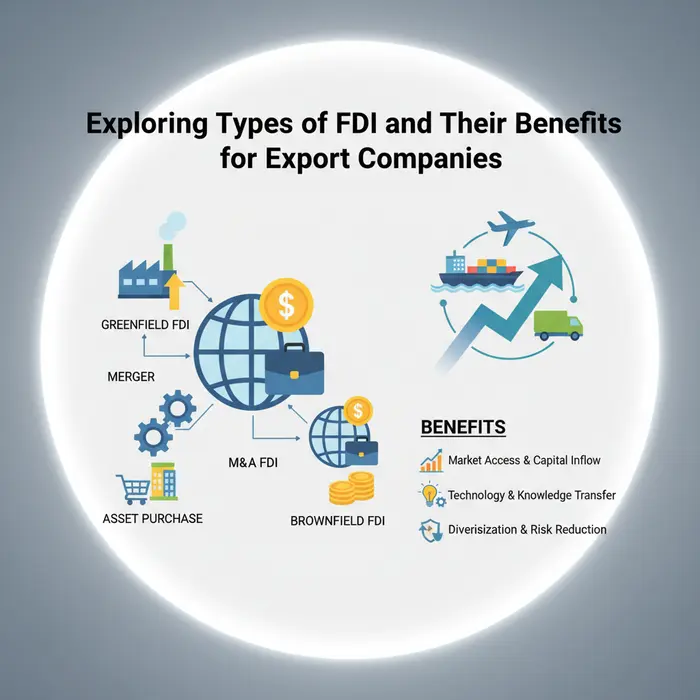
1. Horizontal, Vertical, and Conglomerate FDI Explained
The landscape of FDI is diverse, characterized by several distinct forms, each with unique implications for export companies:
- Horizontal FDI: This occurs when a company invests in a foreign business that operates in the same industry as itself. For an export company, horizontal FDI can mean setting up a new manufacturing plant or acquiring an existing one in a foreign market to produce goods locally. This strategy helps firms circumvent trade barriers, reduce transportation costs, and better tailor products to local consumer preferences, thereby facilitating export from the new foreign base to other regional markets or even back to the home market. It’s a direct way for export companies to establish a physical presence in key markets, deepening their reach and responsiveness.
- Vertical FDI: This type of investment involves a company investing in a foreign business that is either a supplier (backward vertical FDI) or a distributor/customer (forward vertical FDI). For export companies, backward vertical FDI, such as investing in a raw material supplier abroad, can secure critical inputs, ensure quality control, and stabilize supply chains, leading to more competitive export pricing and reliability. Forward vertical FDI, like investing in an overseas distribution network, offers direct access to foreign markets, bypasses intermediaries, and provides greater control over the marketing and sales of their exported goods. This form of types of FDI in trade significantly influences operational efficiency and market penetration.
- Conglomerate FDI: This refers to investments in foreign businesses that are unrelated to the investor’s core industry. While less common for direct export enhancement, conglomerate FDI can provide diversification benefits, new revenue streams, and access to different technologies or markets that indirectly support the parent company’s export capabilities through shared resources or expanded capital.
2. Greenfield vs. Brownfield Investments: Strategic Differences
FDI can also be categorized by the nature of the investment project itself:
- Greenfield Investments: These involve establishing entirely new facilities from the ground up in a foreign country. For export companies, greenfield investments offer complete control over the design, technology, and operational processes, ensuring that the new venture aligns perfectly with the company’s export strategy and production standards. This approach is ideal for firms seeking to implement specific, proprietary technologies or establish a new, state-of-the-art manufacturing base optimized for export, especially when local infrastructure or existing companies don’t meet their stringent requirements. While more capital-intensive and time-consuming initially, greenfield projects often lead to greater long-term competitive advantages.
- Brownfield Investments: This type of FDI involves purchasing or leasing existing facilities or companies in a foreign country and then upgrading or expanding them. For export companies, brownfield investments offer faster market entry, access to an existing customer base, established supply chains, and a local workforce. This can be particularly beneficial for quickly scaling up production for export or gaining immediate access to a new distribution network. The challenge lies in integrating existing operations and cultures, but the speed to market and reduced initial risk make it an attractive option for many firms looking to enhance their export capabilities rapidly.
3. How FDI Boosts Export Competitiveness and Market Access for Firms
FDI offers a multitude of FDI benefits for export companies, transforming their operational capabilities and global reach:
- Technology and Knowledge Transfer: Foreign investors often bring advanced production techniques, R&D capabilities, and managerial expertise that significantly enhance the quality and efficiency of local production. For export companies, this translates into higher-quality products, reduced costs, and the ability to meet international standards, making their exports more competitive globally.
- Capital Infusion and Expansion: FDI provides crucial capital that allows export firms to upgrade machinery, expand production capacity, and invest in innovation. This expansion is vital for meeting increased international demand and achieving economies of scale, lowering per-unit costs for exported goods.
- Access to New Markets and Distribution Networks: Through vertical FDI, foreign investors can establish or integrate into existing global distribution channels, providing local export companies with direct access to new, lucrative international markets. This often includes valuable market intelligence and marketing expertise that helps firms navigate foreign consumer preferences and regulatory environments.
- Supply Chain Integration and Efficiency: FDI often leads to the integration of local firms into global supply chains, optimizing logistics, reducing lead times, and enhancing reliability. This is particularly evident in regions like Vietnam, where FDI impact on supply chains Vietnam has been transformative. For instance, significant foreign investment in manufacturing sectors has enabled Vietnamese companies to become crucial links in global electronics, textile, and footwear supply chains, boosting their export volumes and sophistication.
- Enhanced Competitiveness: The combined effect of improved technology, capital, market access, and efficient supply chains significantly boosts an export company’s overall competitiveness on the global stage, allowing them to contend with international rivals more effectively.
In conclusion, FDI in its various forms is a potent instrument for empowering export-oriented businesses. By providing capital, technology, market access, and integrating them into global supply networks, FDI not only enhances their capacity to compete but also propels them towards sustained growth and greater international prominence.
FDI vs. Portfolio Investment: Key Distinctions
In the intricate landscape of international finance, both Foreign Direct Investment (FDI) and portfolio investment represent crucial avenues for capital flows across borders. While both involve foreign capital entering a host economy, they are fundamentally distinct in their objectives, the level of control afforded to the investor, and their respective impacts on economic stability and development. Understanding these differences is paramount for policymakers, businesses, and investors alike, as they shape a country’s economic trajectory and integration into the global economy.
1. Degree of Control and Management Involvement
The most significant distinction between FDI and portfolio investment lies in the level of control and management involvement an investor gains. Foreign Direct Investment (FDI) is characterized by a lasting interest and significant influence by a resident entity in one economy (the direct investor) over an enterprise resident in another economy (the direct investment enterprise). This typically translates into ownership of 10% or more of the ordinary shares or voting power in an incorporated enterprise, or an equivalent stake in an unincorporated enterprise. FDI investors are not merely seeking financial returns; they aim to establish a strategic presence, influence operational decisions, transfer technology and management expertise, and integrate the foreign entity into their global business strategy. Examples include setting up new factories (greenfield investments), acquiring existing companies, or expanding current foreign operations.
Conversely, portfolio investment represents a passive, non-controlling stake in foreign assets. Investors in this category are primarily driven by financial returns, such as dividends, interest payments, or capital gains, and have no intention of exercising significant influence over the management or operations of the investee company. Portfolio investment typically involves ownership of less than 10% of a company’s shares and includes the purchase of stocks, bonds, and other financial instruments. The focus is on liquidity and market fluctuations, rather than strategic control or long-term operational involvement.
2. Long-Term vs. Short-Term Investment Horizons
Another critical difference between these two forms of international capital flow is their respective investment horizons and the stability they offer. FDI inherently involves a long-term commitment. Investors undertaking FDI often engage in substantial capital expenditure, establishing physical infrastructure, developing human resources, and integrating local operations into complex global value chains. The decision to invest is predicated on long-term growth prospects, market access, and strategic positioning. Due to the significant resources deployed and the nature of the assets created (e.g., factories, machinery), FDI is generally difficult and costly to reverse quickly. This long-term perspective contributes to more stable economic growth and development in the host country.
In contrast, portfolio investment is often characterized by a shorter-term and more speculative outlook. Investors seek quick gains from market fluctuations, interest rate differentials, or currency movements. The highly liquid nature of stocks and bonds means that portfolio investment can be rapidly withdrawn from a country, earning it the moniker “hot money.” This ease of entry and exit makes financial markets more susceptible to volatility and sudden capital outflows, which can destabilize a host economy.
3. Implications for Economic Stability and Development
The distinct characteristics of FDI and portfolio investment lead to profoundly different implications for a host economy’s stability and development. FDI is widely regarded as a highly beneficial and stable source of capital for developing and developed nations alike. It brings not only capital but also invaluable technology, managerial know-how, and best practices. It creates employment opportunities, enhances local skills, and can lead to significant infrastructure development. For example, FDI benefits for export companies often include access to global markets, improved production efficiencies, and enhanced product quality, thereby boosting a nation’s export competitiveness. Furthermore, FDI plays a critical role in integrating local economies into global supply chains, as evidenced by the FDI impact on supply chains Vietnam, fostering industrial development and diversification. The FDI definition and its role in global trade extends beyond mere financial injection to encompass a comprehensive transfer of productive assets and knowledge, driving sustainable growth.
While portfolio investment can provide essential liquidity to financial markets, lower the cost of capital for domestic firms, and offer diversification opportunities for investors, its inherent volatility poses significant risks. Large inflows can inflate asset prices, potentially leading to speculative bubbles, while sudden and massive outflows can trigger currency crises, deplete foreign exchange reserves, and destabilize the domestic financial system. Unlike FDI, which creates new productive capacity, portfolio investment primarily involves the exchange of existing financial assets, offering a less direct and often more precarious contribution to the real economy (e.g., job creation, physical output) of the host country. Therefore, while both contribute to international capital flows, FDI is typically favored by governments for its stable, long-term development benefits, offering a more robust foundation for economic prosperity than the often-fickle nature of portfolio investment.
FDI’s Impact on Supply Chains: A Case Study of Vietnam
Foreign Direct Investment (FDI) has emerged as a transformative force in the global economy, profoundly reshaping international trade and the structure of supply chains. At its core, FDI definition and its role in global trade involves an investment made by a company or individual in one country into business interests located in another country, often taking the form of establishing new facilities, acquiring existing assets, or expanding operations. Unlike portfolio investment, which focuses on financial assets, FDI entails a lasting interest and significant management control, directly impacting productive capacity and economic activity. This deep engagement directly influences the resilience, diversification, and efficiency of global supply chains. Vietnam stands as a compelling case study, showcasing both the immense opportunities and intricate challenges FDI presents in integrating a developing economy into the intricate web of global production networks.
Strengthening and Diversifying Global Supply Networks
FDI plays a pivotal role in strengthening and diversifying global supply networks by fostering new production hubs and connecting disparate markets. By establishing operations in various geographic locations, multinational corporations (MNCs) reduce their reliance on a single production base, thereby enhancing the overall resilience of their supply chains against disruptions like natural disasters, geopolitical tensions, or economic shocks. The FDI definition and its role in global trade extends beyond mere capital injection; it involves the transfer of technology, management expertise, and best practices, which can uplift the capabilities of host countries and integrate them more deeply into global value chains.  Types of FDI in trade, such as greenfield investments (establishing entirely new facilities) or mergers and acquisitions (M&A), directly influence how new production capacities are built or integrated, adding layers of redundancy and specialization that make global supply networks more robust and flexible. This strategic diversification is crucial for businesses aiming to maintain competitive advantage and mitigate risks in an increasingly unpredictable global landscape.
Vietnam’s Rise as a Manufacturing Hub Driven by FDI
Vietnam’s economic transformation over the past few decades is a prime example of how FDI can propel a nation into a significant global manufacturing and export hub. Lured by competitive labor costs, strategic geographic location, and a pro-FDI government policy, global giants like Samsung, Intel, and Nike have channeled substantial investments into the country. These investments have not only created millions of jobs but have also introduced sophisticated manufacturing processes, elevated product quality, and significantly expanded Vietnam’s export capabilities. The FDI benefits for export companies operating in Vietnam are evident in the country’s surging exports of electronics, textiles, footwear, and machinery. This influx of capital and expertise has allowed Vietnam to climb the value chain, shifting from basic assembly to more complex manufacturing. Crucially, this type of long-term investment differentiates itself from FDI vs portfolio investment, which is typically short-term and less concerned with physical production or direct employment, underscoring FDI’s profound and lasting impact on the nation’s industrial base and global supply chain integration.
Challenges and Opportunities for Local Integration in FDI-Backed Supply Chains
While FDI has undeniably fueled Vietnam’s economic engine, it also presents a nuanced set of challenges and opportunities, particularly concerning local integration into these new supply chains. One of the primary challenges is the relatively low local content in many FDI-backed production chains. Many foreign-invested enterprises (FIEs) still rely heavily on imported components, limiting the spillover effects to domestic industries and hindering the development of robust local supplier networks. This creates a dual economy where FIEs operate efficiently within global value chains, but local small and medium-sized enterprises (SMEs) struggle to meet their stringent quality and technological standards. However, this also represents a significant opportunity. The government, alongside development partners, is actively working to bridge this gap through initiatives that enhance local firms’ capabilities, facilitate technology transfer, and promote linkages between FIEs and domestic suppliers. Such efforts are crucial to ensuring that the FDI impact on supply chains Vietnam fosters inclusive growth and deeper industrial development. As detailed by institutions like the World Bank’s insights on trade and global value chains, strengthening local supply capabilities is key to maximizing the long-term benefits of FDI. By nurturing a competitive domestic supplier base, Vietnam can further solidify its position in global supply chains, moving beyond assembly towards innovation and value-added production. The distinction between FDI vs portfolio investment highlights that FDI brings not just capital, but also the potential for long-term technological and skill development that is critical for sustainable local integration.
Partner with Vietnam’s Leading Suppliers
Looking for reliable suppliers in Vietnam? Contact VietnamSuppliers.com today to connect with verified manufacturers and exporters across all industries.
—————————————
References
– OECD Glossary of Statistical Terms: https://stats.oecd.org/glossary/detail.asp?ID=688
– FDI vs portfolio investment: https://unctad.org/topic/investment/foreign-direct-investment-fdi
– :
– Foreign Direct Investment: https://unctad.org/topic/investment/foreign-direct-investment
– World Bank’s insights on trade and global value chains: https://www.worldbank.org/en/topic/trade

